Timothy Olson: Mirage
From The Field
Spirituality, nature connection and meditation while running 50 miles a day on the PCT.
Written by Tom Hill // Photography courtesy of adidas
I wait for my WhatsApp call to connect through to Timothy Olson. As I do so, I’m drawn to his profile photo. Smiling and relaxed, it is a far cry from the most recent image I have of him – sunken eyes, matted beard and a body formed purely of sinew, muscle and bone – roaring like a wild creature stalking along the last few miles of the Pacific Crest Trail. There’s a tradition among PCT thru-hikers to give each other ‘trail names’ : nicknames that they carry for the duration of their time on the trail. Olson was dubbed ‘Mirage’ by a hiker he passed. It fitted perfectly. Olson felt like he had become part of the trail, part of nature. There were times that he barely felt human. Maybe he was a mirage.
The call connects and the voice on the other end of the line is very real: easy-going, but energetic, excited even. Three weeks on from completing the PCT in a Fastest Known Time (FKT), Olson says he is ‘becoming human again’.
‘For the first week I was having huge muscle spasms. I could hardly move up and down the stairs. Things have gradually gotten easier. I’m mostly just tired now.’
While his body may be returning to normal, it’s taking much longer for Olson’s mind to process what the achievement means to him. In fact, it’s a theme that we keep returning to during our conversation. Rather than feeling a sense of completion from finishing the trail, he feels more as though he’s reached a starting point. But the start of what? Lots of things, maybe, but for now he’s just excited about the potential.


The first beginning
Where did his previous journey begin, though? Specifically, the PCT FKT started on June 1st in Campo, California. It ended 51 days, 16 hours, and 55 minutes later. During that time he ran 2,653 miles – averaging over 50 miles a day – to reach the Canadian border at the northerly end of the trail. But for Olson, the true start was much earlier.
‘The PCT was the culmination of my running career so far. It was every run that I’ve completed. Every block of training I’ve been through, every race I’ve competed in. I wouldn’t have achieved what I did without the years and years of experience building up to this.’
Olson started ultra-running after moving to Ashland, Oregon. It was an enormously pivotal moment in his life. Not only was it home to some of the early stars of the sport (he quickly befriended Hal Koerner, Jenn Shelton, Kyle Skaggs, Tony Krupicka and many more), it also sat at the foot of a section of the PCT. His first trail race was a 50km out-and-back along part of the long-distance route. Even then, he entertained ideas that ‘one day’ he would complete the whole trail. This was an impressive aim given that only a couple of years earlier, Olson’s life was playing out down a very different path altogether.
‘I was in my late teens, early twenties when I lost my way. I was depressed, using drugs, addicted to alcohol. I hated life, hated myself. I ended up doing jail time for theft and possession of drugs. In the end, running was my way out of this life that I didn’t want to live. I ran to cleanse myself; metaphorically and literally. It detoxed me and got me through the piss-tests I had to do as part of my probation. It quickly became more than that though. I realised that you can do what you want while you run. Cry if you need to, laugh if you want to, sing if you feel like singing. Running became my way of finding out who I really was. It truly saved my life.’
Setting foot on the PCT
‘So, I guess in some ways, running the PCT is my tribute to running. It’s my chance to pay thanks to the trail that has given me so much, and the people who have contributed to my life: all through the activity that enabled me to connect to this place and these folk.’
I’m interested in why he decided now was the right time to run the PCT and why he was motivated to set a FKT while doing so.
‘I’ve had so much going on in my life in the last few years. Periods of true hurt. My wife and I have been through two miscarriages and the deep sense of loss that comes with that. And then I think so many of us have had similar feelings of loss or disconnectedness with the world as a result of the pandemic.
We all go through loss. It hurts. Those things can break you down. For me, the point of running the PCT was to process those losses. Not to forget them, but to embrace them as part of my life, to work through the sadness. I wanted to use the time in nature to heal, but also to show grace in suffering and demonstrate there is a way through those moments in life that bring you to your knees. I guess I wanted to show that if I can do that, then the world can. Strength, resilience and adaptability are traits that running has given me, but they apply equally to life in general. I wanted to share this process, and more simply, to radiate love.
As for the FKT, I guess I‘ve always been motivated by goals. I need to have something to dream about or work towards. As soon as I heard about ultra-running I knew I wanted to run a 100-miler. I enjoy moving quickly in the mountains. Not all-out five-minute miles, but it’s about flow. I love feeling like I’m water, rolling down the hillside taking that path of least resistance. It’s at that point that, for me, running transcends the act of moving and becomes so much more than that. It’s a lesson that I try to carry with me to other parts of my life. Would I have minded if I missed the FKT time? Sure, a little, but everything I gained from this experience far outweighed the record. It’s hard to distil everything down into words, never mind a few numbers.’
Olson’s resulting story of life on the PCT isn’t just one of human endeavour and endurance, epic suffering and glory. It runs much deeper than that. There are the anecdotes and eyebrow-raising close scrapes. There are also millions of moments in between. The hours and hours on the trail where you are simply trying to move forwards. When he describes his experience, it is the quieter times that he’s drawn to first. A long-time proponent of meditation, he found himself entering a near-meditative state while moving, and the deeper he got into the run, the closer to nature he became.
‘I was never bored, not once. There were times that it was challengingly painful, or I was exhausted and willing the day to be over. But I was never bored. I didn’t see the forest and mountains as just scenery. It was an opportunity to completely immerse myself in nature, to communicate with it. I would talk to the trees and animals; ask nature to protect me. I was nervous of the bears, cougars, and rattlesnakes at first. Later, I saw my encounters with them as messages from nature. I almost got bitten by a rattlesnake early on. It could have spooked me, but in the end I decided to treat it as a heads-up to keep my eyes on the trail and tread lightly. I felt like I was an animal for 16 hours a day. It was this amazing, primal life.’


Life on the trail
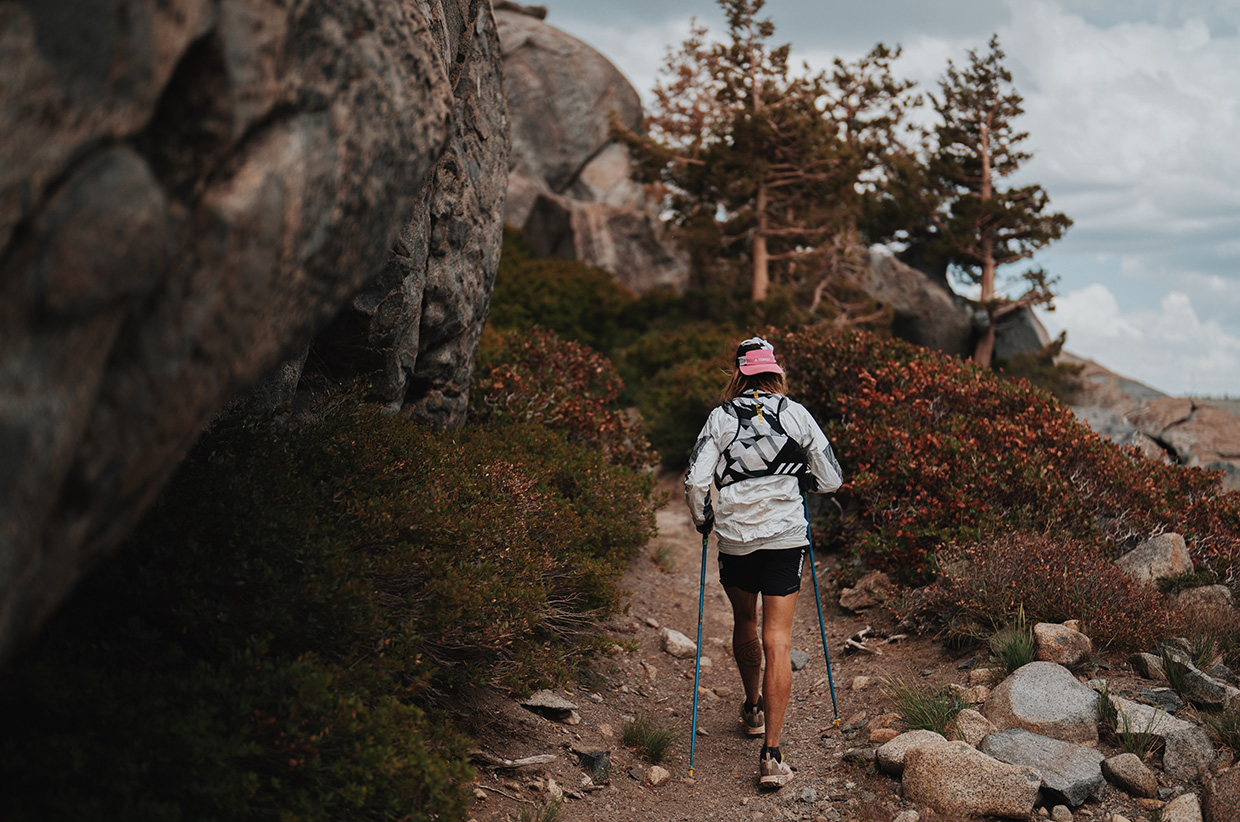
Even primal life finds its routines and patterns. A simple goal brought with it some complicated logistics. Olson was accompanied by a support RV, whose crew would hopscotch along the route, aiming to meet him at trailheads. They also plotted re-routes when necessary to avoid the wildfires that have become an almost annual occurrence, being careful to ensure that the changes were in keeping with an FKT attempt. Meanwhile, Olson concentrated on the running.
‘I would try to wake up around 5.00am. I’d gulp down a protein drink or a smoothie to start the day. Get moving by 5.30. Try and eat something like an egg or turkey wrap on the go. I would pause to meditate after the first hour. Just for ten minutes. It was kind of a body-scan to take an inventory of what was going on. Listen to any aches and pains and gauge my level of energy. I’d then get moving again, trying to break the day into 20km chunks. I would aim to tick off the distances in a way that meant I could meet the RV somewhere for the evening and sleep there.’
There was a larger motivation for Olson to reach his RV than the benefits of a warm meal and sleeping under cover. His family were part of his support crew: children Tristan and Kai, as well as wife Krista, who was eight months pregnant.
‘I couldn’t have done this without my family by my side. It was fundamental to me that they were part of the experience. Some of my fondest memories were the times my kids ran alongside me for short sections of the trail. Having my family there also kept me connected to why I was doing this. I strive to be a better human for them. There is something inherently selfish about being a pro athlete, or attempting something like this. It requires you to focus on yourself. I would spend over half my days alone on the PCT, living this feral life. Then I would switch to becoming a father and a husband again. I would find out about the adventures my kids had had that day. I would place my hand on Krista’s belly and feel the baby kick. I’m eternally thankful to her for devoting herself to this project as much as I did. It was an enormous challenge for her too, and she was just an absolute rock star.’
There were, inevitably, nights where it was impossible for Olson to reach the RV before nightfall. On those occasions, he would take a larger pack after his last opportunity to refuel, loaded with a small bivvy and lightweight sleeping bag. He would pitch up on the side of the trail and try to rest under the stars. Sleep rarely came as easily as it should, though, until one night.
‘It was somewhere in Oregon and I met the crew for the last time that evening. We chatted in the dying light while I ate tacos. Eventually it was time to move on, so I wrapped up a couple of tacos for later and strapped them to my pack, kinda tucked under my chest strap. Later on, maybe 10.30 at night – it was pitch black anyway – I could sense something close by. Then I saw it on the trail right, in front of me. This huge cougar, walking through the night. It was so proud and strong and regal. Walking like it was the king of the forest. And we just passed each other… I had no idea what else to do. There I was, with these bundles of food strapped to me. So, I just kept walking. I remember I had this out-of-body moment. Part of me was overtaken by real concern for my safety, but I felt so calm. I looked back and I swear the cougar did exactly the same. It almost nodded before turning and moving on. I was left thinking, did I just pass God? And I genuinely believe that I did. My entire body felt completely energised: goosebumps, effervescing almost. It was a moment I’ll remember forever. I carried on down the trail, crying tears of joy. And when I finally decided to stop, I slept the deepest, purest sleep of the whole journey. I finally felt like I truly belonged here.’


Such is Olson’s intense positivity that the darker, harder parts of the journey get glossed over in conversation. He has now processed them and moved on; they’re a part of the story, but not what defines it for him. Nonetheless, his body gradually began to deteriorate as he neared the Canadian border.
‘I had a really bad calf problem toward the end, right before I entered Oregon. Actually both my shin and my calf gave me issues, and I’m pretty sure I ended up with a rip in one of the calf muscles. That kind of led to other issues as my body overcompensated. Toward the end, like literally the last day or so of running, my calf was just frozen, and in so much pain. But I knew by then that I would do it. I knew that my body would carry me. It might not have been fast, but I never wanted this challenge to be easy. In some ways, it felt like a fitting end.’
Finishing, Olson let out a primal roar: a final purge of every last ounce of energy, giving himself to the trail. It was a moment of total acceptance of everything that had happened in his life to date, before making his first steps towards embracing the future.
‘Finally I hugged my family. I was overjoyed at what we had achieved together.’
After the call ends, I sit at my desk for a while, trying to take in all the aspects of the conversation I’ve just had. I am not a naturally spiritual person, but it is impossible not to be enraptured by Olson’s earnest, deep love for nature and the activity that brings him closer to it. The calmness that running has brought him, the wisdom through his experiences – the joy and the heartbreak.
There feels like only one thing to do now, so I pull on my trainers and head outside to run through the woods, finding my own flow and sense of place, quietly inspired by a mirage on the other side of the world.
Timothy Olson completed the PCT in a Fastest Known Time of 51 days, 16 hours, and 55 minutes, just beating the previous record of 52 days, 8 hours, 25 minutes, held by Karel Sabbe.
Krista gave birth to Esmeray Olson a couple of days after this interview, on 23 August.
Olson used his run to raise money for Return To Zero: H.O.P.E; a non-profit community of bereaved families and care providers, who are transforming the culture of silence and isolation surrounding pregnancy and infant loss.
@timothyallenolson
@adidasterrex
@rtzhope
Written by Tom Hill // @24Tom