Between Wind & Water
Gear Field Journal Explore Gear & Guides
Stories Behind the Gear: Strike Footwear
Written by Daniel Neilson // Photography by Phil Hill
Produced in partnership with Strike Footwear
Two seals appeared to wave farewell to us as we pulled out of the lock and into the outer harbour. Before us, a Martello stood at the harbour wall, a circular artillery fort built to defend against a Napoleonic invasion. On our 27ft Seascape yacht, the Great Escape, were Rob, el capitan, photographer Phil Hill, and the highly inexperienced crew of me, Gus, and Fin. Fin, 20, and seemingly the most trusted of the crew, was given the tiller.
Beyond the harbour arm, Rob set our course east, along the Sussex coast, and we pulled our collars up against the cold. Above us were slate-grey skies, but the sun seemed to be shining on France in the south, casting an orange glow across the water. Away from the shelter of the harbour, the wind picked up immediately.
With the calmness of an experienced yachtman, Rob gently gave instructions to Gus and me. To the novice, there is a bewildering array of ropes and winches. We hoisted the mainsail, effortful on the boat that was starting to roll and pitch. The drama unfolds at this point: the moment of uncertainty for a boat without direction, and the one with purpose. Once the mainsail was aloft, the direction locked against the vane atthe top of the mast, the wind filled the sail, and the boat began to pick up speed. In doing so, steadied. Next was the jib, unfurled and hoisted.
Sailing is a boat in constant motion, working with the whims of the wind and the waves. The captain and crew are constantly responding to this. We tack east, Hastings and the Dungeness headland beyond. ‘Ready to tack’, ‘ease line’, ‘head!’. The boom swings violently above us. We dart across the stern, in constant motion. A change of person at the tiller and a change of direction cause the yacht to heel. It takes the inexperienced of us by surprise – we’re perhaps at 20º. Those on the starboard lean back, and I join them. Fin stays at the tiller, close to the white sea. We pull in the sail taught, maintain the direction, and we’re sailing. The knot indicator slowly increases. We’re drawn through the water, nature as our only power, Rob’s skill and experience making constant small adjustments to gain more speed. We breathe again. Grins replace concentration. Ah… this is why people sail. It’s thrilling, visceral. The deck is wet, our hands cold. And only then I remember why we are here: to try Strike Footwear ‘built for life on the water’.

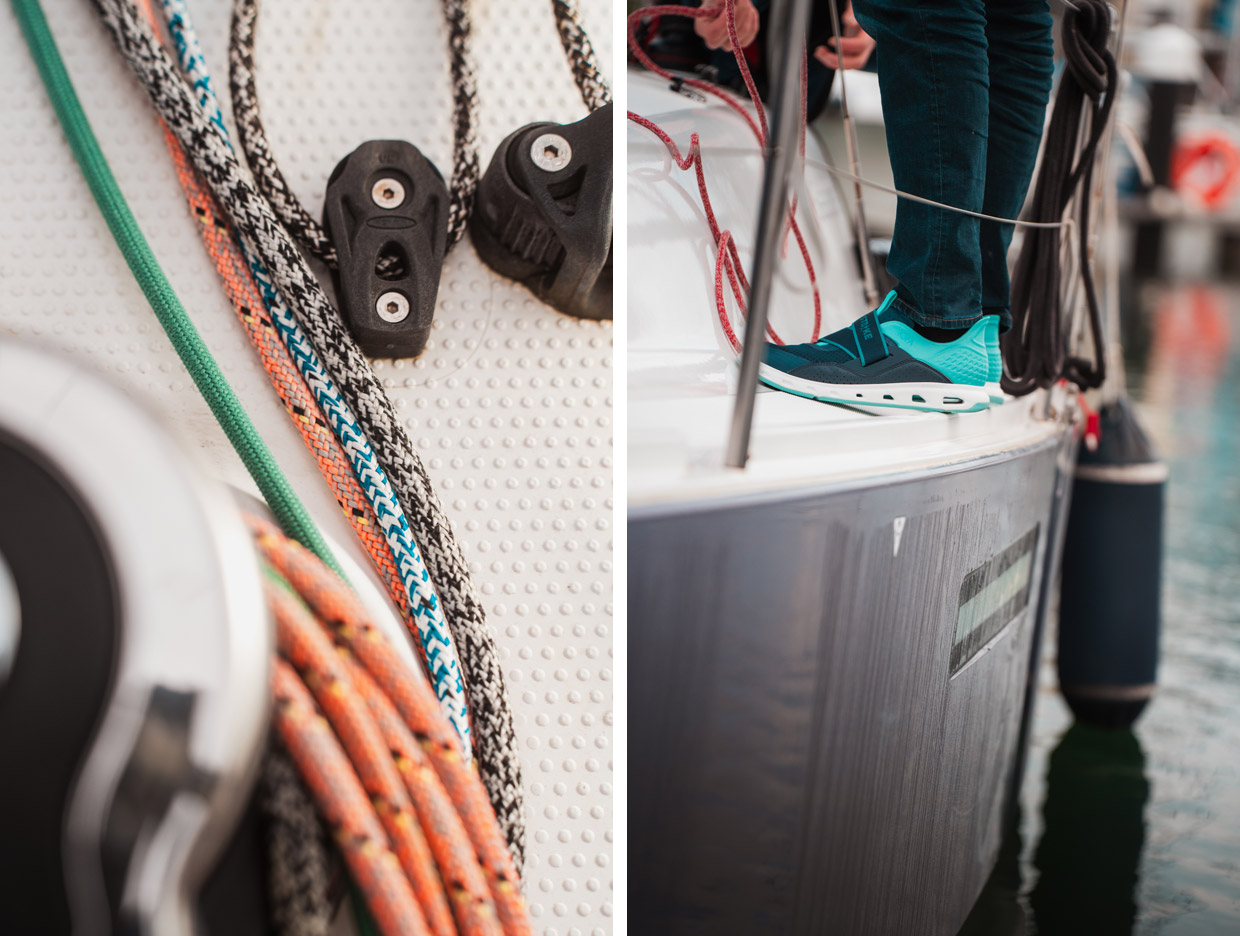

‘They’ve got to be comfortable, and they’ve got to be non-slip,’ Strike founder Stephen Palmer said when I asked him later about the design priorities for Strike shoes. ‘You also want the water to go through the shoes, not into them. You don’t want the shoes to fill with water.’
Out on the yacht, security underfoot is essential. Essential for safety, essential for effective movement around the boat. You’re basically on a wet, slippery plastic that is constantly rolling and pitching. What you have on your feet makes a huge difference to any boating experience. The soles here are designed specifically for wet marine decks, achieved through consideration of grip, compound and tread design.
Stephen, a shoe maker, shoe designer and owner of Overland Shoes, had fallen one too many times on the deck of a boat. Originally from South Africa, Stephen fished as a kid and then, on a holiday to Sardinia introduced him to sports fishing – marlin, swordfish, tuna. And it became an obsession. ‘It’s a disease! It’s a passion and a disease. It just gets more and more intense. You only remember the good days on the water. You never remember the bad weather or the days you caught nothing. The joy of catching something and releasing it or eating it, there’s nothing like it for people like me, for anglers.’
It was his friends who kept asking for angling-specific shoes because they just couldn’t find anything that suited.
‘If you wear boat shoes and you’re on deck and the shoe fills up with water, you spend the whole day slushing around in a bucket of water.’
Then, on one trip in a new pair of shoes, as soon as he got onto the deck, he slipped and protected himself with his elbows. It was a painful experience, especially for someone who has had four back operations. It was time for action.
‘That’s when I really knew that whatever we do has to be non-slip, comfortable, quick drying, sustainable and have some purpose,’ he said.
Stephen approached the International Game Fish Association (IGFA), partly because it was the association he belonged to as a catch-and-release fisherman, and he greatly admired its stance on conservation. This non-profit organisation is dedicated to conserving game fish, and the oceans they live in, and is particularly active in educating young people. Many members also participate in their record-keeping practices. (In fact, Stephen tells me he’s just won a YETI cooler because the billfish he tagged swam the farthest.)
‘We got together with the International Game Fish Association because they have a very strong voice in teaching young kids about the sea, about sustainability and understanding the science of sustainable fishing. Their voice sang true to what we wanted to do.’ A proportion of every sale now goes to IGFA to support their research.
Strike is on a mission to make the shoes as sustainable as possible. The box is recycled and has sustainable ink on it, the leather they use is from AAA tanneries and the shoes are made from recycled plastics. The yarn is made from SEAQUAL, which is approximately 10% upcycled marine plastic collected and repurposed from marine litter and 90% post-consumer recycled polyester. For Strike, it is an ongoing process of making responsible material choices where possible, without compromising durability, performance, or safety on the water. It’s a mission rooted in personal experience.
‘I will spend ten hours crawling at eight knots when I’m fishing and I’ll see so much plastic in the water. One of our lines at any one time will catch some bit of plastic. I know better than anybody else how much crap there is in the ocean.’


On the English Channel, plastics aren’t apparent, but we know they’re there. The channel is home to more than 1,000 fish species, including tuna, bull huss, and John Dory, as well as mammals such as seals (as seen earlier), dolphins, and porpoises.
The cold is biting and tacking into the wind has exhausted us. I’m reminded just how physical sailing is. We decide to pull a large loop and head back to Eastbourne Marina. We shift positions again, we’re calmer now, and are building up an understanding. An experienced crew in full sail must be a thrill to be part of; each with a role, working in harmony to build speed, with a common purpose.
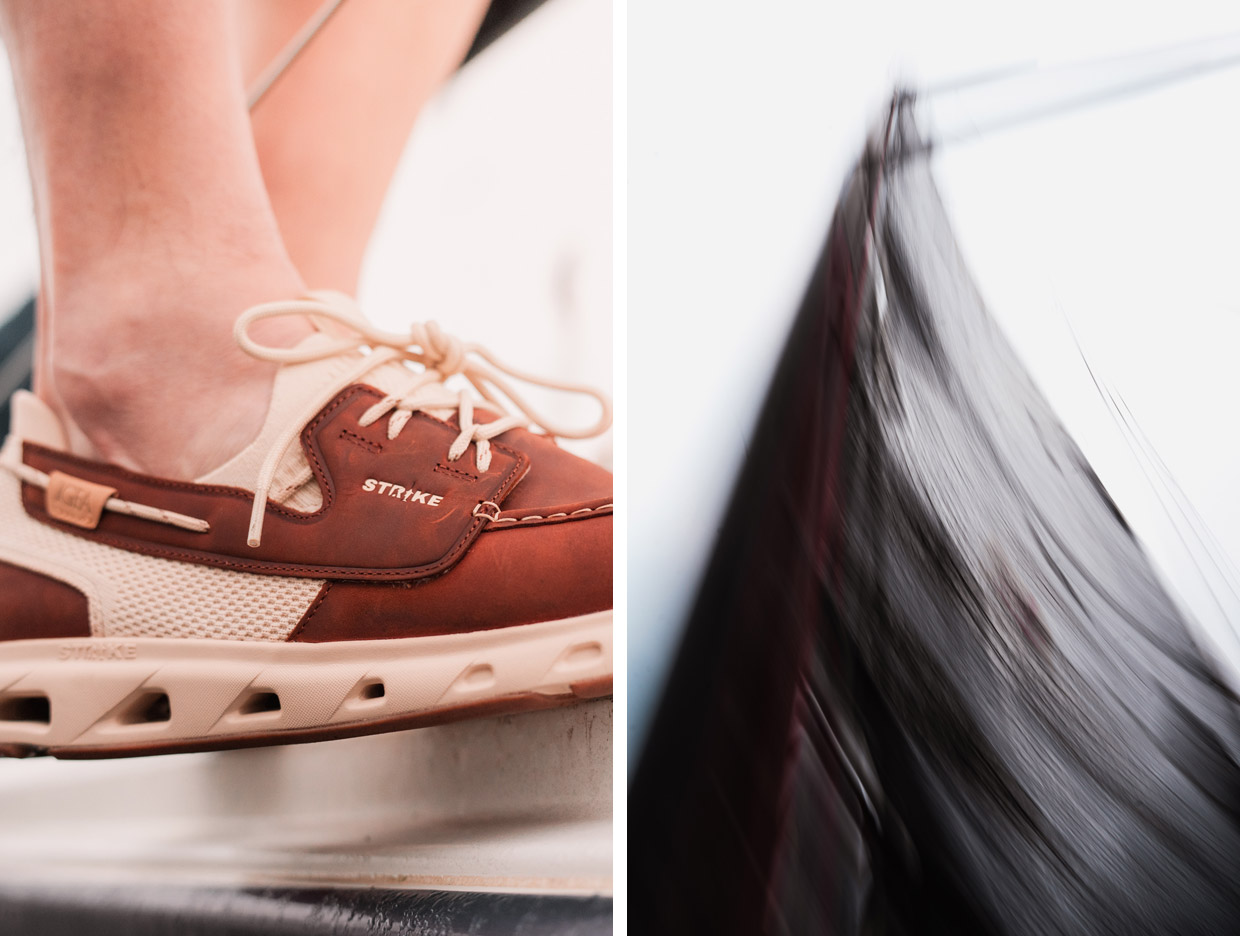
It’s a fairly straight route back, and it gives us an opportunity to look at the shoes in more detail – and get a few more photos. Between us, we have the Silvertip Strap Sneaker, the Silvertip Boat Shoe and the Bigeye Boot. There are two key aspects that make these shoes successful: The outsole and the pattern on the sole. The outsole took two years to develop and is being constantly iterated. The footbed allows water to pass through and out through channels in the outsole, rather than pooling in the shoe.
The next step was to make it non-slip, which is achieved through siping, cutting fine slits through the surface of the sole, which helps channel water and improve grip on wet surfaces. Stephen draws a comparison to the paw of a cat.
I’ve since become a bit of an evangelist for these shoes. I live by the sea, and most of my friends spend a significant amount of time in, on or below the water, whether it’s a paddleboard or a yacht, diving the shipwrecks or leisure cruises to France for lunch. When I show them the shoe, they just ‘get it’. These are shoes that make perfect sense. My female friends are looking forward to the women’s collection coming soon.
The Martello tower comes into clear focus as we approach the harbour. Rob calls into the Marina office to open the lock. We’re lively with in the calm after the thrill. The banter starts swinging. We’re cold, but happy. The seals have gone swimming.
Silvertip Boat Shoe
The most conventional-looking of Strike’s footwear (at least to those who are used to marine deck) is the Silvertip Boat Shoe. Like the other shoes it offers the quick-dry drainage design where water disappears through the footbed and through the holes in the outsole. The upper is a combination of premium LWG-certified water-repellent leather, and a knitted inner sock made from SEAQUAL® YARN, containing upcycled marine plastic. The outsole is designed for the best possible grip on wet decks, thanks to the sole pattern, the siping that channels water out away, and the compound. It genuinely worked too – boats are slippery places, but none of us slipped. The Silvertip Boat Shoe is available in Navy and Brown.
Price: £110
Website: strike-footwear.com
Silvertip Strap Sneaker
The Silvertip Strap Sneaker uses similar drainage technology as the Boat Shoe, but is designed for ultimate comfort and on-deck security for long days on the boat. The upper also features SEAQUAL® YARN, made from upcycled marine plastic, and it has a fully adjustable strap that keeps your foot securely in the shoe, no matter how wet it is.
Price: £100
Website: strike-footwear.com
Bigeye Boot
The Bigeye Boots are designed for the harshest conditions you could experience. These are hardwearing boots made from vulcanised rubber and an aeroprene mesh that offers ample protection. The footbed is an antimicrobial OrthoLite® and there’s a drying SEAQUAL® YARN sock liner. Like the other shoes, the Aqua Deck Outsole, with narrow cuts in the rubber, provides traction on wet decks. The Bigeye Boot is available in Navy, Black, and Off White.
Price: £100
Website: strike-footwear.com
Written by Daniel Neilson // @danieljneilson
Photography by Phil Hill // @philhillstudio
Produced in partnership with Strike Footwear // @strike_footwear
With thanks to Rob for captaining the Great Escape, and Gus and Fin for being great sports.