Walking, cycling and rafting Japan's Ancient Kumano Kodo Pilgrimage Trail
Search
The Long Haul
Meeting the llamas that made South America
Words & Photography by Daniel Neilson
Llamas shaped South America more than any empire. In the high valleys and salt flats of northern Argentina, Daniel Neilson follows their ancient trails and discovers a culture still carried by these animals.
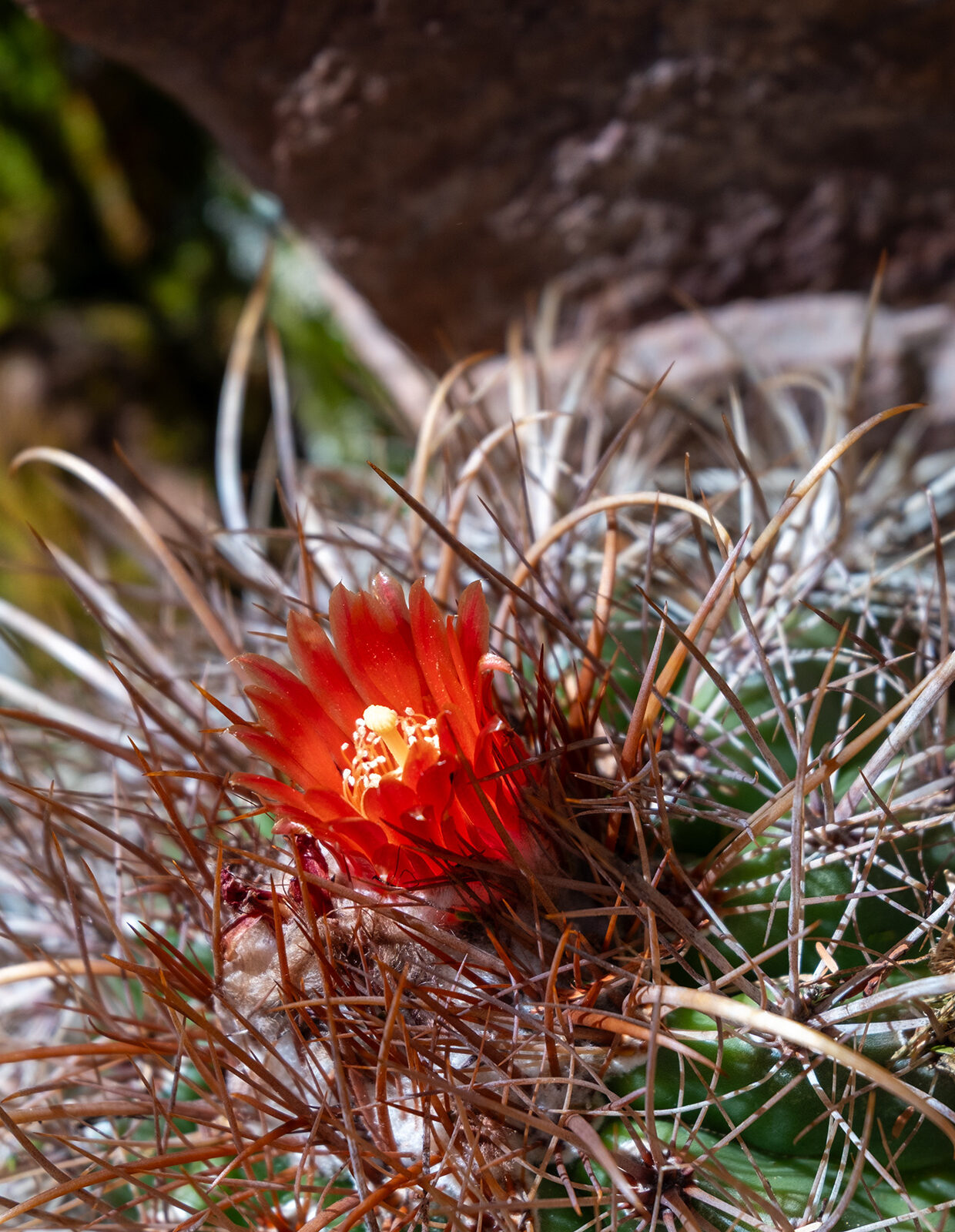
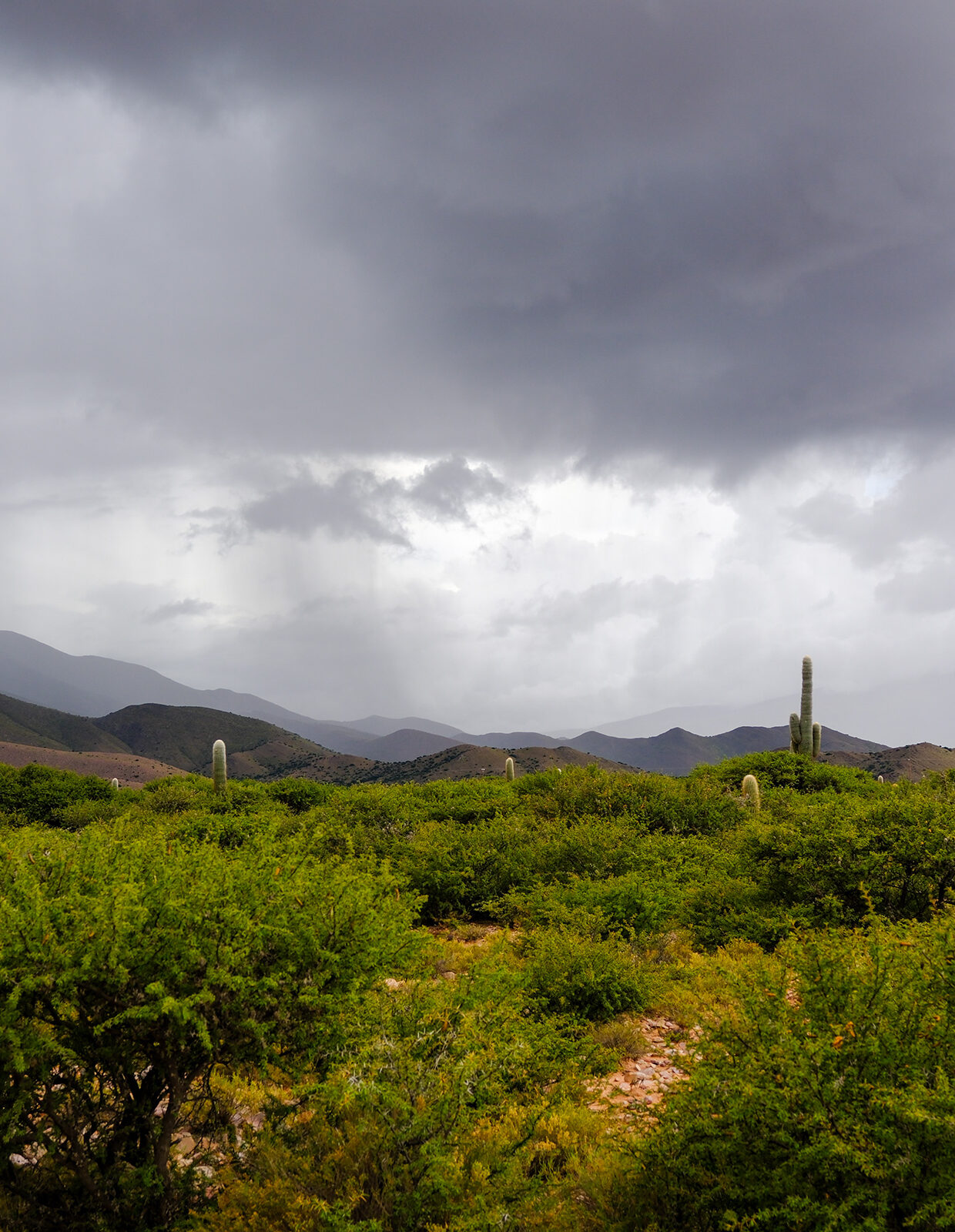
We jumped into the back of a Ford Ranger pickup and delicately trundled up a dusty road that had been partly washed away in a rare, recent rainfall. It looked like more was coming, too, with billowing clouds growing over the Andes to the west of us. Rainfall here is sudden and dramatic, occurring over a short period, then disappearing for another year. We hopped off the Ranger and followed Fabio down a path, around huge cardón cacti, some of which have survived in this arid semi-desert for thousands of years, and thorny churqui trees. An Andean Rebutia cactus, an angry-looking little globe of spines, has relaxed and produced a serene scarlet flower.
Regretting that we ignored the advice not to wear shorts, we delicately walk down to a dry riverbed, and Fabio finds a long stick and positions us on a rock above a small pond. What we see below is remarkable. What looks at first like smooth rock at a 45º angle is actually a huge frieze of rock art, a panel of petroglyphs depicting more than 4,000 years of this area’s history. This spot, by a waterhole, was likely a meeting place for traders across the Andes since around 2,000 BC, according to Fabio. On the right, he points out vicuñas and geometric patterns. Another shows a tumi, a crescent‑bladed knife. ‘These are conflicts,’ he says. ‘The bigger the depiction, the bigger the battle.’ As we move left across the frieze, we travel through centuries. The wild vicuñas become sturdier domesticated llamas – the pack animals that opened up the Andes, as we later learn.
We see the sun, the moon, and the mountains depicted. Pre-Incan cultures had an animistic belief system. Everything had a spiritual essence: the earth, the celestial beings, and high peaks, all respected. Farther right: a very large tumi knife. ‘This is when the Incas arrived here.’ The sun god and a large gap – a period of peace and fewer drawings. And then, chaos. I see a man on horseback, sword drawn against a man on foot. The Spanish had arrived.
Lightning splinters the sky on the horizon, bringing me back to the present, and I see columns of rain. The clouds are coming closer, and there’s a danger that if we don’t move, the road will worsen. It’s still bright sun above us, but we decide to return to Hornaditas, a tiny settlement, with a church, a cemetery, and a large dusty football pitch – this is Argentina after all. There’s also a small farmstead called Clarita y Héctor Lamas, named after the parents of Fabio, where we’re staying for a couple of nights. We hide from the rain in the dining room, which, like all the buildings here, has adobe walls and roofing of cardón cactus wood, thoroughly waterproof despite the downfall. Héctor tells us it will be the last rain of the season; it’s early April. He explains how, almost by accident, this became a place for visitors to stay. In short, one family from Buenos Aires loved it so much that they stayed for a couple of days. The returned again, and Clarita and Héctor decided there may be something in this. Fabio and his sister now do most of the hosting, and they had grilled the goat we eat that afternoon. After dropping a bit of our wine on the floor ‘for Pachamama’, Mother Earth, we dig into dinner. It’s after dinner that something incredible happens.
Fabio takes us down to the valley below to introduce us to Pampito, Bella Luz, Galia – the family’s three llamas – and a donkey with no name. The llama’s corral is next to a dry riverbed, and we wander down to explore it. ‘Shhhhhhh,’ politely asks Fabio. Then, in Spanish: ‘Can you hear that? The river is coming.’ We look at each other, and I ask him to explain. ‘The river is coming, right here.’ ‘What, now?’ ‘Sí, ahora.’
And then we hear a rush, like a waterfall, as we stand on the riverbed. Seconds later, we see a torrent of dirty water coming straight for us – at first two little streams, and then a full river. We jump onto the banks, wondering at the scene. I’ve never seen a river just appear. The water, collected high on the mountains a few hours ago during the thunderstorm we escaped, has been converging and appears just at that second. Even Fabio only sees this phenomenon a couple of times a year. Where we were standing is now a rapid waist-high water.
It’s gone within a couple of hours, and by the morning, completely dry again. It would likely be nine more months until the next rain Héctor, reckons. The llamas are unperturbed. And, as we discover over the next couple of days, llamas are rarely perturbed. Perhaps it’s no wonder that these lovable, hardy, stubborn, mildly gormless camelids became the vehicle that opened up South America.
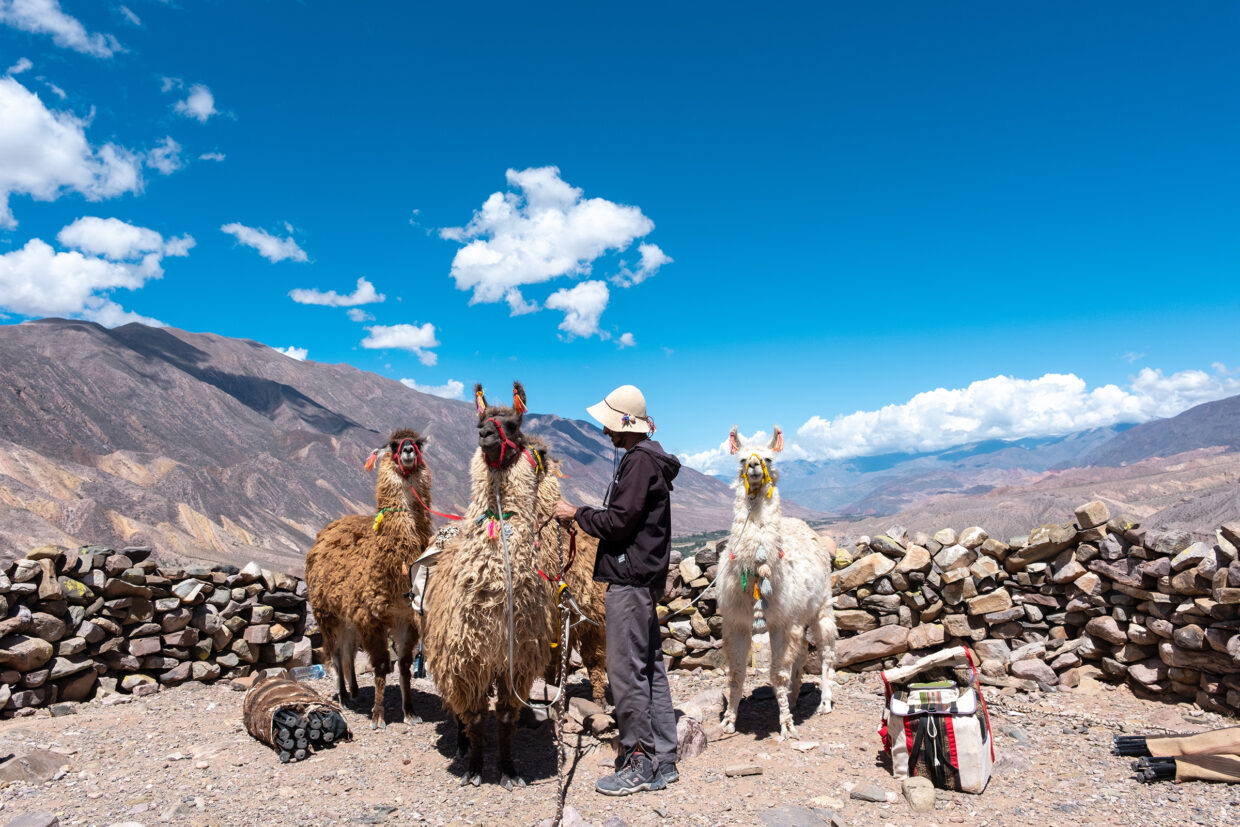
Through tailor-made travel specialists Argentina On The Go, we’d arranged to meet people across Jujuy and Salta who could help tell this story. The next day, we meet Santos Manfredi at his posada and business Caravava de Llamas, high on the mountain above the busy Andean town of Tilcara, Jujuy. ‘Show them who’s boss,’ he says. ‘But respect their wishes; if they want to stop, they will. Just gently coerce them.’ It turns out, llamas need a lot of coercing.
We’re here to learn more about how llamas remain an integral part of life in the Andes and have been for thousands of years. Fittingly, I’m charged with leading and coercing Atahualpa, a handsome white llama with a permanent quizzical look, named after the last Incan Emperor, who was baptised and immediately garrotted in 1533 by the Spanish conquistadores.
Once we’re handed the reins, I soon come to the realisation that if llamas were partly responsible for the human migration across South America, it happened slowly. The llama was domesticated around 5,000 years ago, but non-domesticated camelids – guanaco (Lama guanicoe) and vicuña (Lama vicugna) – have been essential to Andean livelihoods for more than 11,000 years. At higher elevations, we see wild vicuñas; herds of elegant, slender animals with the softest wool of all the camelids. Alpacas are thought to have vicuña parentage. We also see a guanaco, a closer relative of the domesticated llama, tall and sturdy.
Although from Buenos Aires, Santos visited Jujuy province back in 2001 and became enchanted by these animals. A year later, he moved to Tilcara and started a service walking with llamas. He studied them in the Archaeological Museum of Tilcara and spoke to archaeologists and anthropologists to learn all he could. He walked them across the Puna (a remote, high-altitude desert plateau just beyond the next mountain range) to the salt flats, where we are soon headed, and to Bolivia.
‘Without the llamas it’s impossible to understand Andean life,’ he explains. ‘Without a carrier, it’s impossible to exchange, to get the dried fish from the Pacific Ocean, across the driest [non-polar] desert on Earth and share with the honey coming from the rainforest in the east, full of water and full of species. It’s why people came to the Quebrada de Humahuaca and the region around Tilcara. It’s at the crossroads.’
We continue uphill, and the true extent of the 155km-long Quebrada de Humahuaca becomes apparent. As Santos says, to the north and west is the Altiplano, a vast plateau that extends from here, through Bolivia to Peru. Until the mines came, llamas and vicuña herding were key to economic survival and trade. To the south, the warm, green valleys, now home to some northerly Argentinian vineyards; to the west, the lower Andean hills and rainforest. He points east: ‘There are monkeys just over those mountains.’
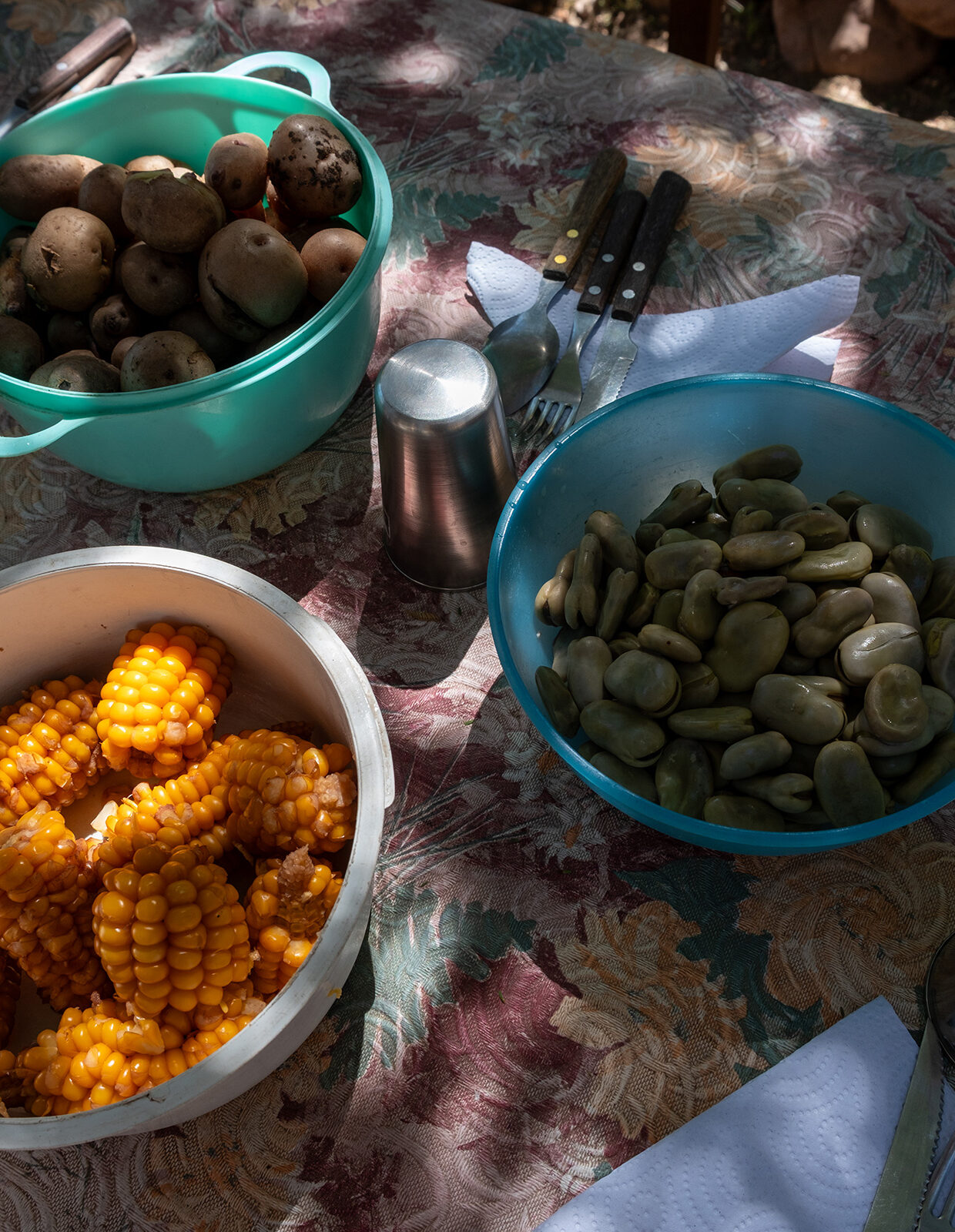
We stop at a little shelter, no more than a few walls, and no protection from the sun. Even in the valley, we’re at around 3,000m, and the effects of the altitude are clear on us – shortness of breath, occasional dizziness. We’re grateful for the break. Here, he opens up a picnic table and loads it with empanadas, fruit and pulls out a bottle of wine. ‘Here in the Andes, every time we take our food, or something to drink, we share with Pachamama, Mother Earth, the first drop. So, “gracias Pachamama”, and thank you to your family for visiting us and learning about our way of life.’
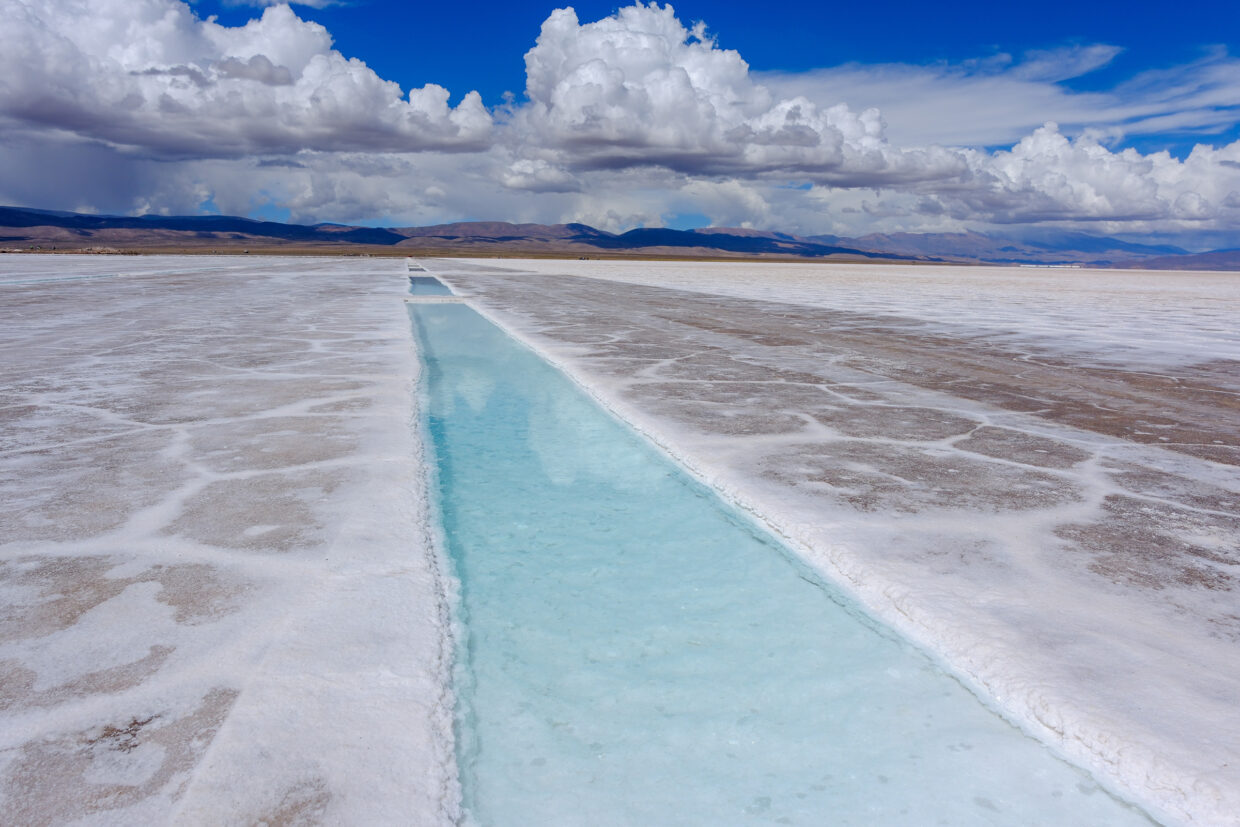
The next day, we’re back in the pickup to visit the Salinas Grandes, a huge salt flat around about 4,700km2. We climb higher and higher over the mountain pass at 4,170m and then slowly back down to the salinas at 180m. Herds of vicuñas skit across the high valleys, herds of goats are shepherded along the road; we see three condors high on the thermals. We all suffer from the altitude, but gently folding coca leaves over in our mouths offers almost instant relief.
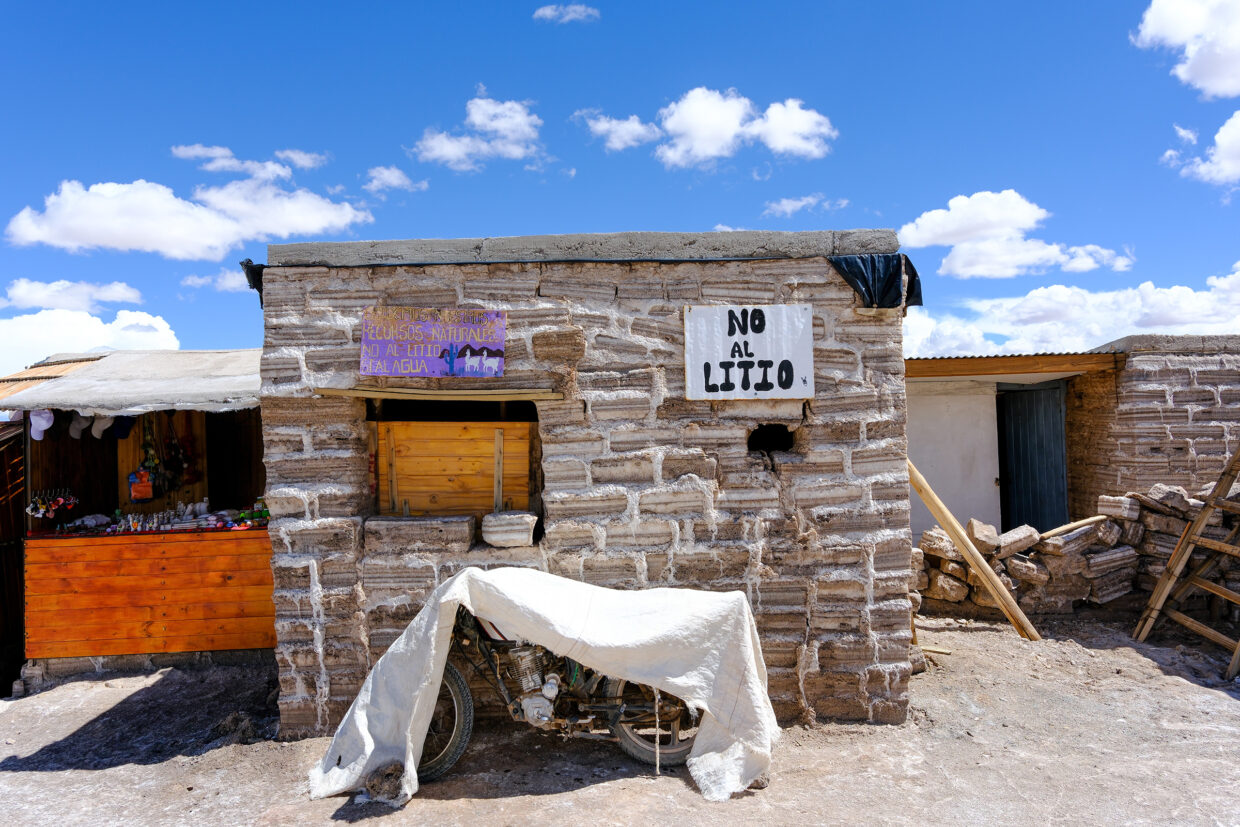
The salt flats are a vast expanse of white, hemmed in by mountains. We arrive at a small settlement run by the local community, with buildings built from salt bricks. Salt is still harvested here and traded, but the population also makes money from a handful of tourists who stop to take amusing photos in a place where perspective is lost. An inch-high toy dinosaur towers over a tourist. We eat our umpteenth tortilla a la parrilla, a folded and filled flatbread cooked over coals, and pay a small fee to walk on the flats.
The guides here are completely covered, protected from the bright sun above and the sun reflected from below. Hand-painted signs protest against lithium extraction, which has affected other salt flats in Argentina, Bolivia, and Peru: the scarily named Lithium Triangle where 53 per cent of the world’s deposits are thought to be found. Salt has always been harvested here, but never at industrial levels. Industry here will shrink the space, and potentially damage communities as has been seen in other parts of South America. For now, it retains that otherworldliness and conveys a sense of this region’s vastness.
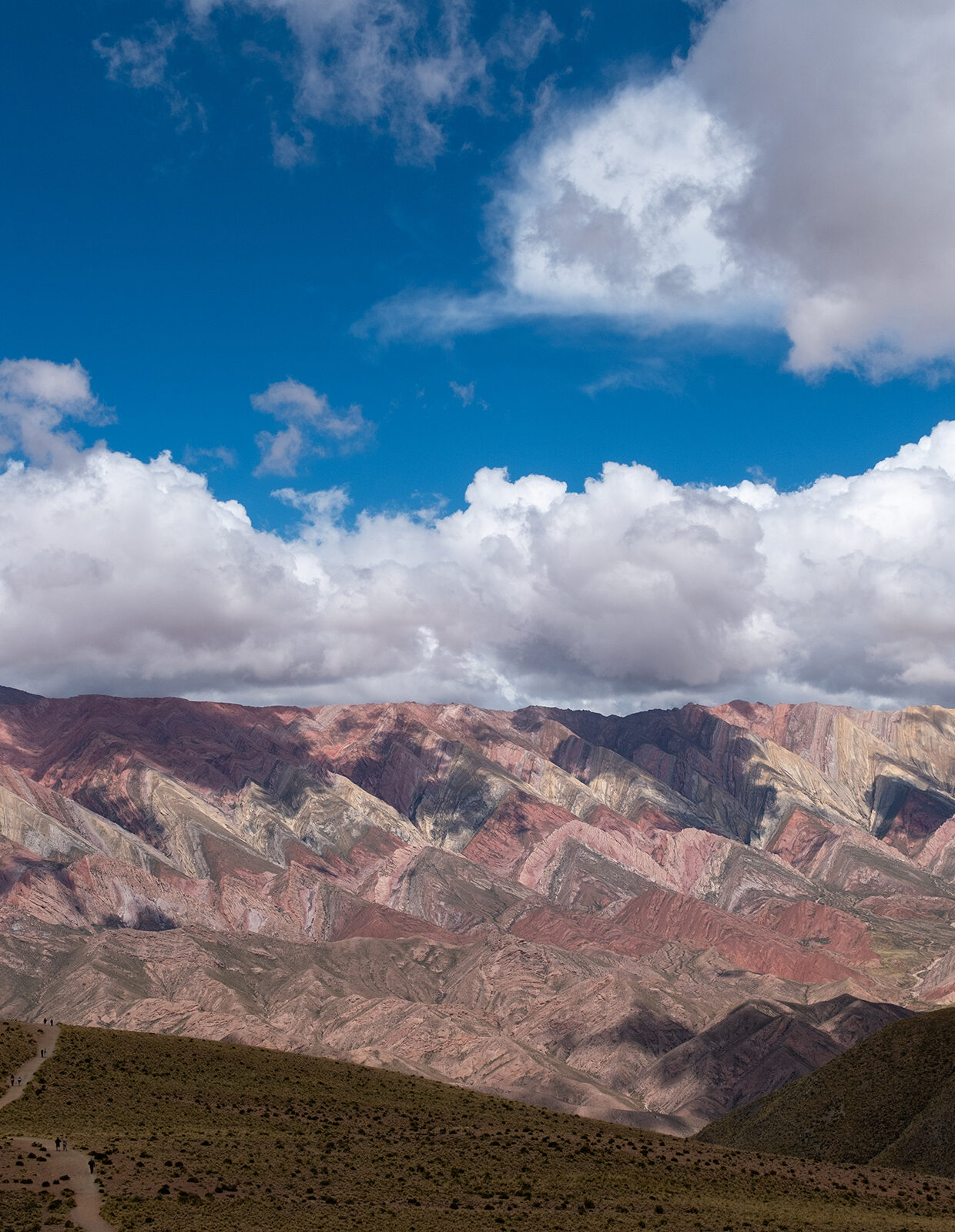
The sun is painfully hot here, so we move on. It’s time to return across the pass and begin the long drive to Salta. On the way, we stop at Horonocal, often cited as one of the most beautiful places on the planet. It’s a mountain system layered with mineral-rich bands of sediment that create a striking variegated palette.
As we drive south, out of the Quebrada, the earth flattens out and turns greener. We move into the Salta province and soon arrive at the city itself. It’s one of my favourite cities anywhere, a relaxed place defined by Spanish colonial architecture. It’s also home to the Museum of High Altitude Archaeology, an incredible place. Notably, it’s home to the remains of three Inca children who were found on Llullaillaco Volcano at 6,739 m in 1999, and sacrificed as part of a ritual known as Capacocha. They are remarkably preserved. Only one is on display at a time, and we see ‘El Niño’, a boy around seven years old, wearing gold and silver bracelets and other funerary trousseau. His dark hair is braided, and his face almost seems alive. They were probably taken from Cusco in procession to this high mountain, a factor in the almost perfect preservation of the children and attire. The children’s clothing is made from llama wool, as are the ponchos and brightly coloured, immaculately preserved blankets. The leather of their moccasins is from a camelid. El Niño has a small sling, made from camelid wool. Among the hundreds of artefacts, many represent llamas, guanaco, and vicuñas. Gold and silver figurines are thought to be fertility symbols, as the erect penis suggests. There are two representations of camelids buried with the boy, made from bright red spondylus shell, found in warm coastal waters. They symbolise prosperity, protection, and the deep connection between people and animals. Andean camelids were essential for transport and survival in the high mountains, stubborn though they might be.
Argentina On The Go is a local travel specialist creating tailor-made journeys throughout Argentina and Chile, connecting travellers with authentic experiences, local cultures and remarkable landscapes. Explore these journeys at www.argentinaonthego.com
keep exploring
The Magazine
Sidetracked is a printed outdoor adventure magazine featuring photography, design and storytelling from expeditions and journeys around the world, and published three times a year....