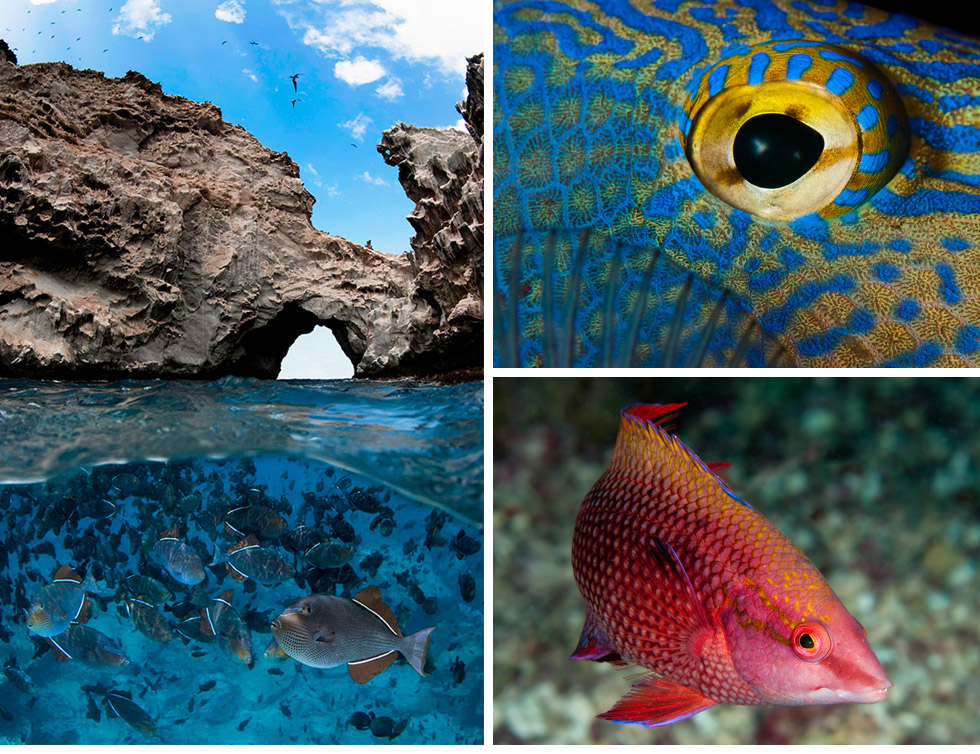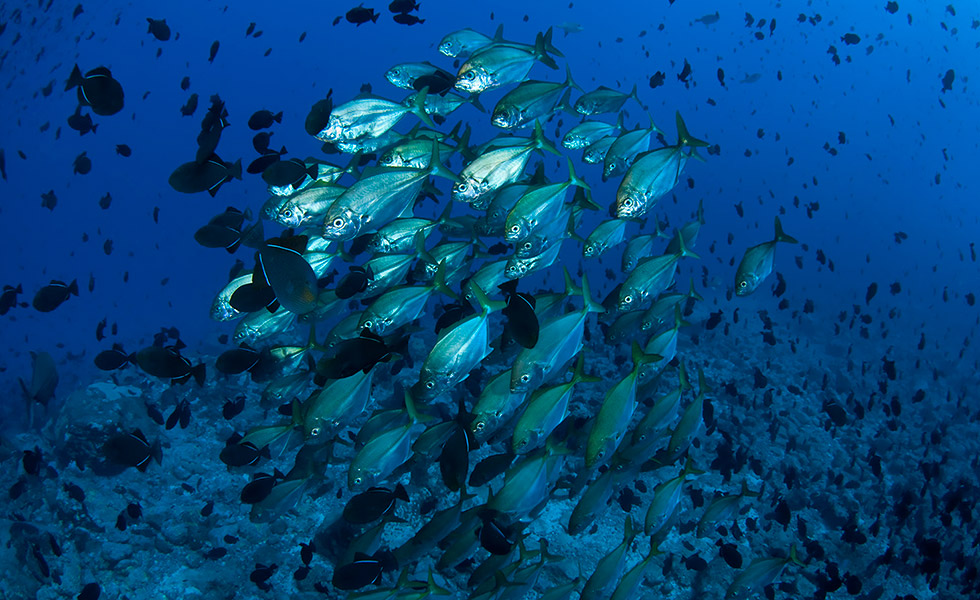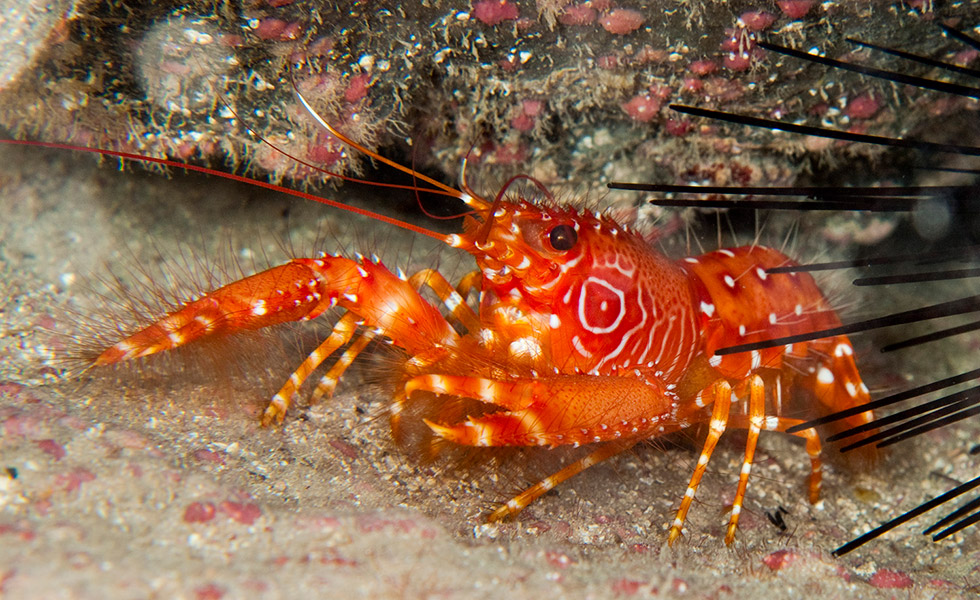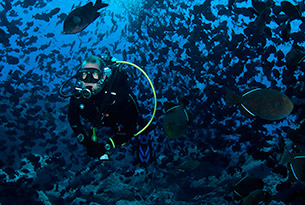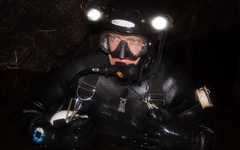
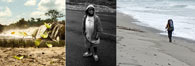






Ascension Island is an oceanic relic of volcanic activity; a lone island almost mid-way between South America and Africa and only a few degrees south of the equator. With no permanent or indigenous population, it is a communications relay base and staging post for flights to the South Atlantic. Its harsh lava flow and cinder cone landscape is dotted with green foliage and the surrounding waters are warm and clear. But the coast can be buffeted by strong winds and powerful surges, which makes diving here challenging. The attraction is that its remoteness makes it a remarkable place for marine life.
You feel small standing on the island but not because it is big. At only a few miles wide and over a thousand miles in any direction from the nearest mainland, it is the South Atlantic that feels huge. The harsh abrasive rock rising out the mid-Atlantic ridge is a tiny speck in a delirious blue setting and well off the diving beaten track.
The first few thousand miles from UK are simple enough on a flight that can take the best part of 9 hours. What makes the journey adventurous is what happens on island. It begins at an austere base in English Bay at the northern tip of the island, from where diving expeditions range out to dive sites peppered around the island. This kind of diving - a mixture of shore and small boat operations - is a physical experience because, unlike the luxury of the tourist trail, the manual labour is down to you. Charging air cylinders and loading heavy equipment onto 4-wheel drive vehicles and boats soon works up sweat and toughens slack muscle in the burning equatorial sun.
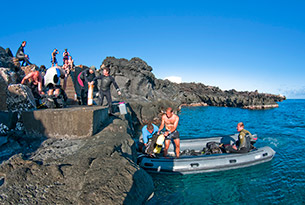
The dives start with a short road trip to get at the natural rock jetty in guano bay, where we load dive gear onto impossibly small inflatable boats. With 6 people aboard each it is crowded; packing equipment in the right sequence is an art form. Trying to rectify errors once the boat is subject to wind and tide just irritates fellow adventurers. And even this apparently simple step can be surprisingly hazardous, because steady wind on open ocean makes it too dangerous to tie the boats up alongside; heaving rubber hulls against pumice has predictable outcomes. So instead a brave soul swims out to the boat moored in open water, starts the outboard engine and then guides the nose of the boat, protected by a tough rope mat, into the jetty. He then skilfully holds the boat in position under power while people scurry up and down like so many tiny ants to load the equipment, timing their throws to meet the upward rise of the ocean swell. Occasionally, a big wave breaks over the jetty. If people are not careful, boats can be thrown onto the jetty, air cylinders and dive equipment can be tossed into open ocean and divers can be pitched into the water. I've seen it happen and was caught once. Despite many years of adventurous activities, the stark realisation that I had lost control of the situation was frightening. You feel powerless under the grip of high energy water; the natural forces are incredible. Luckily, a quick-witted colleague grabbed onto a flailing limb and reduced an otherwise uncontrolled dive at the ocean into a rather slower, but undignified scrape along volcanic rock.