Against the Elements
Gear Field Journal Explore Gear & Guides
Ortlieb: Waterproof Without Compromise
Written by Daniel Neilson // Photography by John Summerton
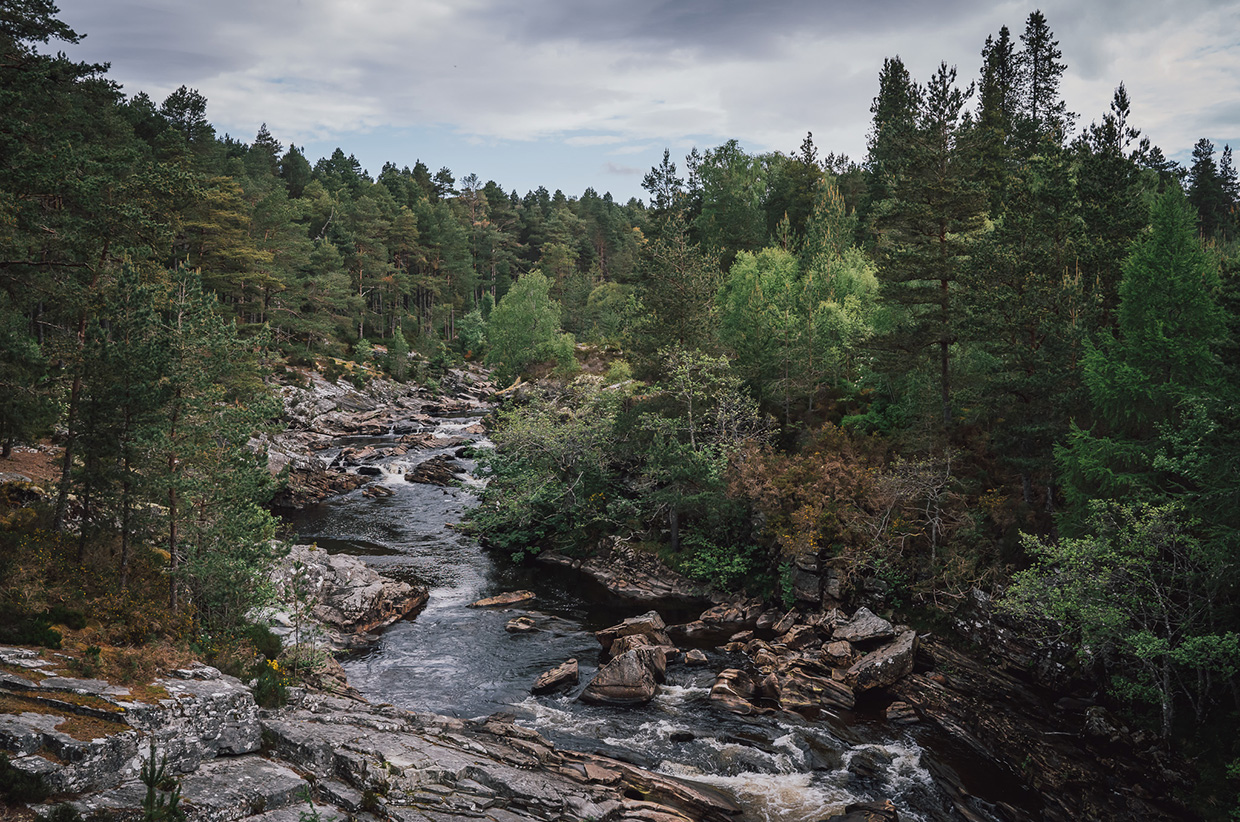
This far north, summer was already turning. Fly agaric fungi were fruiting out of the moist moss. The river’s name, Black Water, is aptly named; it was dark enough to daub a coracle. Despite a little involuntary jig when we plunged into the water, there was no dancing, but the view cheered us. We’d come on what we like to call a ‘test trip’, a short excursion to put our gear to the test before an expedition.
The river tumbled loudly along the ancient drove road. For centuries, this path brought together drovers gradually converging at the market at Muir of Ord, or farther south to Crieff and Falkirk. For millennia, Black Water has carved out a blocky sculpture of rock around Silver Bridge and Little Garve, a mile away. These days, it’s kayakers who navigate the river’s falls, cataracts, bridges, and boulders. Pleasingly, one kayaking guide describes the drop just after Wade’s Bridge at Little Garve as descending into a ‘meaty hole’.
At Little Garve the river relaxes and begins a gentler push south. At the meadows here, the drovers would meet before their final push to market. Together they would sing songs and tell stories. ‘Is ceòl an crò nan gamhnaichean/Bhiodh iomadh spors aig sean is og/S bu shòlasach bha’n danns aca,’ the Song of the Drovers tells us: ‘And music in the farrow cows fold/Both young and old were amply entertained/How cheerfully they danced!’
On too many trips, new gear, untested, has failed at a critical moment. A river crossing on the Ganges, a mountain pass in Bolivia, a cliff edge in the Alps. Sometimes it is the gear at fault, but most often, the user; an expedition is no place to be learning how things work properly. Gear needs to be tested and learned about in as similar circumstances as possible to the real deal. What seems an easy zip to pull on the living room floor is very different wet, cold, and at 5,000m.
We do this with all our gear now. Plus, it’s an excuse for a lovely day out. As well as a great testing ground, Black Water is a very lovely spot indeed.


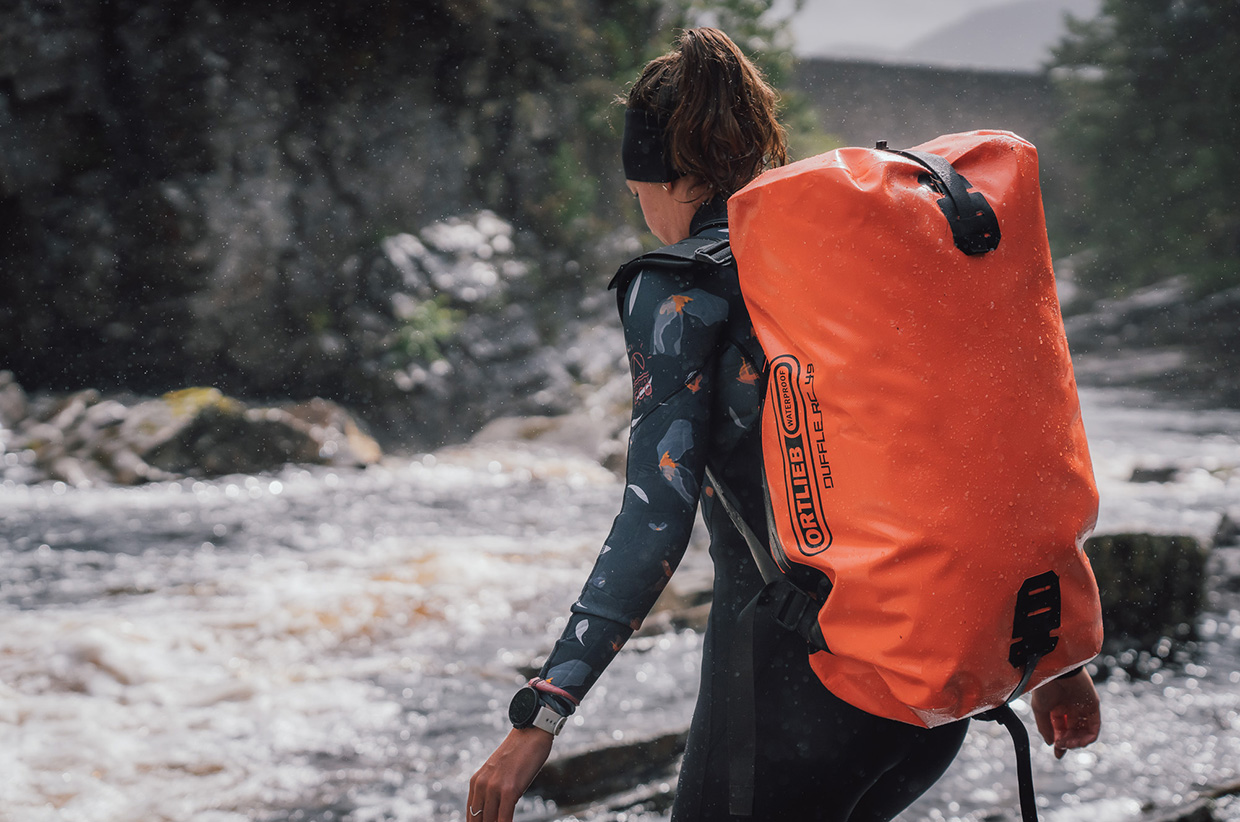
Today, among a couple of other new items, we were testing the Ortlieb RC Duffle for a trip to Argentina. The journey would include lakes and rivers and perhaps water falling from the sky, so we needed big waterproof duffle bags to take with us, float through the waters, survive the Patagonian winds and rain, and keep our stuff dry.
The new Ortlieb Duffle RC comes in 49L and 89L sizes, and we had one of each. (The RC, by the way, stands for Roll Closure.) The requirements were, admittedly, specific: we needed waterproof bags, but they would be the only large bags we’d take long haul. They needed to survive trips down the river, being strapped to the top of a local bus and, perhaps most testingly, surviving the carousels at Heathrow.
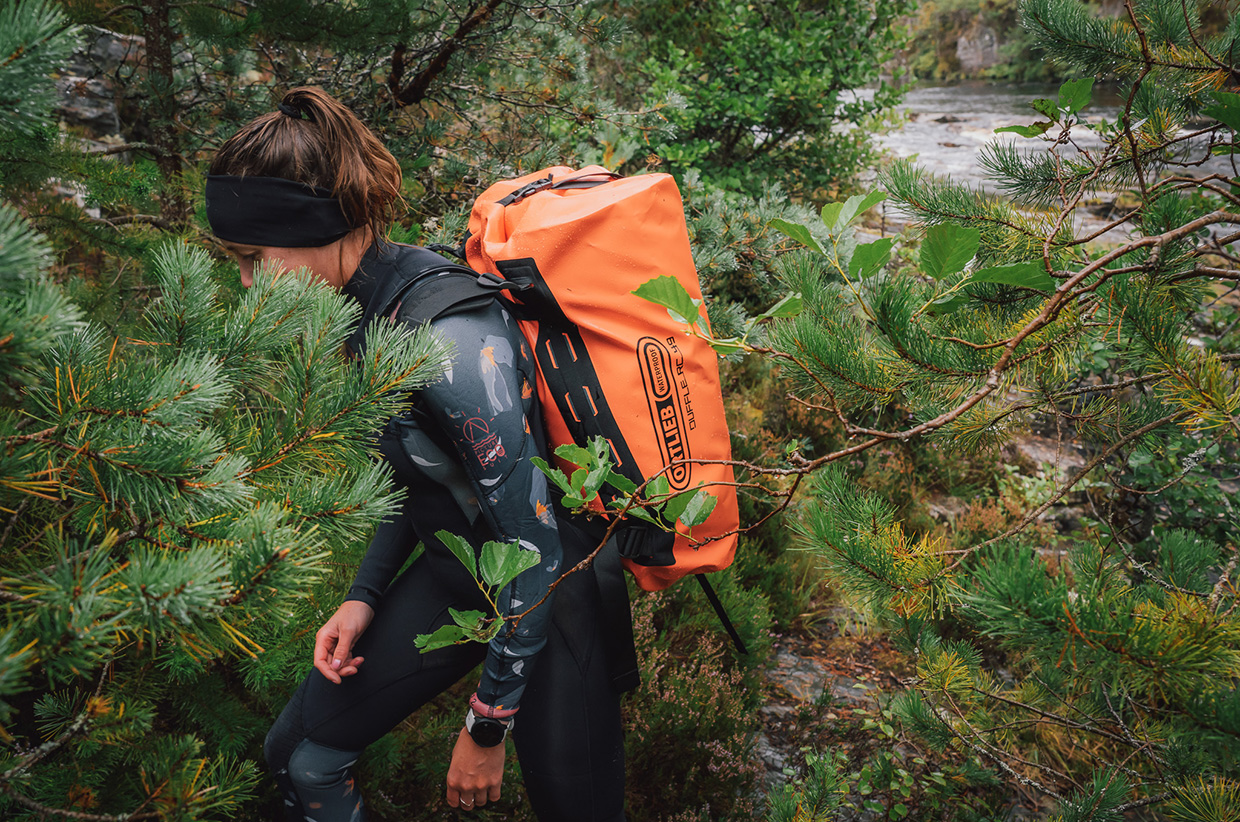
The Duffle RC is made with extremely strong, tear-proof, and abrasion-resistant fabric. Nothing gets into these bags. It’s a duffle bag first, one designed for long adventures. It has comfortable and adjustable shoulder straps, so you can use it as a rucksack. The straps can also be detached and stowed away.
One of the non-negotiables for a duffle bag is extremely strong things to grab onto: for hauling onto the top of a bus, for throwing across a river. Duffle bags are probably the most abused piece of kit. The Duffle RC has daisy chain loops across the top for fastening things to the bag or the bags to things. However, the key feature, as you’ll have picked up, is the waterproofness.
Ortlieb is, of course, well versed in waterproof bags. It’s their raison d’etre. Since 1982, when Hartmut Ortlieb founded Ortlieb Sportartikel in Nuremberg, Germany, they have produced some of the best waterproof equipment. The company arose out of a need for waterproof bike panniers, and the first were made on his mother’s sewing machine from truck tarpaulin. They were tested on the winding passes of the Alps. Today, the company produce around 500 products for outdoor activities from its production facility in Heilsbronn, Franconia. Its tagline: ‘Waterproof without compromise’.
Ortlieb uses high-frequency welding technology to ensure that each product is incredibly waterproof, and each is tested for up to 100,000mm water column. For comparison, a tent can typically withstand a water column of around 10,000mm. In short, it’s very very waterproof.

Ortlieb has also taken great strides in sustainability. The most important aspect to sustainability is making gear that lasts. From the beginning, it was the word ‘indestructible’ that led Hartmut Ortlieb’s design ethos. It made sense from a product viewpoint as well as from a sustainability perspective. By keeping the production in Germany, it has allowed them to repair damaged products, and it conducts around 18,000 repairs a year. Each product, Ortlieb believes, should last decades.
However, the company has further goals: to produce 100 per cent of its energy from renewable sources (currently around two thirds of the plant’s energy is produced from solar power on the roof) and to be totally energy independent by 2030. Ortlieb offers a five-year warranty and has a repair service for all items.
The key to any waterproof bag is the opening. The Ortlieb RC Duffle uses the proven roll-top system for waterproofness. Roll it over three times, fasten it, and there is no water coming in. It’s simple and effective. It also eliminates the need for bulky zips and means that if the bag isn’t quite full, another roll will reduce the volume of the bag.
***
We hauled the bag onto our shoulders from the van. In it, we had a wetsuit and swimming gear. Rain pattered down and bounced off the bags. Another reason we always take waterproof bags on excursions, even where deep water won’t necessarily feature, is that no ordinary backpack will keep things dry for hours strapped to a Landy in Scotland in dreich weather. A waterproof bag will. And that’s why we like them.
At Silver Bridge, the sun began to appear. It was time for the true test. We snuck on our wetsuits before the next dog walker came along, then waded inelegantly into the river. Pools have formed below the double-arched stone bridge, water edging over the sills before plunging and dispersing into the falls below.
We started with the 49L duffle on our backs before the true test of plunging it (and our hands) into the cold water. The water is best described, with understatement, as ‘refreshing’. But it allowed us to test the opening and closure. The conclusion is that it passed the test. The gear was dry as when we put it in. But perhaps more surprising was the ease of use. The roll closure was effortless and simple – and it needed to be. If you’re needing to dive into the bag on the move, at altitude or in the cold, even seemingly simple tasks need to be intuitive.
The next time we see the bag, we’ll be putting on flight BA249 to Buenos Aires. From there, an internal flight to El Calafate and into Parque Nacional Perito Moreno by 4×4. The waters below the glacier will be colder, the car park significantly farther away, and more guanacos than Labradors, but we go confidently, Duffle bags on our back.
For more information visit www.ortlieb.com/uk_en/duffle-rc and find them on Instagram @ORTLIEB_waterproof
Written by Daniel Neilson // @danieljneilson
Photography by John Summerton // @johnsummerton
Produced in partnership with Ortlieb // @ORTLIEB_waterproof