Arc’teryx Backcountry Academy
Gear
The Future of Women’s Outdoor Gear
Written by Katie Bamber // Photography by Mirae Campbell
‘It was riding with a group of women that let me find my mountain voice,’ Michelle Parker says as big flakes fall around us somewhere in the alpine of Whistler Blackcomb.
It’s not my usual Thursday – out in the wild in British Columbia, shoulder to shoulder with the boss of big-mountain skiing. Just an incredibly good Thursday, spent at a women’s backcountry clinic during Arc’teryx Academy week.
Off the mountain later, we discuss her own experience of being the token woman in a group, and of earning your stripes whilst finding confidence in the backcountry. ‘It can be intimidating’, she reassures us, ‘but the space is really opening up for women.’ These are themes from the ski documentary Nexus, in which Michelle features, released early in the season. But these aren’t the same conversations and stories of the young female athletes she mentors – young female athletes coming up in the sport. The landscape has changed for the better. And it’s in no small way thanks to her.
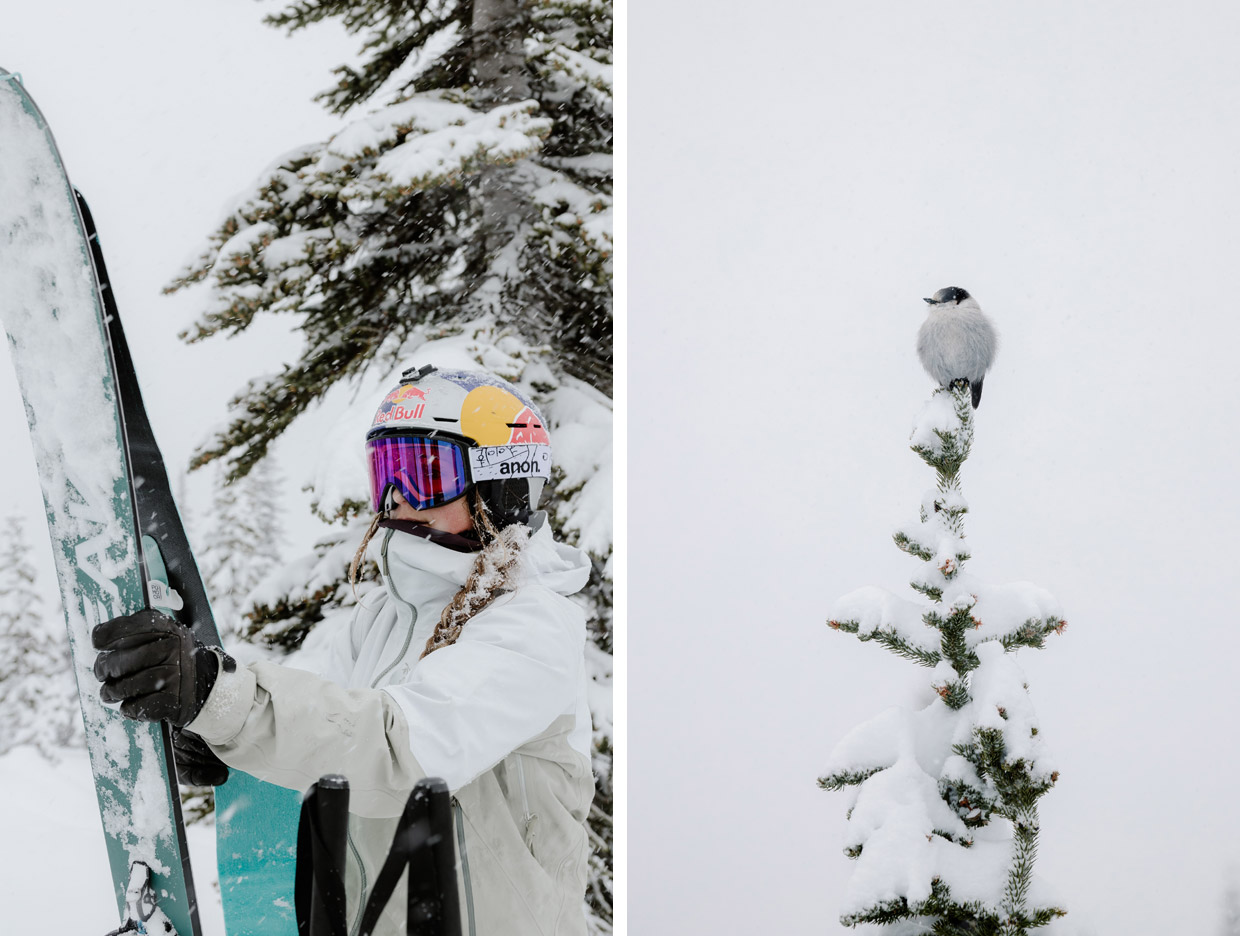
A Canada jay flits from treetop to a ski wedged upright in deep snow, then back again – watching as we stumble around, punching through knee-deep powder, locating, probing, and digging out buried transceivers. Ours is a diverse group of women: snowboarders new to the big mountains of the Coast Range, first-time ski tourers, pro freeskiers (and Arc’teryx athletes), and everything in between. Though our backcountry experience is varied, this turns out to be one of the most relaxed days: one of deep connection, with the mountains and environment and with each other. There’s no big-dog energy here. So much so, in fact, that it takes me until our end-of-day descent to recognise pro Izzy Lynch, who I’d seen on screen only a week before in Motherload. Talk about humility…
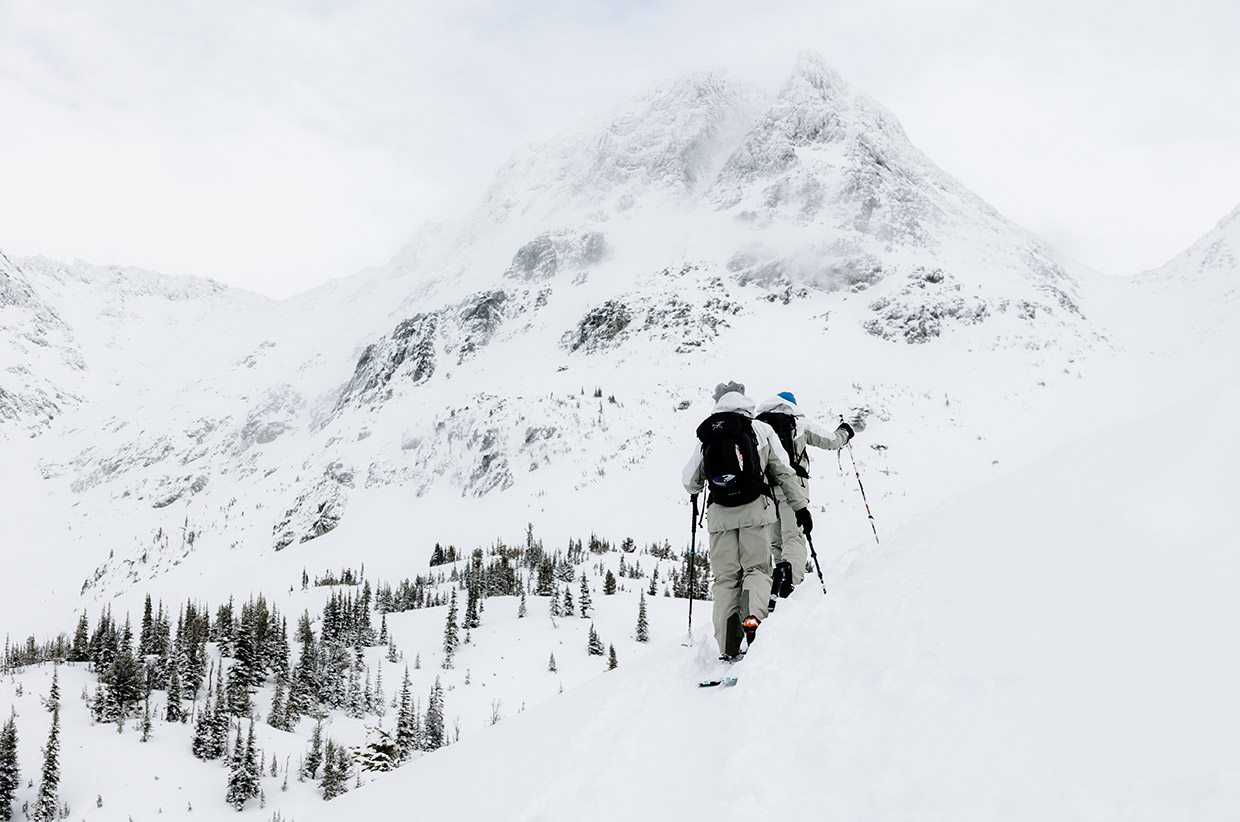
Out there in BC backcountry, avalanche skills are taught and tested, first skin steps are taken, skis are lost in deep snow, spirits are high, and all-round positive backcountry experiences are enjoyed within this 13-strong group of women.


There are three things that enable sport in the outdoors: knowledge, community, and gear. And gear is where Arc’teryx comes in. Specifically, its snow products – Arc’teryx’s most technical and coveted line.
‘The bottom line is that women’s outdoors gear hasn’t been where it needs to be,’ says Arc’teryx Chief Creative Officer Katie Becker, who joined the brand in 2020. ‘This brand has been very male focused – the way we build the product, the way we tell stories, the athletes and ambassadors that we’ve had in the past. And it’s given us this sharp technical edge. But I also think there was a feminine mindset that was maybe lacking, and the brand has a massive opportunity to get after that.’
In the three years since Becker joined, Arc’teryx has pivoted and refocused. Of the brand’s athletes, 45 per cent are now women – double what it was before – who are key to product design and development. The entire design team (across men and women) is led by women. All design innovation is 50/50, despite women’s product not making up 50 per cent of sales – ‘which just shows us where we need to double down.’
Autumn ‘22 saw a big change to snow gear. An expansion to the brand’s sizing means that clothing now ranges from 00 to 16, and with it a move away from ‘Large’ or ‘XXS’ language and labels. Looser fits were incorporated into the ever-popular Alpha and Beta jackets. Autumn ‘23 will see silhouette variations. In time, all collections will incorporate ‘fitted’, ‘regular’, and ‘relaxed’ cuts. This adds much-needed choice to women’s kit across the board. The hourglass shape has long dominated jacket designs from all brands – but this is not something many women I know are after out on the mountain.
The brand has also pulled back from the city lifestyle product path it started on. Anchored in the mountains, Arc’teryx is focused on technicality and functionality. Research is pulled in from its athlete base and from science. ‘Shrink it and pink it’ was for a long time the method for designing women’s outdoor clothing, starting from men’s product innovation or design. Considering the physiology separating men and women when it comes to gear, going beyond proportions, it’s been a long time coming.
Thermoregulation is one factor – men and women deal with heat and climate very differently. Women are more sensitive to cold due to fat dispersion and muscle; men run warmer. Women feel cold more at their neck, wrists, and tops of hands, and controlling the perception of being cold in these specific areas goes a long way. Zoning insulation means that you can control the weight, keeping gear light and packable whilst maintaining weight-to-warmth ratio and functionality. Similarly, extra space around the shoulder and pit increases comfort and mobility, with women tending to layer up more.
The design process is now truly equitable and design pivots both ways. The Beta shell, for example, was designed for women and developed for men. Going forward, the question will be this: does there need to be a separate men’s and women’s product? If needed for fit and performance, one is adapted. The team is also focused on what the athletes want and need. With the style of younger generations becoming much more gender neutral regarding fit and colour, talk turns to a possible future of unisex kit.


‘Ignoring the science of physiological differences might mean compromising on performance, which really isn’t Arc’teryx’s style,’ Anson says. ‘But we’re considering less gendered categorisation and how we address fit.’ A more democratic naming convention is a good start – adapting the language to offer greater inclusivity, blurring the lines between fit, colour and size.
Arc’teryx is committed to improving women’s gear, but that’s not its only priority. Sustainability is front and centre. ‘Sustainability lines have been crossed,’ Anson says. ‘That’s true for all brands. Now we’re in a state of flux, the whole industry chasing this problem, with everyone grabbing to find alternatives.’
Arc’teryx is presented with big tensions in designing gear for the outdoors. The most suitable materials – waterproof/breathable membranes, and PFCs – that extend the lifetime of garments also persist in the environment.
To mitigate current issues with materials or DWR treatments, the ReBIRD hub handles everything from care and repair (for kit longevity) to resale and upcycling. In the near future, the aim is for repairs for every item to be done in every store around the world.
Final word? ‘Our goal is to try and make a product that will work for every body. To give people choice. It’s about which one works for you. We want it to be technical – obviously, that’s what we stand for – but how we bring a little bit more style to the mountain, to then let people choose how they want to bring it to life, is what we’re working on.’
Photography by Mirae Campbell // @miraecampbell
Produced with support from Arc’teryx // @arcteryx