New Heights
Gear Field Journal Explore Gear & Guides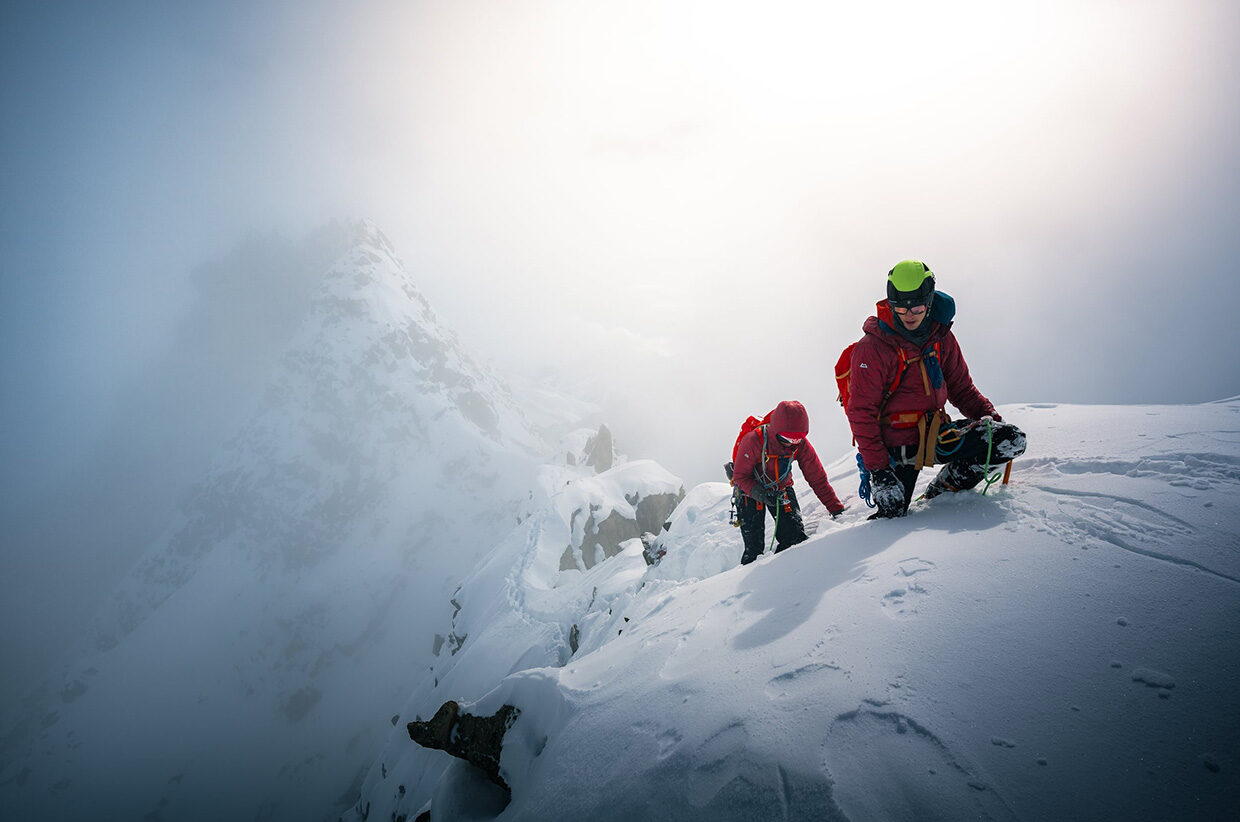
Stories Behind the Gear: Mountain Equipment Oreus
Written by Daniel Neilson // Photography by Silvan Metz, Hamish Frost & Tom Livingstone
The Oreus Jacket is the first to use a proprietary synthetic insulation called Aetherm™, tested on the world’s highest mountains and in wet winters in Scotland. It’s one of the most versatile jackets Mountain Equipment has ever made.
The summit of Gasherbrum III is at 7,958m above sea level on the border of Pakistan and China, in a subrange of the Karakoram. It fails to pip the arbitrary 8,000m mark and is considered a subpeak of the Gasherbrum massif. It’s often overlooked by mountaineers, but it is a highly technical route on challenging terrain and, of course, very, very high.
When Tom Livingstone and Aleš Česen hauled themselves onto the summit of Gasherbrum III earlier this year, they had just completed the first ascent of the West Ridge, in true alpine style – a journey of seven days on the mountain and ten years in the planning. It was the first time the mountain had been summited from the West Ridge, and it was Tom and Aleš’s second attempt. They named the route Edge of Entropy… chaos, not predictable, disordered.
When he did summit the mountain – at 7,958m, remember – Tom Livingstone, a Mountain Equipment alpinist, was wearing the new Oreus Jacket. The Oreus jacket weighs 390g. The designers of the jacket describe it as a game-changer, and for once, it’s not hyperbole.
Tom has been there from the early days of developing this jacket. He said: ‘I’ve been lucky enough to be in the design process of the Oreus Jacket for a number of years. I was looking at a mid-layer insulation piece that could be really really warm and ideally, it would be synthetic.
‘I’d taken prototype versions on multiple trips from Pakistan to Nepal, and I took the current Oreus model to Gasherbrum III this summer. I think I put the Oreus on at the start of the route and didn’t take it off again until the end of the route.’
 https://vimeo.com/1033100945?share=copy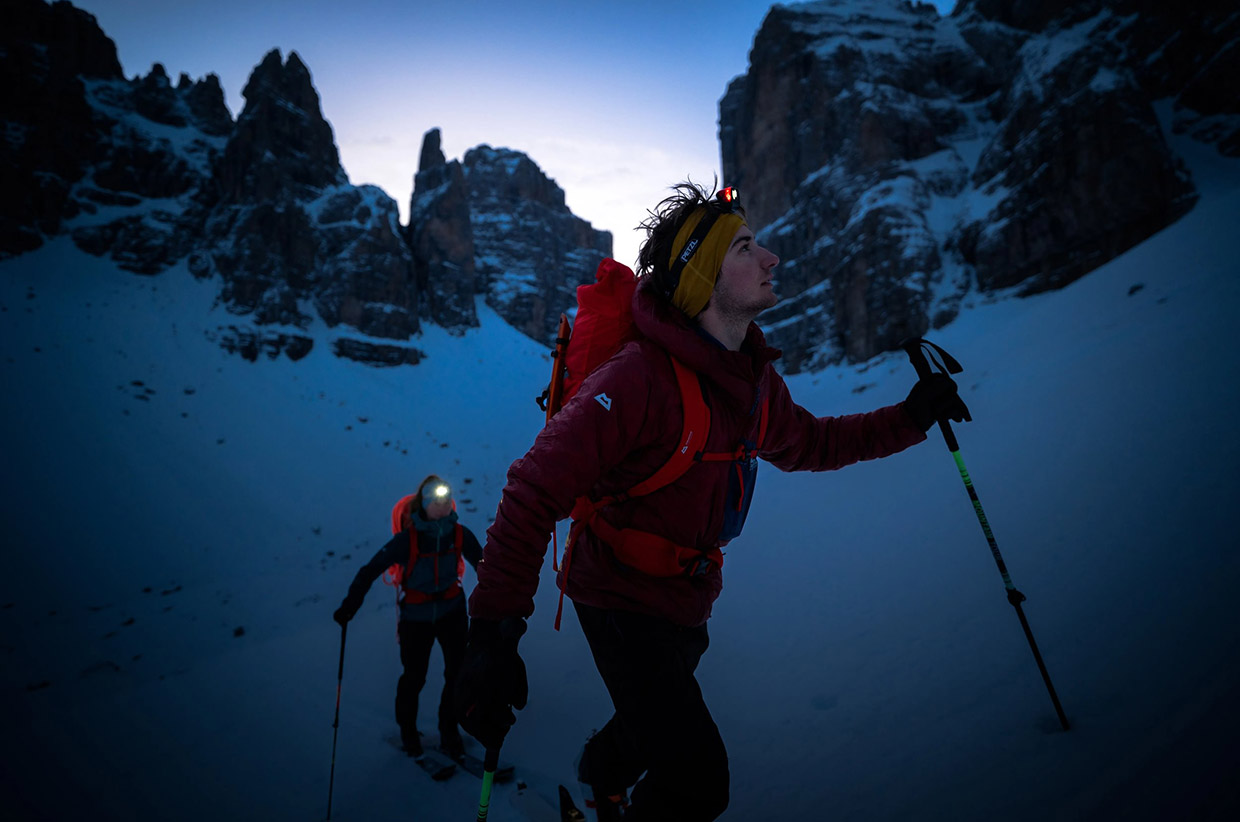
The Oreus Jacket wasn’t initially designed to be worn on 8,000m peaks. It’s lightweight, packable, and wind-resistant – perfect for alpinists moving quickly and backpackers needing warmth and low weight. But something about this jacket – or more to the point, the insulation – means it is incredibly warm, to the level of down. And yet still works in damp conditions.
Developing a synthetic material that is as warm and packable as down, but holds its warmth in the wet, is an eternal problem. Well, it probably feels like that for product designers. However, Mountain Equipment sensed a breakthrough.
‘We started by looking at the synthetic insulation area. We’re always testing the latest greatest offerings from our partner suppliers, but then we came across two materials that we put together and we just ended up creating our own patented insulation,’ Chris Bottomley, Senior Designer, explained.
The secret of the fabric is in the unique construction, whereby multiple strands of recycled polyester fibres are interlocked within a reflective layer. OK, perhaps no longer much of a secret, but these strands also allow moisture to dissipate quickly because of a large surface area while at the same time allowing air to pass through the fibres. This also ensures a quick drying time. And because it is engineered as a flat sheet, there is no need for baffles in the jacket, therefore eliminating cold spots. Aetherm™ Precision Insulation is the name they gave to the insulation. And Oreus is the name of the first jacket to use it.
Product Engineer Dr Matthew Fuller took the material into the cold lab pretty early on in its development. ‘We had some very basic designs made here that were tested by members of staff, and the feedback was unanimously amazing. As soon as we heard that, we knew we needed to really pour some effort into it.’
The team developed several prototypes: a vest and then a jacket. And despite these versions not being perfectly tailored and without the features the final jacket has – such as, you know, pockets and a hood – the testers still didn’t want to give them back. They were definitely onto something.
Tom Livingstone took an early version of the jacket on an expedition to K7 and it completely changed his layering system. Dr Matthew Fuller said, ‘Tom doesn’t wear a lot of clothing anyway. A lot of people would look at his clothing system and be like “wow, that’s what I use in Scotland in the winter” and he’s using it at 6,000m, 7,000m peaks, but by using this jacket, he was able to reduce the number of mid-layers by one, take a lighter weight down jacket, and reduce the weight of his clothing system by 4–500g – a lot.’


It’s a sentiment echoed by other Mountain Equipment climbers who were also involved in the jacket testing. Freja Shannon was admittedly a little sceptical at first, but experience on big walls in the US and summer in the Alps convinced her that it could replace any down jacket. She said, ‘It’s just suited every occasion that I’ve wanted to use it for, whether it’s a belay jacket that you throw on or your main mid-layer under a shell. It just always keeps me warm, no matter what the environment is.’
Matt Stygall, an IFMGA British Mountain Guide who works at Plas y Brenin National Outdoor Centre, agreed. ‘For me, synthetic insulation is the best sort of insulation for the places I go, even in the Alps. The first time I used the Oreus Jacket was 10 days of graft in Scotland in January, out in all conditions. I didn’t really want to give it back because every time I went to pack my bag it was the one thing I wanted to put in. I’d use the jacket all year round: in the spring for a belay jacket, when I’m out in the hills, or even climbing. It’s a very useful bit of kit.’
After the testing period, the designers started adding on features. Chris Bottomley, Senior Designer, said, ‘With a Mountain Equipment product you’re always going to get a fantastic helmet-compatible hood, and there’s also a great glove-compatible cuff. Plus the outer fabric is a 10D nylon, which is a super, super lightweight fabric, but it’s one of the strongest 10D fabrics we can find on the market.’
‘The Oreus has completely changed the way that I approach insulation,’ Tom said. ‘It allowed me to take a lot fewer items to have the same level of warmth. What you’re wearing is essential; it makes a huge difference whether you’re going to freeze to death or be comfortable and warm enough to recover at night and be able to keep climbing the next day.’
After the summit, Tom wrote to UKC: ‘When we launched for G3’s west ridge, attempted by Scots in ‘85, we pushed on a door to what we wondered was possible. Shedding expectations, worries and ideas, we simply moved upwards with an inquisitive mind and a silent, crashing body. Sick in the head and stomach, we slowed.
‘Alpinism is such a beautiful trap of what you want and what you need.’
Written by Daniel Neilson // @danieljneilson
Photography by Silvan Metz // @silvanmetzfotografie, Tom Livingstone // @tom__livingstone & Hamish Frost // @hamishfrost
Produced in partnership with Mountain Equipment // @mountainequipment
For further information and to learn more about the Oreus jacket, visit www.mountain-equipment.com