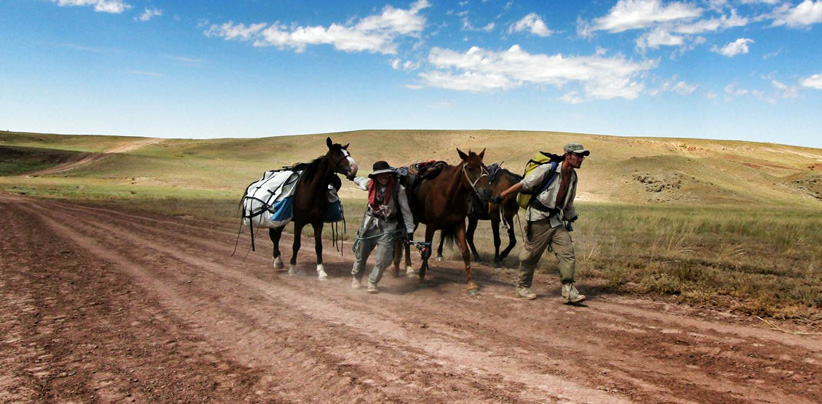
Sidetracked joint editor Jamie Bunchuk & Matthew Traver recently successfully crossed the length of Eastern Kazakhstan by horse as part of the One Steppe Ahead expedition. The journey was riddled with complications, as Jamie reports here.
The three horses we purchased in Ust-Kamengorsk were by no means unsuitable for expedition travel, but they were not perfect. Their ages were 5, 8 and 9, one with a big, but scabbed girthband wound (our girthband rested in a different place so it seemed an acceptable inconvenience) and one that was blind in one eye, although I never had any indication that this affected him in a negative manner; indeed he was the best and strongest of the lot. They were called Charlie, Totoro and Arman.
The first few days of the riding were pleasant, if slightly shambolic. It became apparent that the routine of readying the horses each morning and decamping took on average four hours. Even when we became adept this was rarely cut down to less than three. Our rota involved waking up at 6am, leave by 10, ride until 4 or 5pm for three days and then have one day off for the horses to recover and graze. We rotated the pack animal regularly.
The environment was much, much harsher than anticipated, and within ten days we were thrust into a true desert landscape, with little water and grazing and long distances between these islands. Temperatures were rarely lower than 30’C and peaked in the mid 40’Cs. We had stretches where the only water available to us for several days was briny and the salt drove us half mad. On top of that, at the end of the day sometimes we’d have to go crawling about on our hands and knees cutting foliage out of the bare earth to gather as much grazing for our animals as possible. The absence of water dictated our distance that had to be covered each day, with the longest stretch a 60km push across bone white salt pans in the simmering heat. By the end of it we had all five nearly collapsed of heat exhaustion. These distances wore at our horses, especially Charlie, who it had become apparent was the troublemaker of the group; indolent, lazy, unintelligent and prone to sending kicks aimed at my hip and knees for the least bit provocation.
His old girthband wound opened up, unseen by us as it was hidden behind a concealing scab, when I finally got close enough to check, it had become infested with maggots , prompting an hour’s employ of tweasers and sterile washing. We kept off the horse, walking instead in the heat of the day, 20km walking in 35’C heat every day for a week. The wound healed in due course without further complications.
Further sections of waterless terrain, dictated longer days, and more wear on everyone. We’d long ago realised that our pack bags were too heavy and had thrown out all none essential items. The sum of my personal belongings amounted to one set of clothes, a coat, a toothbrush and a knife. We carried a skeletal minimum of food with us, relying on resupply in towns. If shops were not forthcoming, we survived on a half packet of noodles and a handful of plain pasta for dinner. Less than 700 calories for 35km days. Often we carried no emergency water, the horses obviously needed to drink and so there was no point adding to them extra weight; if we failed to find water we’d all suffer as equals.
Despite the pack bags now weighing less than two hefty rucksacks – much less than a rider – and the massive protecting felt pad, the pack saddle still had the tendency to cause sores. The only explanation I can give for this is whilst we meticulously weighed and equalised each bag, I believe the contents were particularly prone to shifting inside the bag, especially during a rising trot. This could have created an internal imbalance with the weight concentrated and one particular point of the bag and hence causing the sore. We could not figure out an effective solution to this problem, despite our many attempts to do do.
The pack saddle created a swelling on Arman. It seemed like a natural swelling that would in due course turn into a steadfast and then heal. As we were in a particularly bleak and waterless section of the landscape, we made the decision to continue riding him, paying particular attention not to apply any direct pressure to the wound. This was our single greatest mistake of the trip and – four days later – it erupted as an enormous fist sized abscess under the withers. It was a truly terrible wound. Following our veterinary contact’s (the Paralympic equestrian team’s vet) advice we kept the wound flushed out with salt water solution five times a day. Every morning I would spend an hour picking out maggots from the recesses of the opening. Despite keeping the wound covered to protect from flies, they always seemed find a way in.
We walked again, keeping off the riding to rest the horses, through a succession of 40’C days. Luckily there were more settlements and thus more water for us. Arman’s wound began to heal. We reached just over 160km outside of Almaty before the terrain became worse and we had to resort to riding for the fear of not reaching water. Each wound was heavily padded but it was apparent that all three horses were in need of respite. It would have been unethical to push them across the last four 50km days to Almaty (dictated by available water). We hired a truck which took all of us to the outskirts of the city.
There we waited four days, camped in a field behind a motorway petrol station, whilst we waited on a buyer. During this time their wounds healed phenomenally well, the abscess filling in almost completely. It was as if they sensed the expedition’s end. We sold the horses to a reputable horse dealer whom our contacts in Almaty located for us. With some of our riding equipment, their own contacts in the villages and rural settlements outside the city and their own truck to transport the animals, we felt these devout men offered our horses the greatest opportunity of a good and continued life.
From a personal account I can say that aside from the sheer behemothic physical difficulties of the environment (I have lost well over a stone and a half in weight) more taxing was the moral questions and compromises towards the animals within our care. At times it wracked at the very core of my being and made me question whether I was being an immoral creature for attempting and continuing such a journey.
I have documented this angst, and everything else, and hope to write my first book on the expedition. Meanwhile Matt has recorded enough footage for what I believe will be an outstanding documentary on the our journey and the native people of Kazakhstan, who’s generosity is truly without limit.