Stories Behind the Gear: La Sportiva
Gear Field Journal Explore Gear & Guides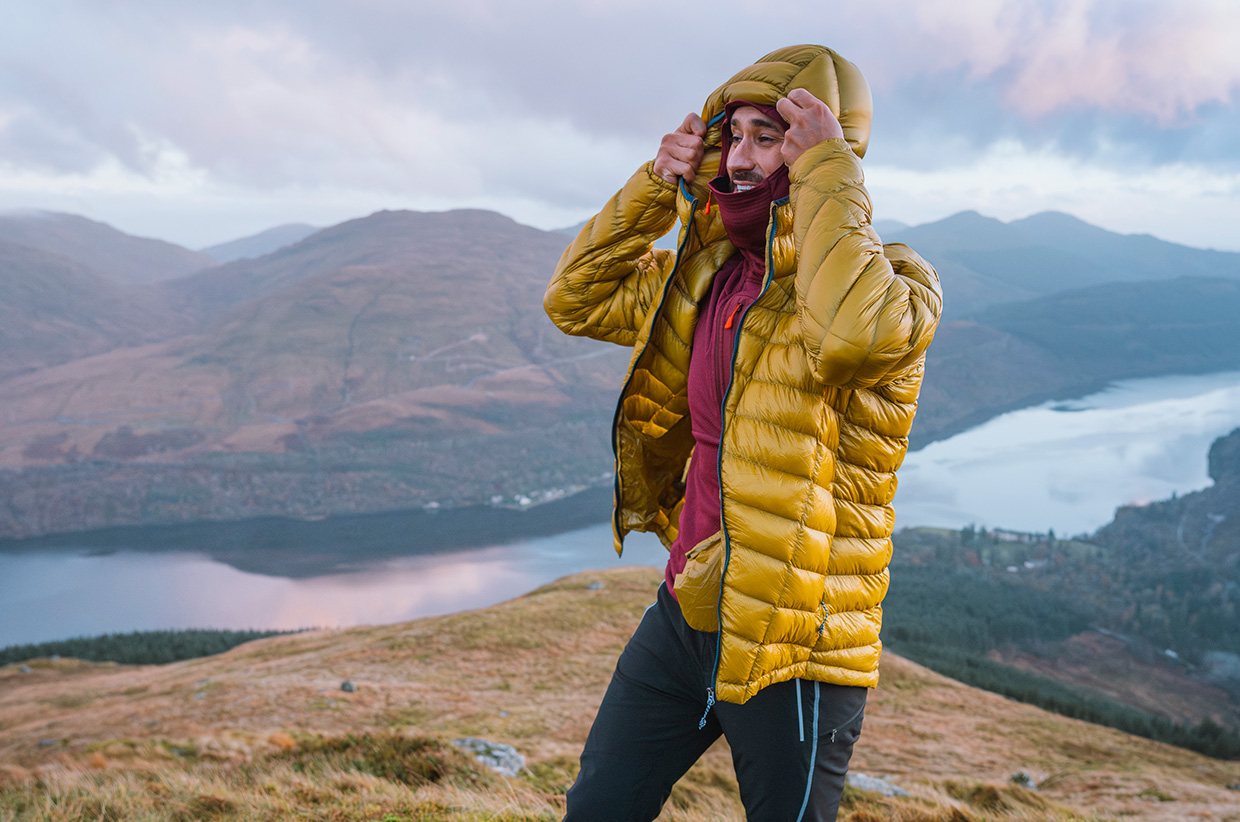
The Lumina 200 Down Jacket
Written by Daniel Neilson // Photography by John Summerton
Produced in partnership with La Sportiva
When the cold begins to bite, it becomes all-consuming. Functioning becomes harder: taking a photograph, opening a chocolate bar wrapper, putting up a tent. Physically, things just take longer, including what you need to do to get warm: make a hot drink, put up a shelter, get the next layer out of your bag. Judgement often becomes fogged too; that’s why climbers and mountain leaders operate a buddy system, regularly checking in on their partner.
In the mountains, temperatures change quickly – due to weather systems, of course, but also altitude. As air pressure drops, the air expands, and in doing so it cools. But the rate at which this temperature drops is quicker than you might think. It depends on how windy it is and the amount of moisture. In moist air, when the mountains are in cloud or very near the top of them, the ‘lapse rate’, as it’s known, is around 0.5°C per 100m. In dry air – those clear, cloud-free days – the lapse rate is around 1°C per 100m. It’s why snow lingers in shadowed corries, it’s why storms build over peaks, and why a clear, mild forecast at sea level can unravel higher up. It governs glacier survival, treelines, and the fine margin between rain and snow. The contour lines on a map govern shifts in temperature and weather as well as elevation.
On the day of our mountain summit, the temperature in Arrochar, the village at the head of Loch Long in Argyll and Bute, Scotland, was around 6°C. Snow had not yet fallen on the Arrochar Alps, the group of mountains surrounded by lochs Long, Fyne, Goil, and Lomond. But it was windy, and our destination, the Cobbler – also known as Ben Arthur or Beinn Artair – was 884m above Loch Long where our ascent began. We didn’t do the maths then, but you could. This fairly average winter temperature at sea level would have made the summit of the Cobbler somewhere between 0°C and –5°C, with wind chill making it feel much lower. We needed to be prepared.


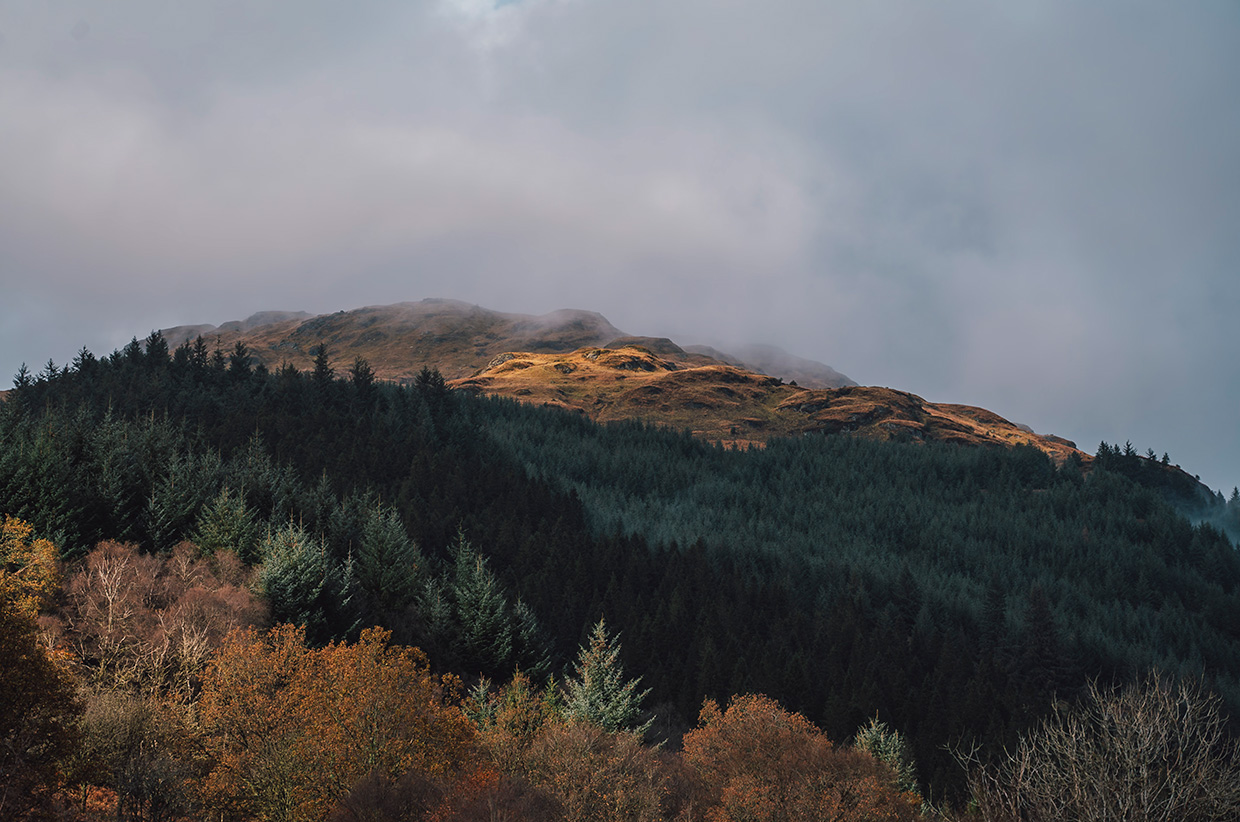
The Cobbler is a distinctive mountain said to resemble a cobbler bending over a last. It takes a fair amount of squinting to make that comparison, but it is nevertheless an unusually shaped peak crowned by an outcrop. Our assembled group of friends took a direct route up Allt a’ Bhalachain, tracing the contours as we went. Zero, 100, 200, 300, steeply. At 350m we turned west, over the ford and up a wide, open, gentle slope. As we did, another layer went on, we swigged our drinks and continued in high spirits. We were aiming for the ridgeline, and the narrow path that traces its way north-west over the first-named peaks: An t-Sron at 614m and Arthur’s Seat at 706m. As we rose over the ridge, the wind hit us with a ferocity unexpected on our sheltered walk up.
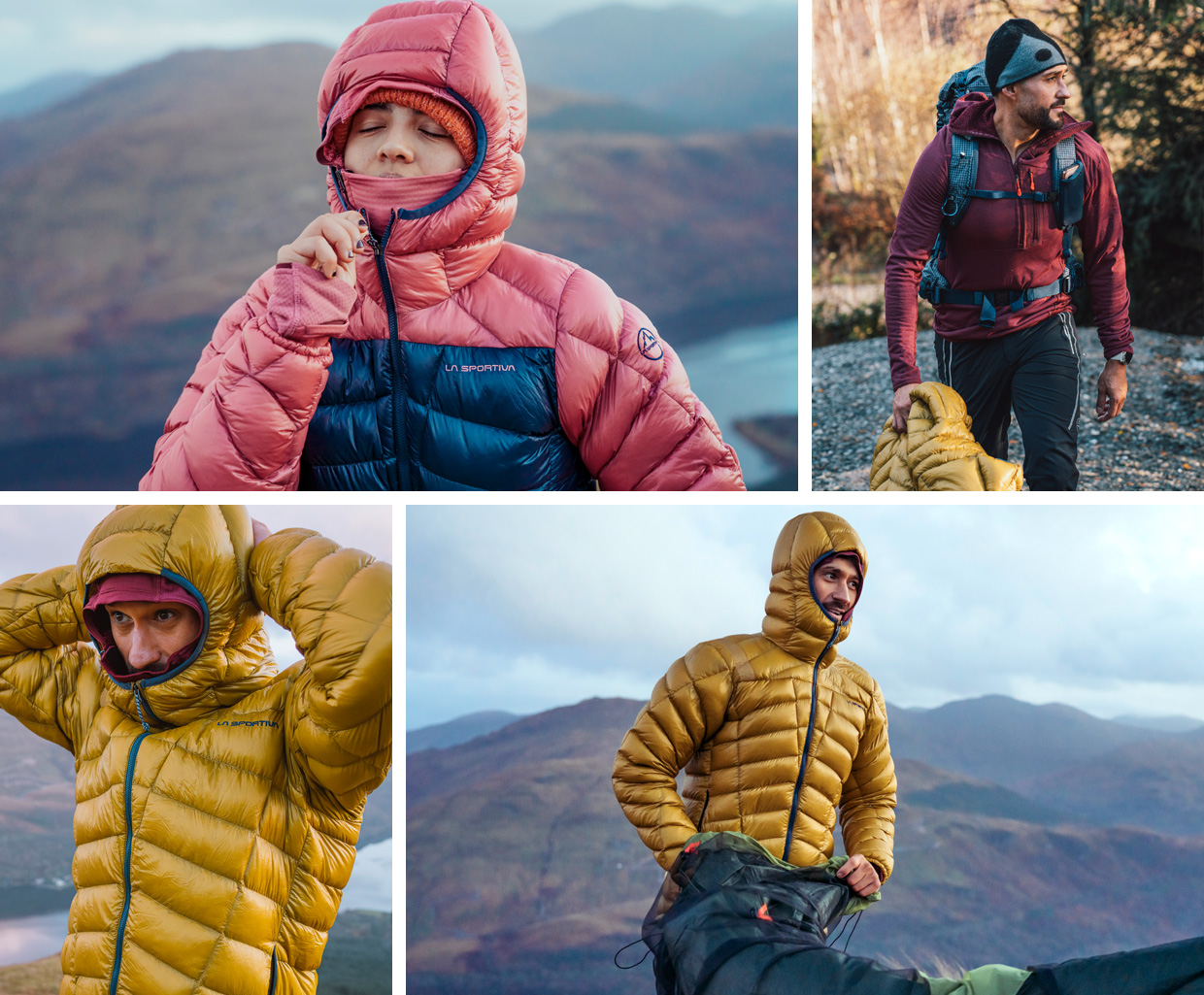
We’d packed new jackets from La Sportiva: two of the Lumina series of down jackets, which we were on this trip to test, among a few other bits. The full review is below, but there were lots of very positive noises from Adam and Vedangi, who were lucky enough to put them on. They are remarkably light down jackets, designed specifically for days like these: quick mountain ascents that could start with them packed away, then deployed when the weather requires. The Lumina 200 Down Jackets we were testing weighed a mere 250g, and are filled with 1,000 cuin down (that’s among the best you can buy). La Sportiva’s designers were likely given one brief: create a jacket with the best warmth-to-weight ratio possible. The result is impressive. Barely noticeable in the backpack and life-saving on your back.
The wind by now was gusting at 40mph on the northern downslopes. Wind chill doesn’t change the air temperature, but it has a powerful effect on your body, making it lose heat much more quickly. When air is still, your body warms a thin layer of air next to your skin. Wind strips that layer away, again and again, forcing your body to give up heat faster. With an air temperature of 0°C and a wind speed of 40mph, the wind chill will be around –9°C. This formula applies to exposed skin, but the effect on the entire body is significant. It will speed up frostbite, your motor skills will diminish, and your energy levels will decrease. Warmth is everything
As we climbed onto the summit of the Cobbler, we were fully exposed to the wind and the views over the Arrochar Alps. Taking the formula for the lapse rate at the peak of The Cobbler (884m) with an air temperature of –5°C and the Met Office’s wind chill formula, we were probably experiencing a wind chill of –16°C. This is classic Scottish winter weather. Not too extreme on paper, but serious in effect. And bear in mind it was around 6°C and sheltered when we set off. This is why, in winter, you need to obsess over both the wind and the temperature. It’s why you need the right clothing to stand up against it. And when you have that, well, there are few better places on Earth to be than standing on the top of a mountain, in the Scottish Highlands, with friends, sheltered, drinking tea and enjoying the world.


Review: Lumina 200 Down Jacket
Unpacking La Sportiva’s Lumina 200 Down Jacket, the overriding impression was incredible lightness. It weighs just 250g, and packs into a tiny compression sack. This is a jacket designed for mountaineering – when you’ll be starting low and moving very high, very quickly.
All else being equal, the compromise for lower weight is always warmth. At least half of a down jacket’s weight is the insulation. But the Lumina 200 Down Jacket uses 1,000 cuin (cubic inch) fill power down – this is the gold standard for jackets. It means that one ounce of down fills 1,000 cubic inches. Most down jackets fall into the 600–750 cuin range, making them bulkier (but cheaper) for the same weight. Simply put, with higher cuin ratings you need less down to achieve the same warmth. This makes the Lumina 200 ideal for short stops, fast-and-light days where insulation lives in the pack until needed, and cold summits after a hard ascent. It is for people who move through cold places and want insulation that stows in a pack, then delivers instantly when the wind bites.
Insulation is just part of the design that makes it light, packable, and warm. Designers have utilised a no-expense-spared approach to this jacket. The outer is best-in-class Pertex® Quantum – tightly woven recycled polyamide that is exceptional against the wind and also down-proof, so you won’t find escaping feathers anywhere here.
There are elasticated inner cuffs that help with warmth around the sensitive wrists. The hood has an elasticated hem. There are two front pockets with zips that sit above a harness and there’s a compression sack for the jacket. It also comes with a repair kit.
La Sportiva’s Lumina 200 is designed for mountain days – those we love at Sidetracked – and is easily one of the best we’ve tried. Boy did we need it on the Cobbler in December.
For more information visit lasportiva.com and find them on Instagram @LaSportivaUK
Written by Daniel Neilson // @danieljneilson
Photography by John Summerton // @johnsummerton
Produced in partnership with La Sportiva // @LaSportivaUK