Darkest North
Bikepacking 1,400km through the Arctic Night
Story & Photography: Joffrey Maluski // Written by Alex Roddie
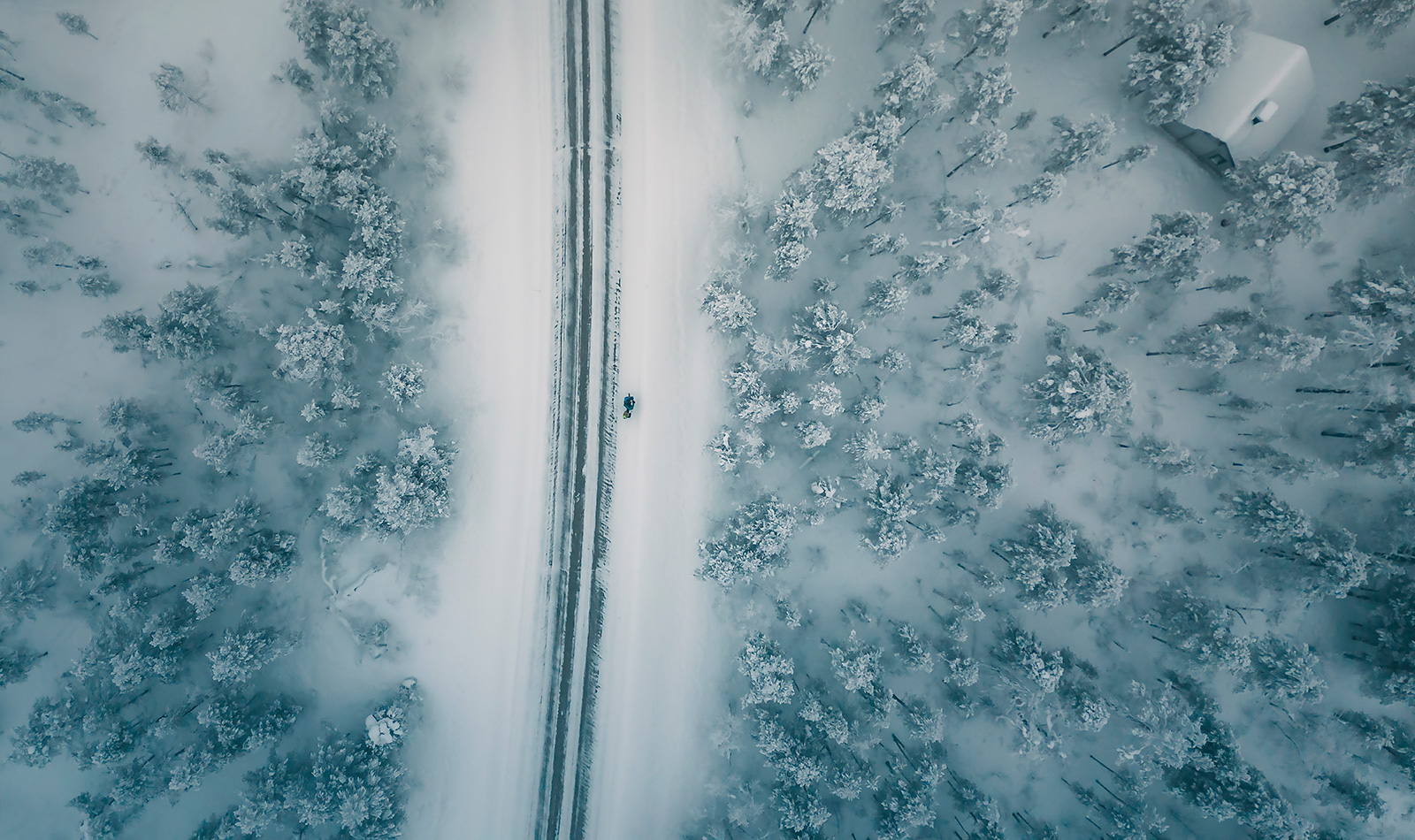
All I have to do is one final gear check, close up my saddlebags, and I’m ready to start this adventure. From now on the plan is simple: pedal from the end of the Lofoten Islands to Vardø, easternmost point of Norway – 1,400km through the forests of northern Scandinavia. But simple doesn’t mean easy. Yesterday, December 13th, was the start of the polar night, and 25 days of Arctic darkness and deep cold lie ahead.
Although it isn’t my first time bikepacking through Arctic Norway, it’s my first time here in the polar night. I’m feeling a nervous, energetic excitement as I set my bike on the compacted snow of the road. With a gloved hand I give my bike an experimental nudge. Although it feels implausibly heavy, as if the panniers are stuffed with lead bars, it also communicates a reassuring sense of readiness to me. I’ve chosen my equipment with care, configured and maintained this set of wheels, poured all my knowledge and experience into it. It’s ready. I’m ready. Let’s go!
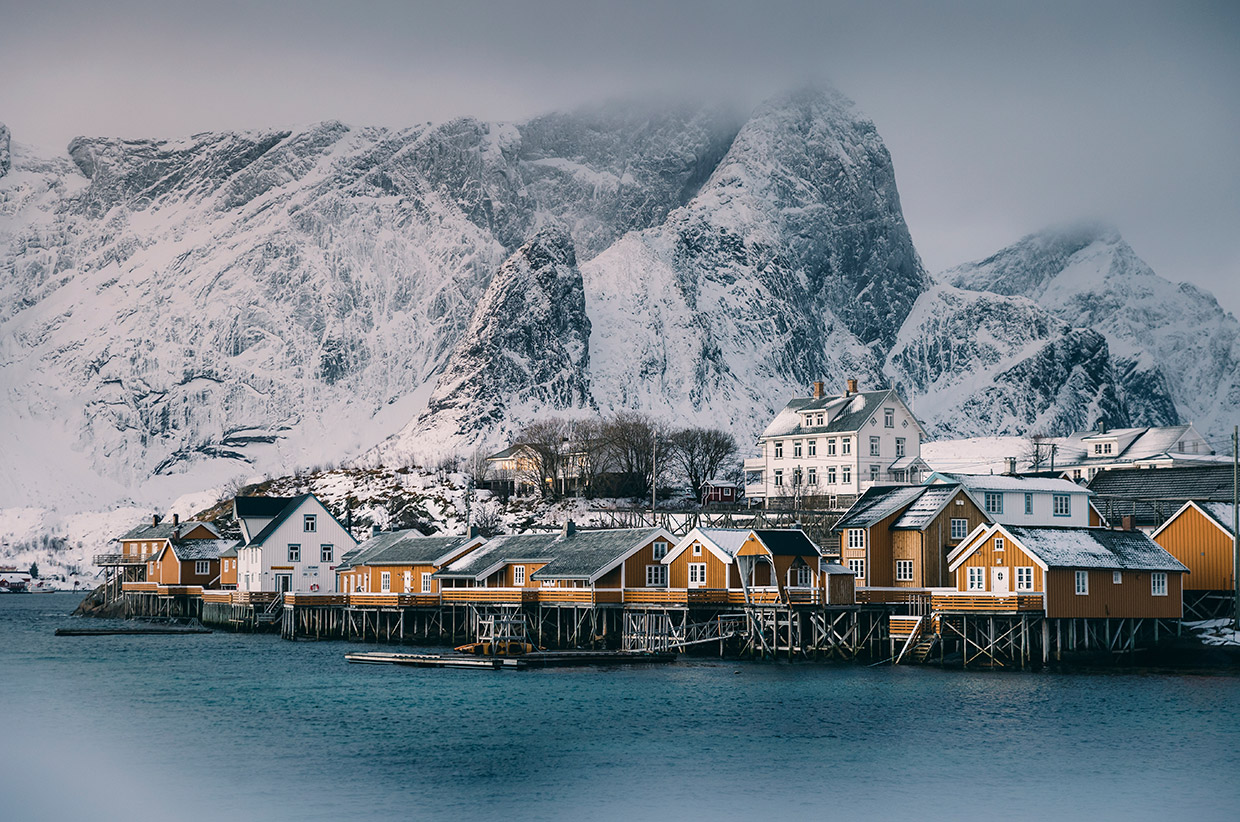
But first, one moment looking back, reflecting on the place where it starts. Although I’m standing on the edge of the polar night, there’s a soft, diffuse glimmer in the air. Here in Lofoten, looking across the fjord to the classic view of Hamnøya’s colourful houses with snowy mountains rising behind, there is a sense of delicate twilight – as if this fragile scene exists here only for a moment, painted with the lightest pencil strokes before deep and lasting night will return to shroud all in blackness. The buildings of Hamnøya cluster at the edge of the fjord, some rising from the grey waters on stilts. Little marks of yellow and red against a scene of whites and greys.
One last look at the view, then it’s onto my bike. First pedal strokes. A long way to go.

At the time, the first few days of any big trip often feel like the hardest. Heavy gear. Heavy bike. Adjusting to cold or heat or headwinds, letting my body ease back into the rhythm. Already my trip has thrown challenges at me: slow progress with studded tyres through the snow, feeling exhausted before my first night in the tent.
My route has taken me along quiet roads clasped between the mountains and the sea. Now, three days and over 120km from the start, my resolve is being tested – as are my expectations about the Arctic winter. Rain all day and 3°C. The deluge sluices down, washing the snow into muddy, softened heaps by the side of the road. I’ll hear an engine behind me, see the glow of headlamps, and then a vehicle will come roaring past and spray me with filthy brown water. Sometimes the slush hits me in the face, dribbles from my goggles onto my cheek or gets in my mouth if I’m not prepared. Merde! C’est aquatique!
Between 10.00am and 2.00pm there’s a bit of light in the sky even though the sun doesn’t fully rise, just enough to turn off my lamps. But after 2.00pm the darkness sets in again and I’m riding in a narrow tunnel of light slashed through with endless sleety rain. My pogies and shoes are soaked; it feels a lot colder than 3°C, as near-freezing temperatures often do. But, despite all this, I’m not miserable. I came here to do this, I still have a long way to go – a long way with a lot of ups and a lot of downs – and there’s no choice but to keep going. So that’s what I do.
When I ride into the temporary respite of a road tunnel I’m really tempted to just stop there for the night and call it a day. At least it’s dry! But the occasional car or truck keeps thundering through and eventually I end up carrying on. Finally, after 5.30pm, I find a car park with heated toilets where I spend the night.
***
Two days, one gigantic lightning storm and an unpleasantly busy main road to Narvik later, I’m on my way out of Norway – for now – and towards Sweden. And it feels like things are on the up! The temperature has dropped below freezing again, and as I climb on a quieter road out from Narvik the precipitation abruptly switches from rain back to snow. Soon it’s piling up at the side of the road, caking my bags and clothes and bike. I’m no longer getting dangerously soaked, but my toes are starting to feel cold – seriously cold.
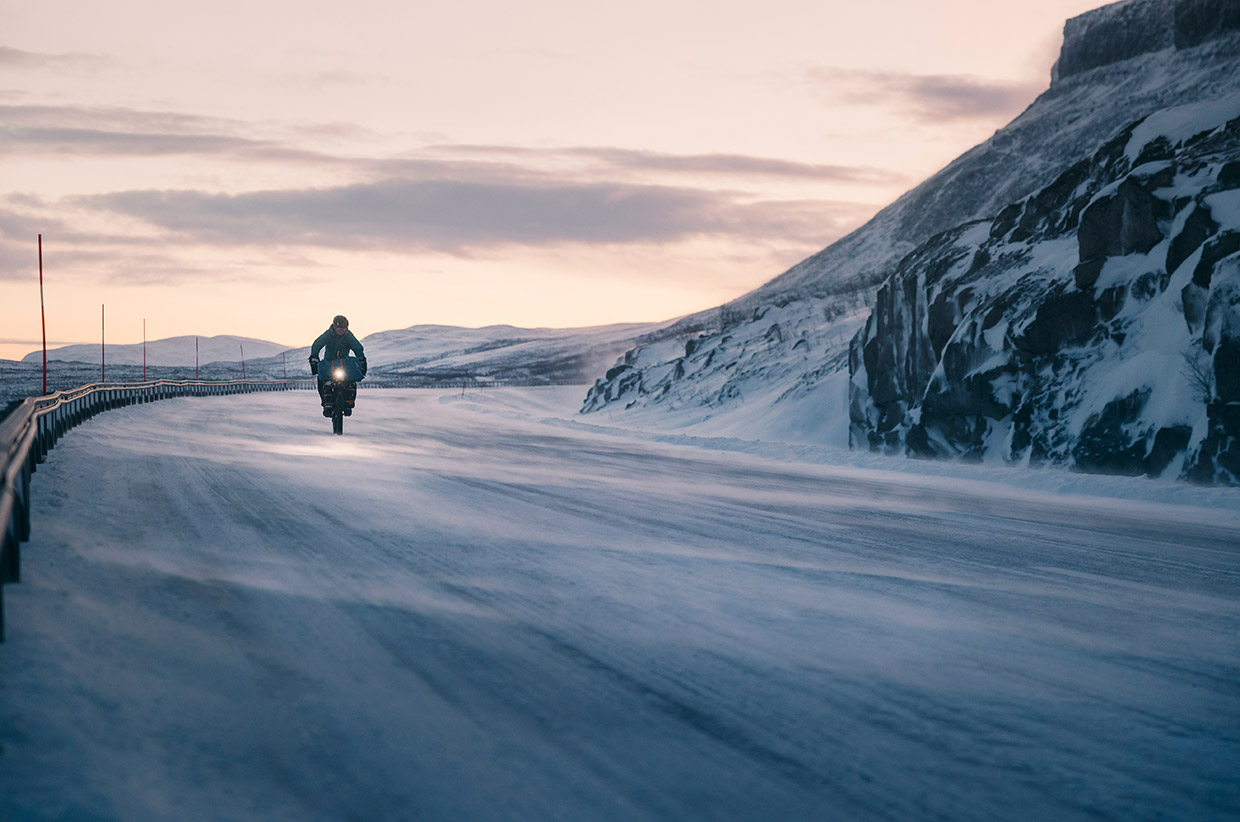

I’m heading into the mountains now. Haunting forests of dwarf birch crowd in on the sides of the roads, sparse and skeletal, and in the midday gloom I scan the trees for any signs of life. Sometimes I see a raven take off from a branch and dislodge a clump of snow. Once or twice I even see reindeer leap from the snowy banks at the side of the road and gallop across in front of me, their white fur coats blending in with the background.
It’s an entirely monochrome landscape. I’m cycling through snow drifting down from an overcast sky and there is no trace of colour anywhere. I could be a grainy picture in a 1940s newspaper or a cartoon character drawn by a charcoal artist. I’ll be pedalling as always, feeling the weight of the bike and focusing on my destination for the day or when I can next eat a snack or just daydreaming, and then suddenly the weirdness of this will hit me, like a toggle flipping in my head. There’s no colour. None at all. And in an hour or so there won’t be any light either.
For a disorienting moment it’s like I’ve forgotten what the concept of colour even means, as if that part of my brain has been unplugged or short-circuited, and then it’s gone and I’m just cycling along in the snow again and a bit cold, a bit tired, a bit hungry. I laugh quietly to myself as I coast down the gentle incline.
The next day, it’s colder still and brutal headwinds taunt me as I tackle steep uphill climbs. The icy landscapes and windswept trees don’t get any less impressive, and there’s an oddly specific kind of awe in the repeating patterns that sweep past me – a maze of branches and twigs stark black against the floating white, like some kind of interference pattern lulling my brain into a trance. But when I cross the border into Sweden, the clutter of human infrastructure breaks the weird voodoo and I zip past the blue ‘SVERIGE’ sign with a smile on my face and a holler of joy into the wind.
Suddenly the wind eases and a long downhill opens up in front of me. Quel cadeau! What a gift!
***
I started this journey with a strange blend of feelings. I knew that in some ways this would be different to every big cycling journey I’ve ever done. But I also knew, deep down, that in many ways it would be much the same. Getting from A to B across a really big place is simple when you get down to it: keep going, don’t get lost, stay fuelled, stay warm or cool enough, don’t get injured or exhausted, find somewhere safe to rest at the end of every day. The differences are always in the details – and part of the pleasure lies in figuring those details out. And in the surprises too. We can plan as much as we want, but there are always surprises.

Many days and many kilometres after leaving Lofoten, I’ve pedalled through the northern wedges of Sweden and Finland and back into Norway again. Now I’m starting to feel how adventures often have more in common than the differences separating them. Every big journey has challenges – some unique, but some universal.
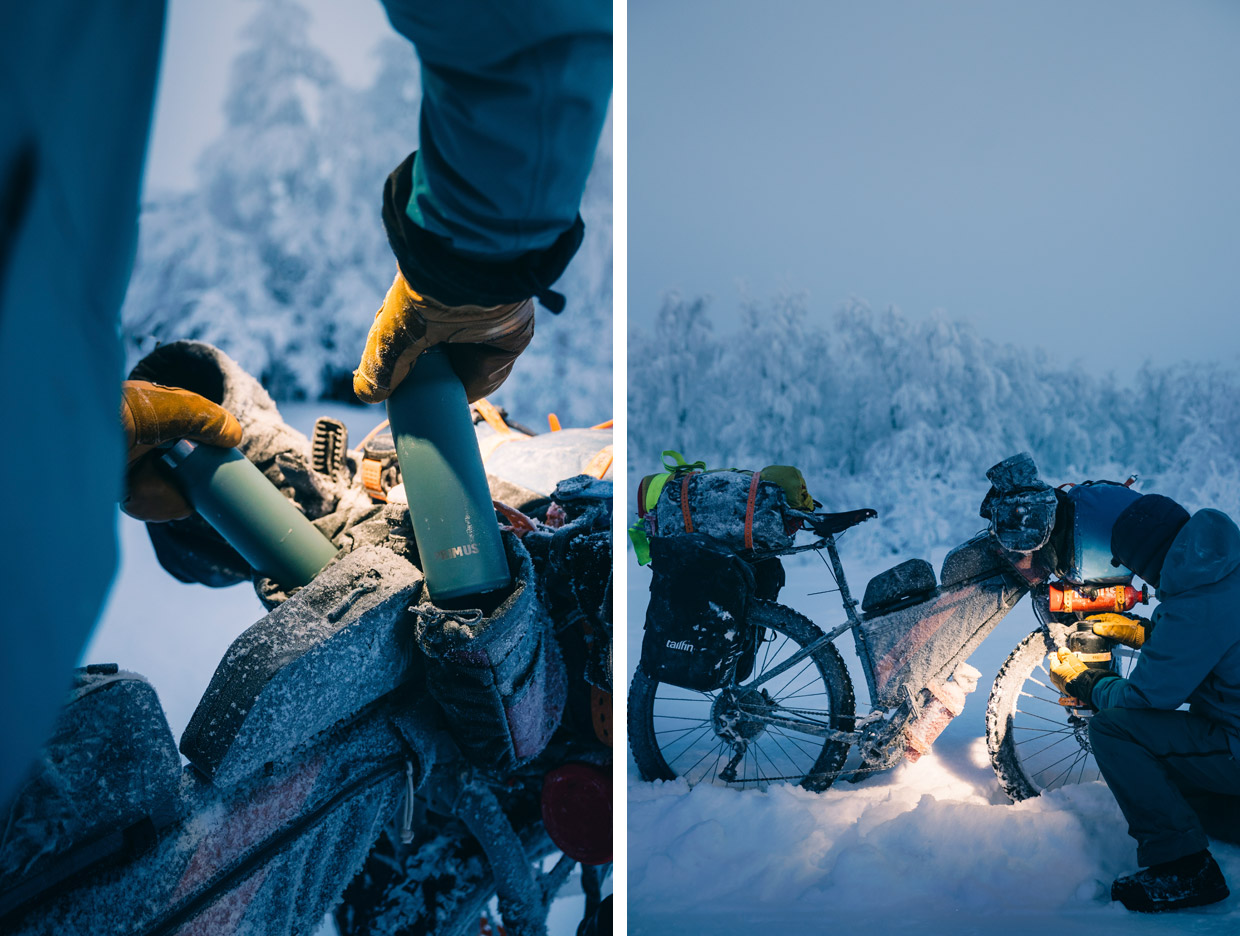
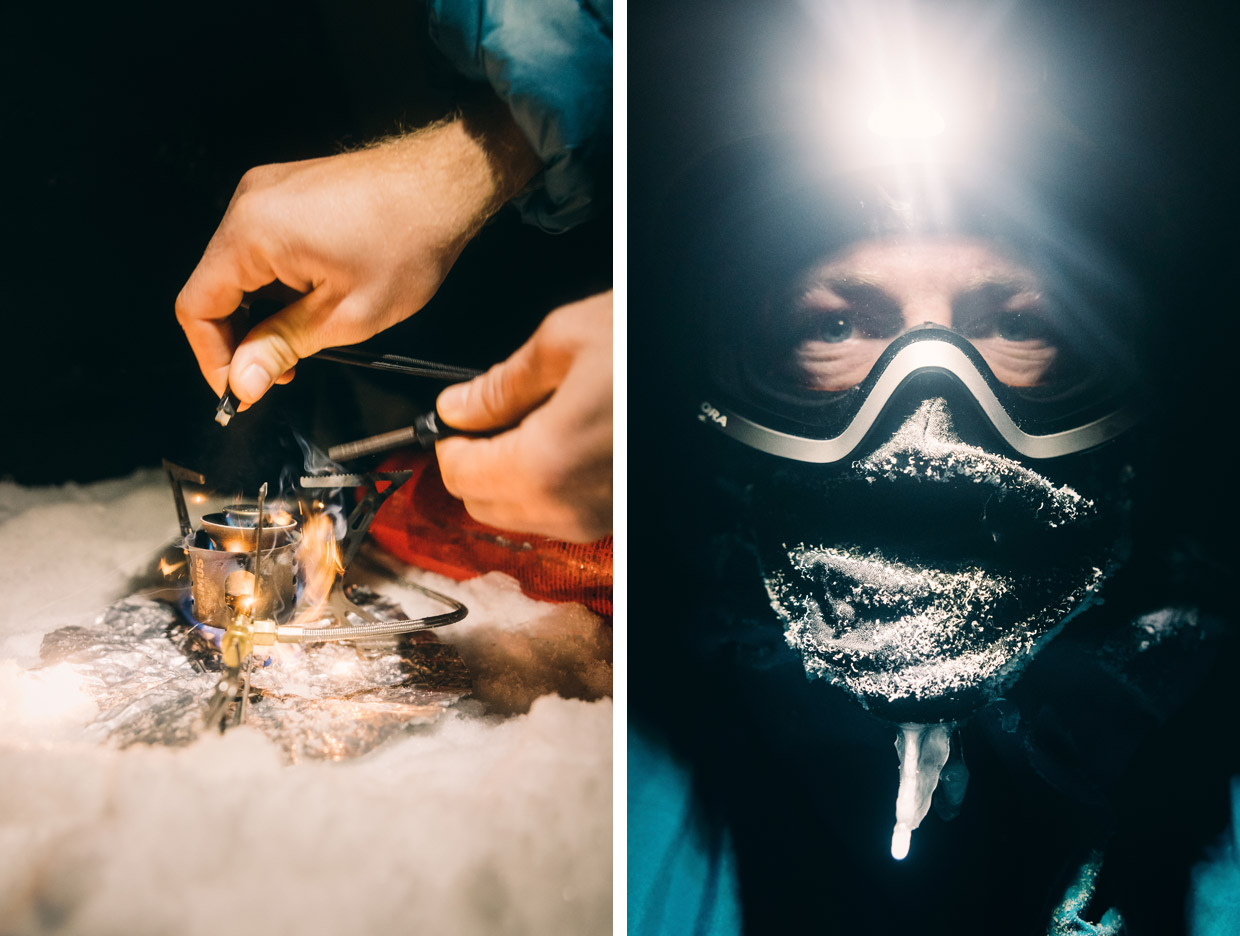
This time my most pressing challenge is the cold. It’s become much colder over the last few days, with the thermometer on my watch sometimes reading –25°C or below. I’ve been layering a foam mat over my inflatable in camp for extra insulation. I wake up each morning to find a thick plating of ice over the hood of my sleeping bag, condensed there from my breath, and the humidity inside the vapour barrier is unpleasant. This non-permeable layer between me and my sleeping bag prevents the insulation from filling with dangerous moisture.
Days follow each other and my routine settles down. I wake at 8.00am, have hot chocolate and muesli for breakfast, then take my first pedal strokes around 10.00am at dawn. I’ll aim to travel 60–100km per day. It starts to get dark at 1.30pm or 2.00pm, depending on the weather, but I’ll continue for a few more hours before finding somewhere to camp. The little rituals of each evening are things I soon come to appreciate – such as the moment when I finally get to tuck in to a hot meal. Then it’s down for the night again, trying to sleep in intense cold.
Despite gloves, pogies, and a down jacket, it takes me a long time to warm up in the morning when I set off, and I often have to pedal hard to generate enough heat. By day 18 I’ve started to notice pain in my toes, too. After stopping to adjust my shoes, I realise that they are slightly too small, restricting blood flow – which means I feel the cold all the more. Nothing I can do about it at this point. I experiment with adding extra socks, which just compresses the insulation all the more, and removing the insoles, which makes no difference. Eventually I accept the situation: my toes are going to get cold, they’re going to hurt, and I’ll have to manage this as well as I can. ‘Toes nonstop super bad’ – that’s what I write in my trip log.
From this point onwards, foot pain is my constant companion, flavouring the experience. Sometimes my toes hurt at the start of the day, then the pain fades off later on; sometimes they just hurt from morning until night. Sometimes I get warm when climbing uphill. Sometimes it’s so cold the sweat freezes inside my clothing and I stay cold all day.
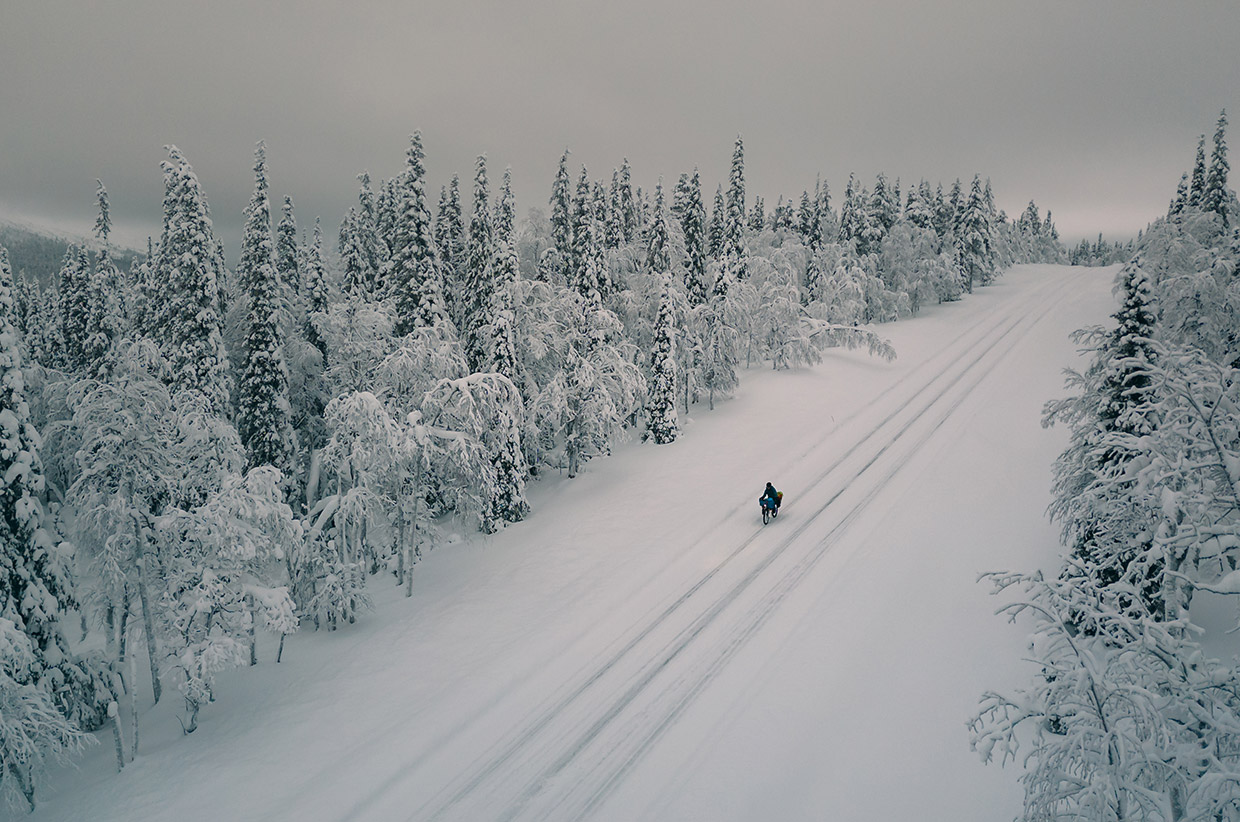


The endless pedalling through the long night does feel monotonous sometimes, I’ve got to admit. In these moments, especially when my feet are full of pain, pedalling can take more motivation than usual. But, just as every adventure has unique challenges, every adventure has unique rewards too – and I’m starting to think that the rewards this time are all the sweeter for being rare and fleeting.
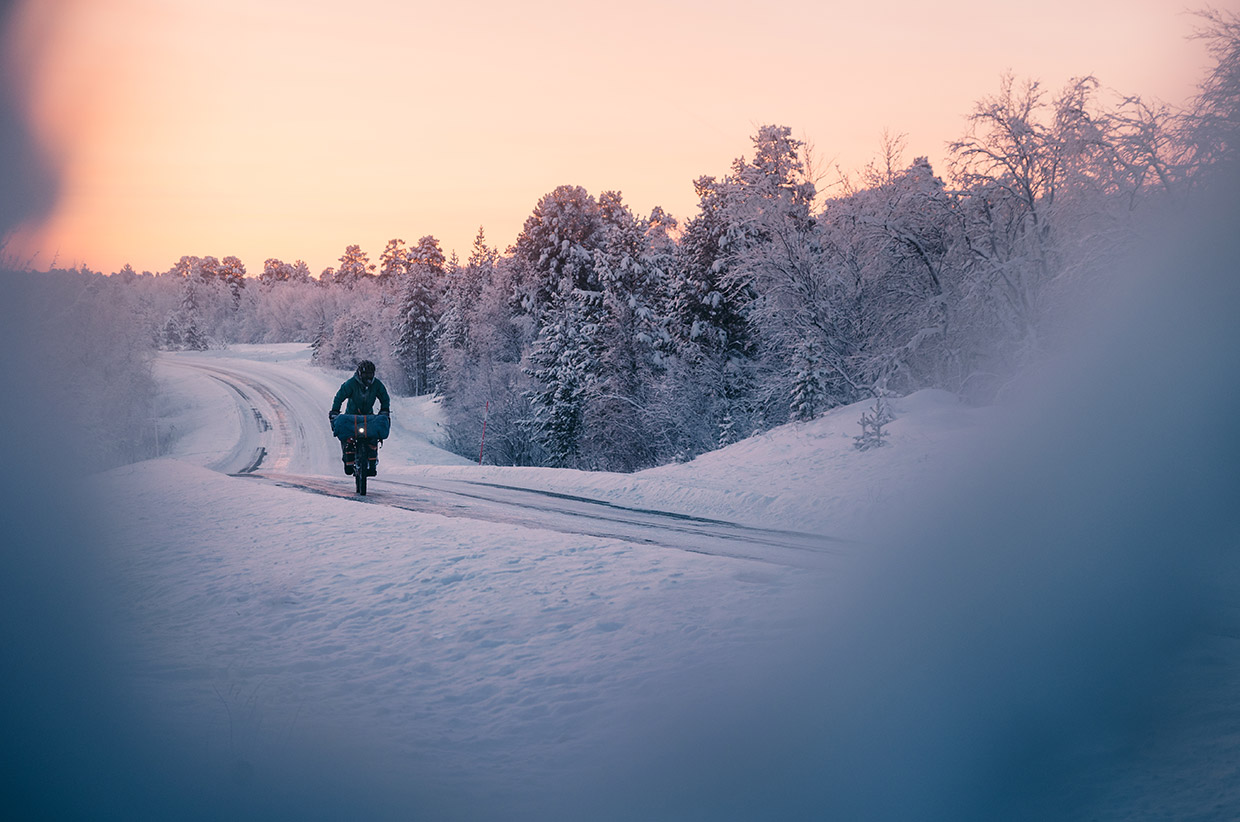
I live for the precious hours when the sun touches the horizon, but never quite lifts above it, and the sky transforms. It starts with a beautiful pastel gradient of pinks and oranges so characteristic of the northern lands. This twilight lasts and lasts, developing and morphing, the colours blending into one another and transforming everything as fragile rosy light washes over the forest. Crystals of hoar frost twinkle, suddenly alive. Although these colours are often subtle, after the sensory deprivation of my monochrome life in the polar night they are like a rock anthem in my mind. And sometimes the colours are bold, strident, crazy. In these moments, my emotions are so strong that sometimes I stop my bike and just stand there at the side of the road, forgetting the pain in my toes, staring up at the sky and marvelling that I can hold it all inside me. In these moments I think: yeah, this is why I’m really here.
Big journeys are about the big picture, but they’re also about the moment – looking past discomfort to realise that this too will pass, and also holding on to ephemeral beauty that you’ll never experience again. Balance these factors and you can keep going day after day, through long night after long night. Travel for long enough and a grey sky will always break into a golden dawn.
First published in Sidetracked Volume 32
On January 7th, 2024, after 25 days, Joffrey Maluski completed his 1,409km bikepacking journey through the polar night.
Story & Photography: Joffrey Maluski // @joffreymaluski
Written by Alex Roddie // alexroddie.com