Waiting for Mumu
A Blank Spot on a Map?
Words & Photography: Michal Lukaszewicz
To find a blank spot on a map in our age and time is like stumbling upon a leprechaun riding a unicorn. Unlikely? Yes. Impossible? That’s a worry for non-believers. And I believed. A lot. I believed that a vast patch of rainforest in western Papua New Guinea labelled on wartime paper maps as ‘OBSCURED BY CLOUDS’ would yield some secrets.
‘Where are we going?’ my wife Karolina asked me after we had landed in the small mining town of Tabubil. I looked around and noticed a tall local man squeezing through a hole in the airport’s fence, newspaper tucked in his armpit. He walked directly towards us, and said, ‘You don’t look like mine workers?’ His warm smile extended all the way up to the dove tattooed on his forehead. Bird of peace. A good sign.
‘We’re not miners,’ I explained. ‘We’re looking for the local market where we hope to employ companions for our journey. Our plan is to cross the Blucher Range on foot.’ But the tall man shook his head. ‘In Tabubil you won’t find anyone better than me. Everyone else works for Ok Tedi mine. We will go to Kiunga town tomorrow and equip ourselves for the journey ahead. By the way, my name is Kevin.’
This journey was to be a classic adventure: find somewhere as unknown as possible, and go on a quest to explore it. We didn’t know what lay ahead of us in the Blucher Range, but our goal was simple. The only documented Western survey of the area dated back to an expedition led by Charles Karius in 1927. Even that only mentioned the area briefly. Karius, trying to reach the headwaters of the River Fly, mistakenly followed the Palmer River and noticed the Blucher Range in the distance. But he never set foot on it. Our initial goal was to cross that stretch of rainforest on foot – and identify whether any south-to-north connection existed amongst the local communities.
Two days later
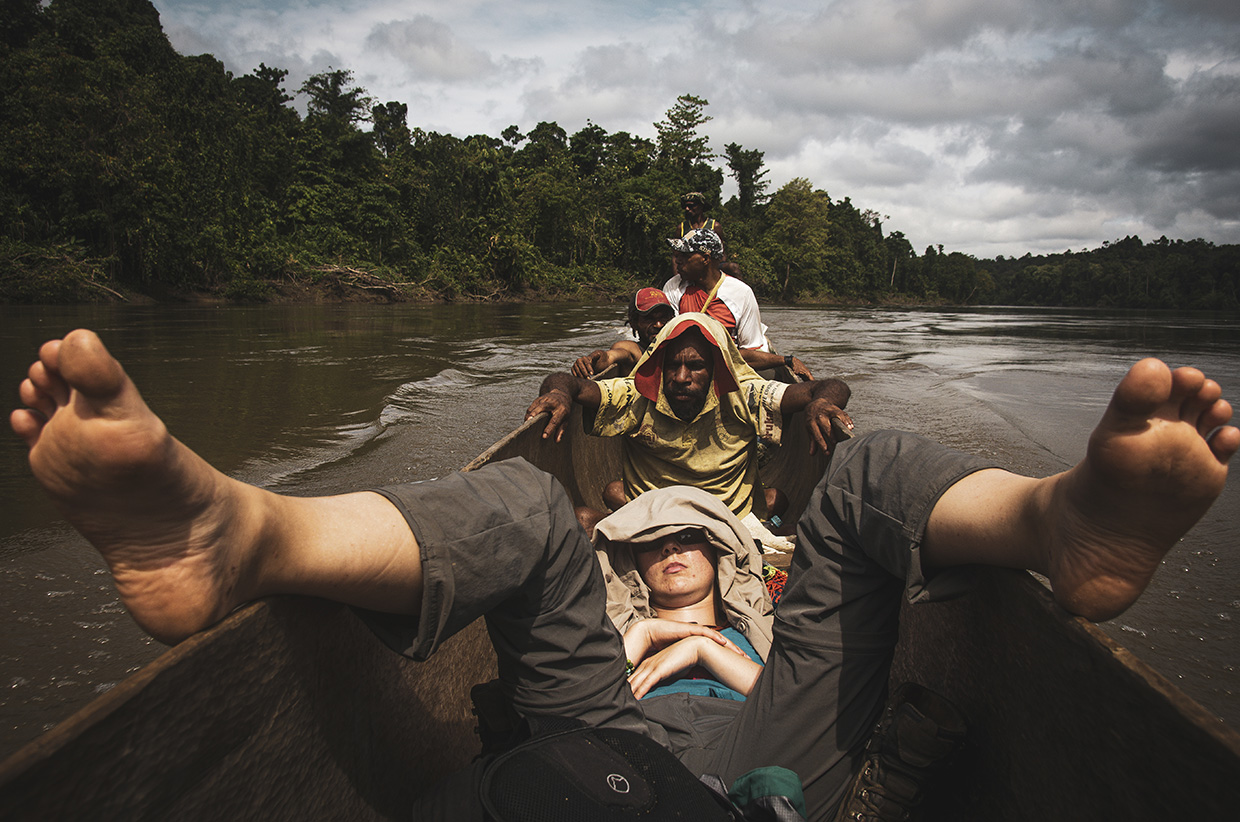
Pristine rainforest stretched far and wide as we glided up Fly River in a narrow dugout canoe. Rainforest noises tried to silence the roaring outboard motor – the mighty wingbeats of hornbills, and screams of crested cockatoos. Up front, our backpacks stabilised the boat, a month’s worth of supplies squeezed between hammocks, tarps, ropes, and machetes.
Karolina was dozing. Behind her sat Rambo, a short but mighty local who had joined our expedition the day before. Kevin, with a live chicken crammed between his legs, was visibly shaking in the back. ‘I have never been in a boat,’ he told us in a worried tone. ‘I can’t swim. If anything happens, puk-puks will deal with me instantly.’ Puk-puk means crocodile – and we had just passed a pair, basking in the equatorial sun at the confluence of rivers Palmer and Black.
We followed River Black until log-infested shallows stopped us. The skipper let us off the boat, turned around, and left without ceremony. For us, it was showtime.
There were no paths to follow. Dense, lush overgrowth surrounded us. Giant spiderwebs spread like hammocks between century-old trees. The haunting calls of birds of paradise echoed from inaccessible canopies above – a divine world of sunshine. Meanwhile, we mortals forged a difficult path in darkness below.
‘Let’s gain some ground before night,’ I proposed while the others devoured pilot biscuits. ‘What do we do with Sophia?’ Karolina asked, pointing at the chicken. Lesson number one in expedition planning: no live chickens. Sophia was forced to take the greatest of all sacrifices.
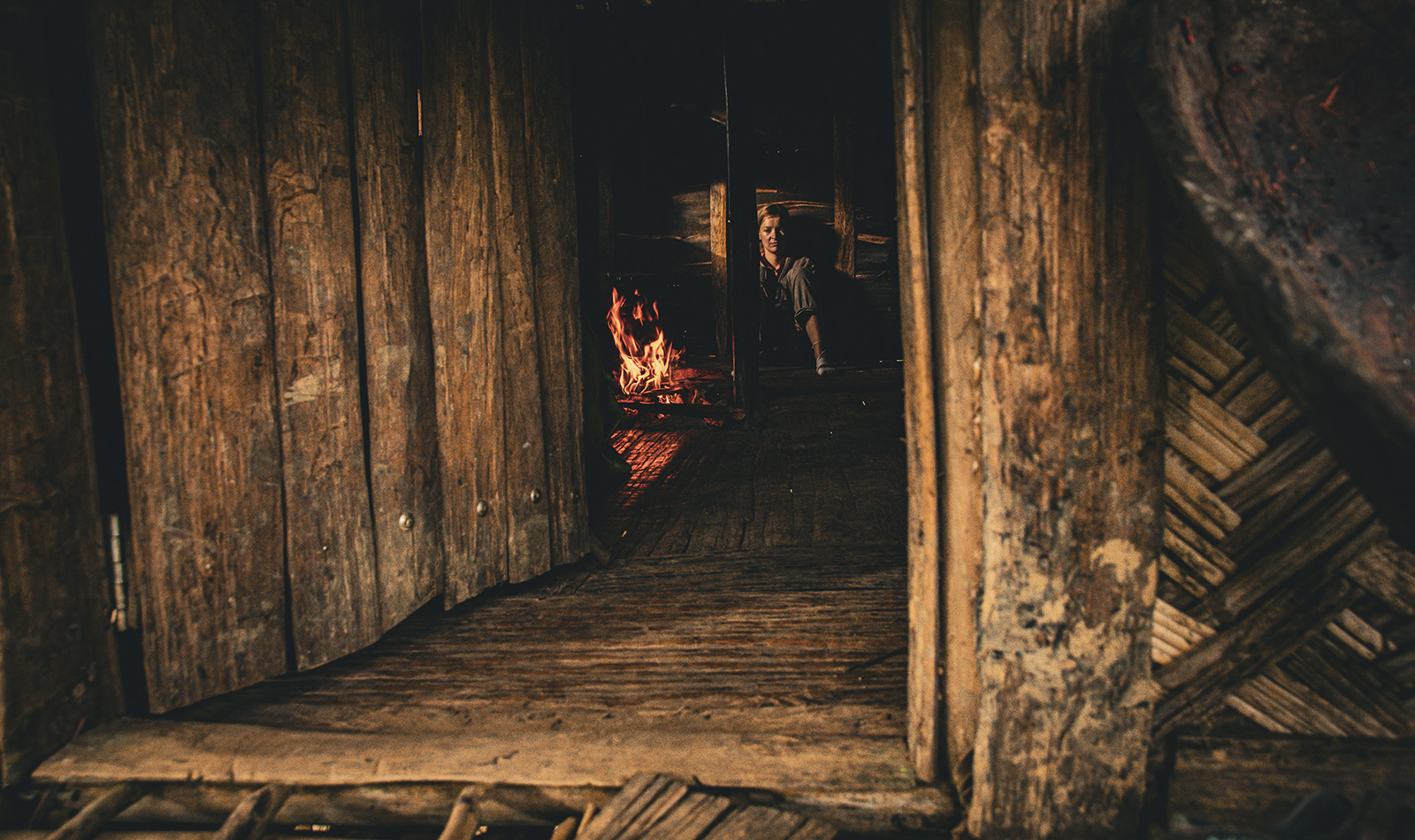
Equatorial night dropped with atomic speed. After boiling the chicken, we started to set up our hammocks, but Rambo and Kevin shook their heads, instead making up a campfire and curling around it. ‘We don’t need those,’ Rambo said. The long night of giggling and storytelling turned strangers into friends.
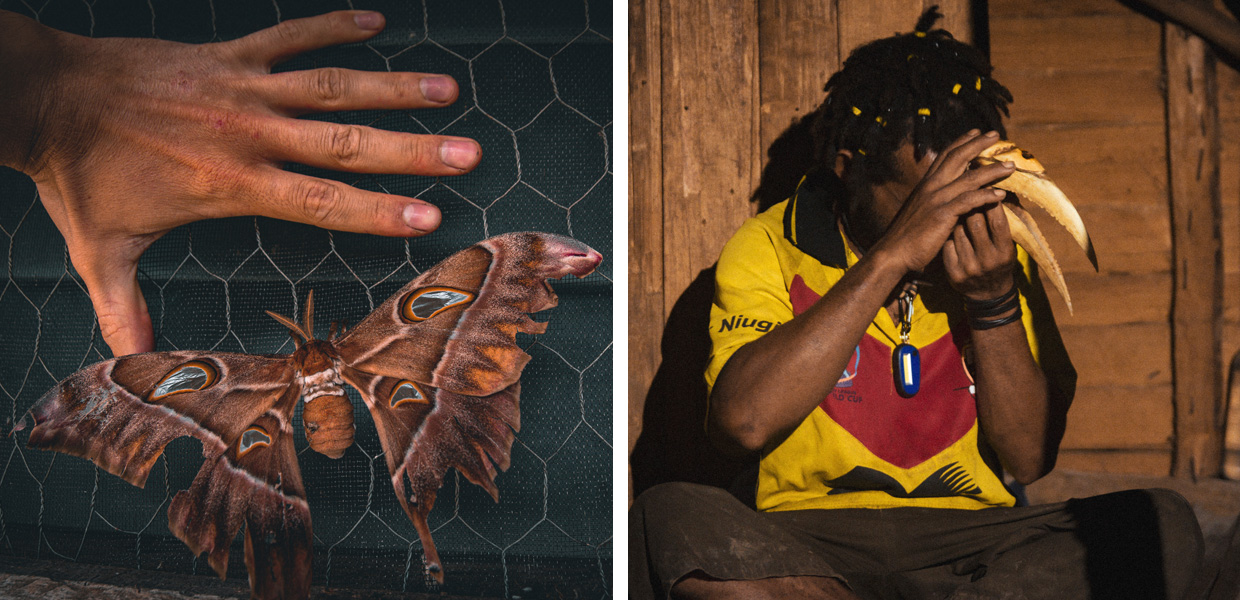
Rambo taught me that the natnat bug is a great earbud replacement – once inserted into the human ear it feeds on wax only to drop out when its job is done. I taught Kevin a figure-of-eight knot. Karolina taught Rambo about the food pyramid and the importance of balanced nutrition. Rambo taught her that a jungle shower is best taken by lying fully dressed in a rushing creek, rubbing your body against flat rocks: shower and laundry in one. The dead load of four hammocks quickly dropped to the bottom of our heavy bags as we continued to strengthen our teacher-teacher relationship around the fire each night. Hammocks weren’t needed.
Towards the end of the week, we stumbled upon a clear path leading northwards. Time to retire our machetes and simply march on – a welcome respite after long days of pouring sweat. But where would that path take us? Before the expedition, Karolina and I had been convinced this forest was uninhabited by people. We based our belief on the lack of scientific research done in the area, as well as colonial maps bearing no mark of human habitation.

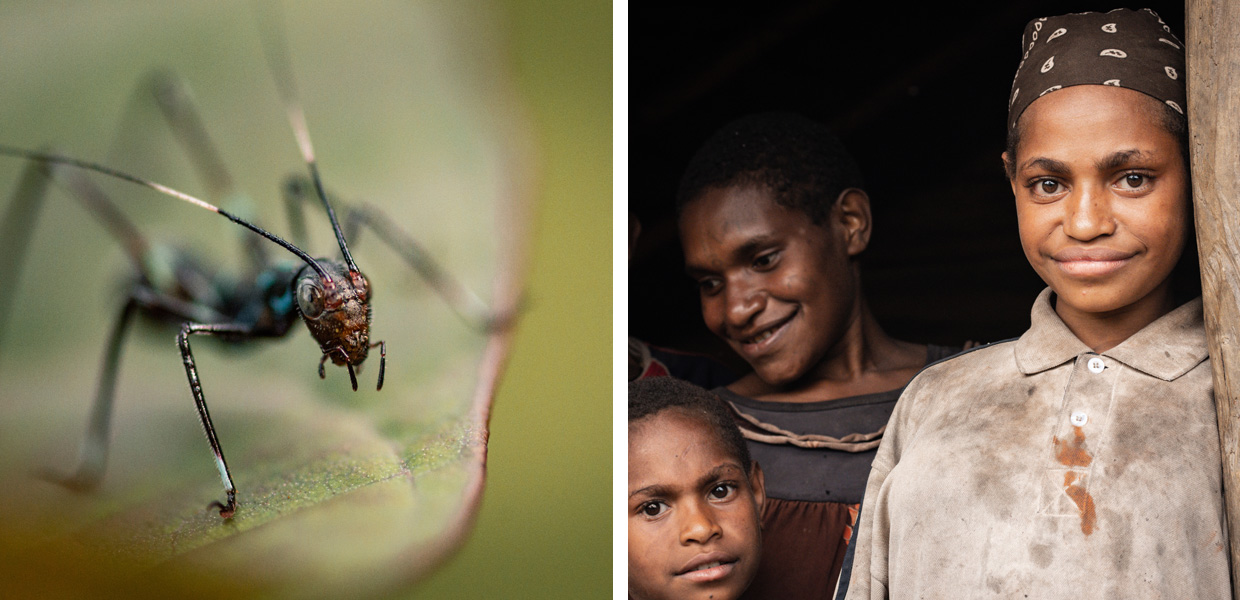
‘Look! A human footprint!’ Karolina pointed out the print in the clayish soil. Then Kevin’s response reframed my entire perception of this place: ‘I can’t wait to see their gardens! It’s a great climate for growing pumpkins.’ I felt childish then, for foolishly assuming that if Western science and decades of colonialism hadn’t recorded settlements in this forest then it must be devoid of humans.
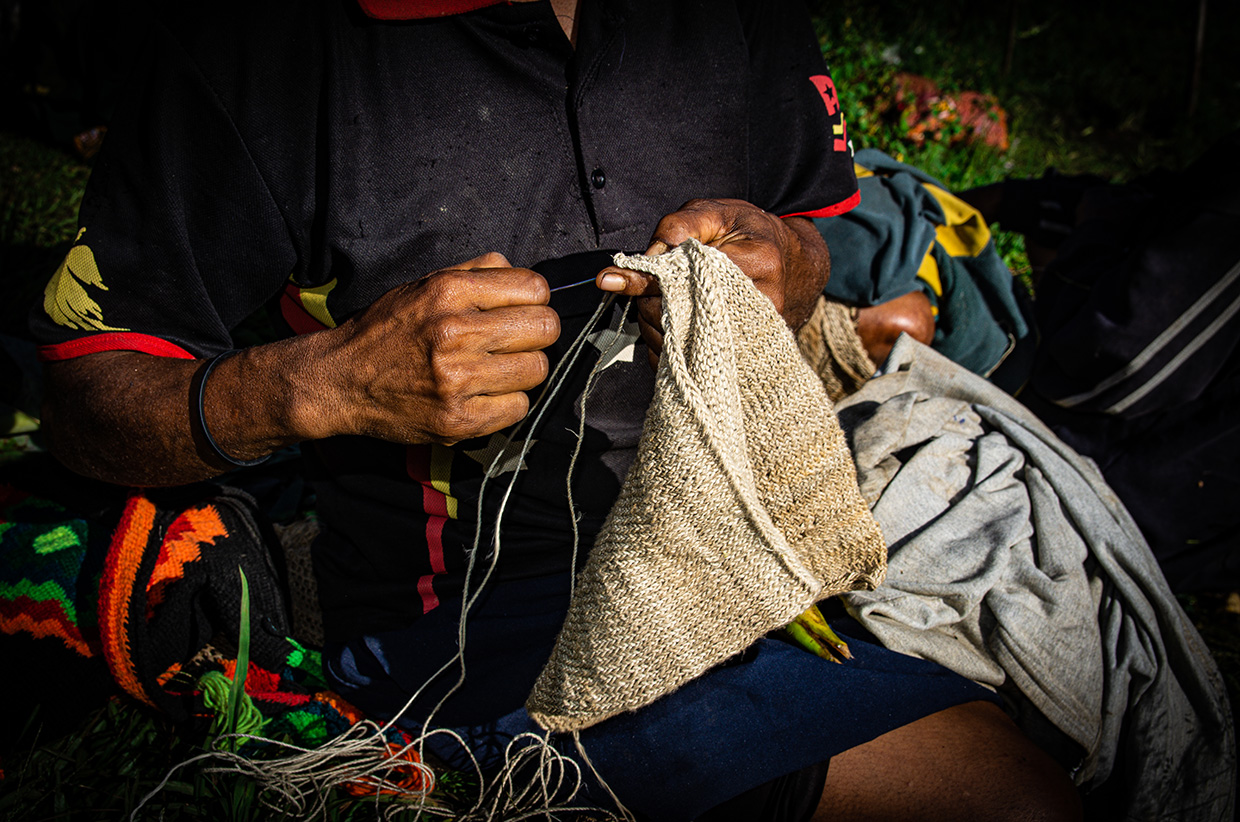
Miles later, we entered cultivated land: rows of crops, mounds of sweet potatoes, and – indeed – patches of pumpkins. Rambo spotted two elderly women working the soil, bilums (traditional tree-bark bags) hanging on their backs attached by the forehead. ‘Gud moning, tupela!’ Rambo shouted merrily in Tok Pisin, the language which unites the nation. We approached the ladies, offering help in carrying the crops to the village.
On the way, we passed a round clearing that sparked our curiosity. ‘Why did you clear the ground like this?’ Kevin enquired. The ladies replied, ‘Not us. Chinese people. They come in a chopper looking for rich. They say bigpela oil under our village. They offer some money.’
We were all awestruck that afternoon. First, by the warm welcome of the Aedro community, who greeted us with fire-cooked pumpkins, realising Kevin’s deepest cravings. Second, by the fact that foreign mining companies are fishing for riches in those secluded pockets of our planet where exploration is unregulated, where taking advantage of local communities is their ticket to meeting their goals.
But how, I asked myself, is that different from our actions? We also turned up uninvited, lured by the same land. Yes, the motives might differ, but this community would be just fine with none of us paying a visit. Examining my own motives more deeply, I realised that we needed more time – to find answers, to justify our presence.
***
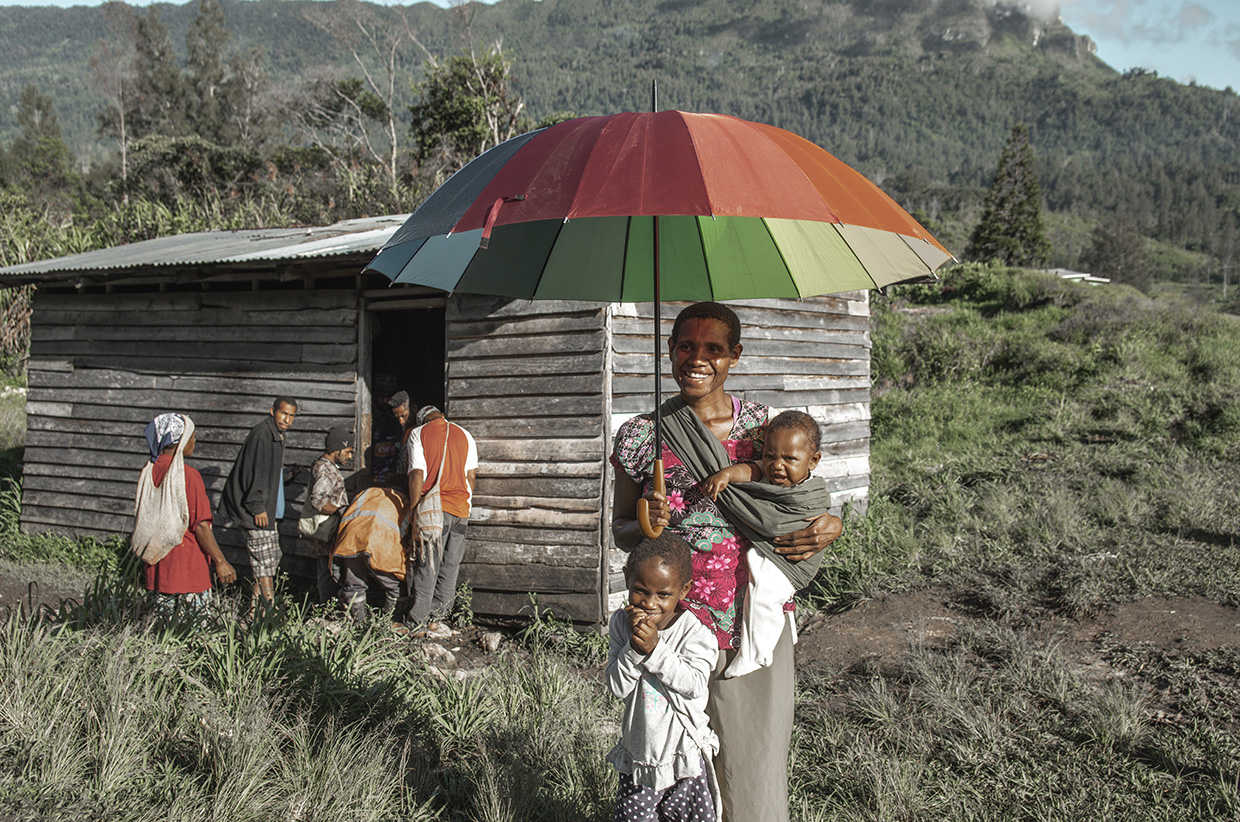
I never thought of an umbrella as a man’s best companion in the rainforest. Kevin moved up the steep pathless terrain holding his umbrella as if hoping to be blown off the ridge Marry Poppins style. Wet and slippery exposed roots underfoot forced me to pull myself upwards through the trees. ‘I can see the hunters’ hut,’ Kevin shouted from above.
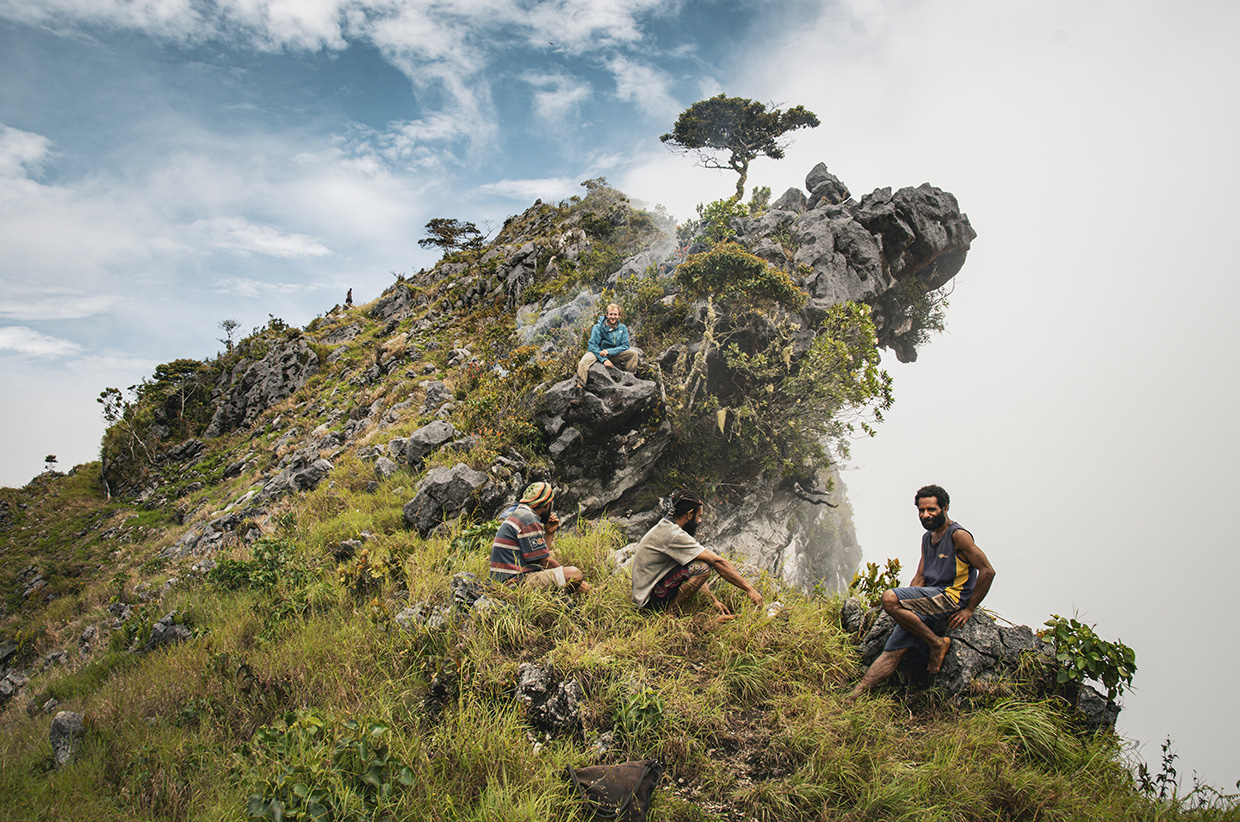
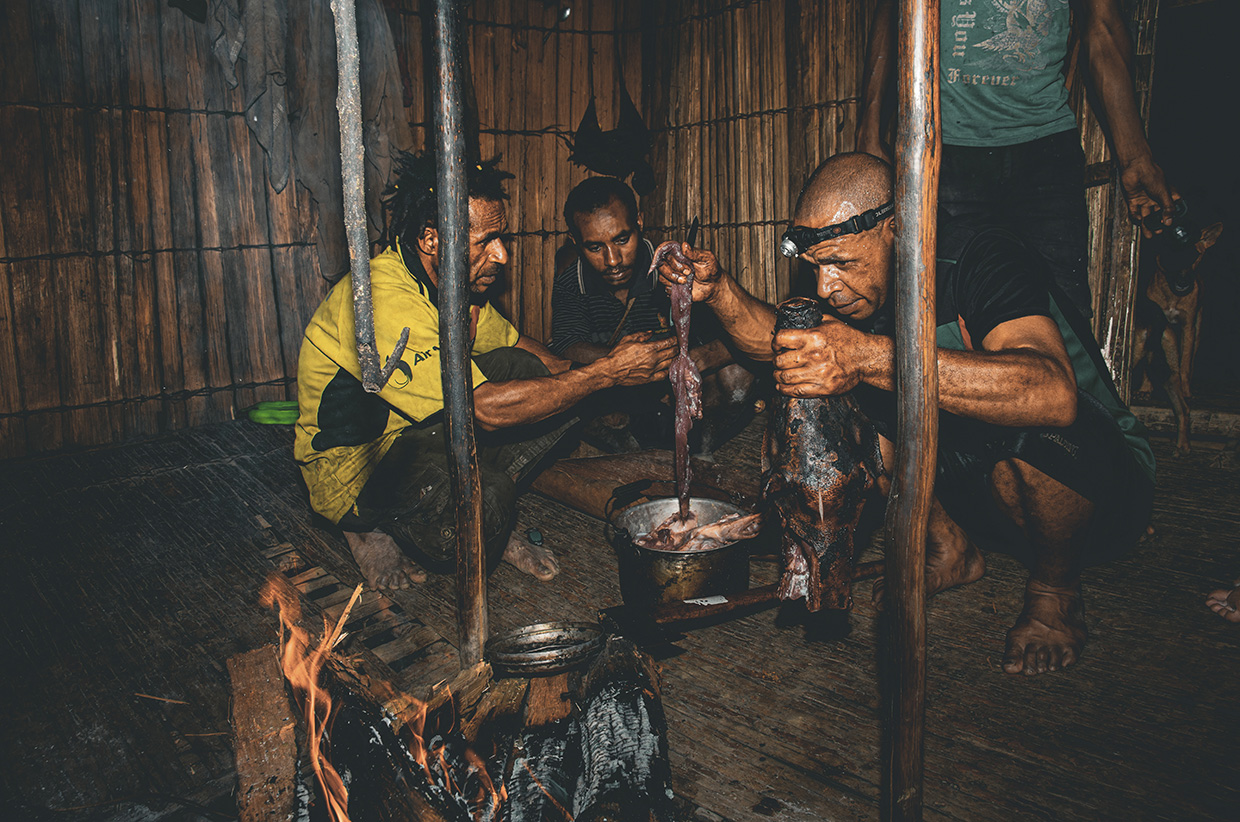
Fast-forward a few hours and we were all in the hut: me, Karolina, Kevin, Rambo, 12 hunters, and Chief Morten. Crammed around the crackling fire in a room no bigger than an ice-cream truck, we awaited our treat. The chief had trapped a cassowary, which was now cooking underground, buried beneath a layer of hot stones and banana leaves. As we looked out through the tiny, glassless window, mountain shapes revealed themselves through post-storm clouds. The Blucher Range.
Three weeks into the trip we followed Morten and his band along a muddy ridgeline to their village. To the east, the distant River Strickland snaked through an evergreen canyon. To the west, limestone crags guarded the densely populated Victor Emmanuel Mountains, and right before sunset the forest suddenly opened up into a massive clearing in front of us. Karolina took the pause as an opportunity to remove her shoes, wincing; I saw detached toenails bathed in blood. ‘It looks like the makeshift airport,’ she said. Kevin replied, ‘It is an airport. Just not ready yet. We rest here until you’re good to go again.’ Dozens of villagers escorted us to our home for the night. We had made it to Yasep.
Every Monday, all 500 inhabitants of Yasep gathered at dawn with pickaxes and shovels to build another inch of the airstrip. And the next morning we joined them to help. ‘Until we finish,’ Chief Morten explained as we worked, ‘Yasep remains isolated from the rest of Papua New Guinea. The nearest shop is two weeks’ walk away. So is the nearest school and aid post.’ I asked, ‘How long do you reckon till the first bush pilot lands here?’ My question created a pause, giving us time to shift another bag of dirt. Morten shrugged. ‘We started five years ago. We’re halfway finished. So another five years. Maybe a bit longer.’

We left Yasep loaded with bags of sweet potatoes. Our rations were nearly gone and from this point we had to rely on village produce. Jungle paths became wider and clearer – a combination of increasing connectivity with the highlands and thinner vegetation in the cloud forest. Rumour has it that Yasep played a monthly football match against villagers of Sengen, two communities bridged by a 20-mile jungle slog.
We took a rest at a viewpoint overlooking the faraway Fly Gorge. Rambo’s eyes turned watery as he peered through my binoculars. ‘I can see Baktamin village. Once I nearly married a girl from Baktamin. She gave me this necklace.’ He grabbed a string of wild boar’s teeth adorning his neck. ‘Why didn’t you marry?’ Karolina asked while peeling fire-cooked potatoes. Rambo’s dreamy eyes shed a slow-flowing tear. ‘I couldn’t afford the bride price. Her father asked me for 100,000 Kina [$25,000].’
By reaching Sengen we left the Blucher Range behind. The altimeter read 2,400m and we were officially in Victor Emmanuel Range. Pineapples replaced papayas and taro replaced sago pancakes. Villagers welcomed us in their guesthouse and watched as we changed our wet-sweat-smelly day clothes into dry-smoke-smelly night clothes. Chief Alexander came in and started the fire, which always takes centre stage in all PNG houses. ‘Would you like to buy a pig?’ he asked casually. The room went silent, like a movie scene when a villain enters a rowdy bar. Rambo and Kevin gave me the look. Karolina sent me a gentle nod. Dozens of children held their breath for my response. Many firsts happened for us during this journey, but I never thought buying a pig would be one of them. ‘Of course I’ll buy it. Let’s cook it your way. Let’s make a mumu tonight.’ The room went loud and merry again. In Papua New Guinea you never say no to a pig.
***
Peering down through the bush plane window we could see how far we had come: 250km through the jungle. ‘I loved this journey, one hundred per cent,’ Kevin summarised while Rambo searched for Baktamin in the sea of forest below.

The physical journey, although difficult at times, was only a tangible confrontation of our egos. ‘We did well,’ Karolina said, patting me on the back. ‘Did we, though? What good came out of all this?’ I replied, mood sombre. ‘Are you kidding? Look at yourself. You haven’t asked yourself that question before. And from now on you will.’
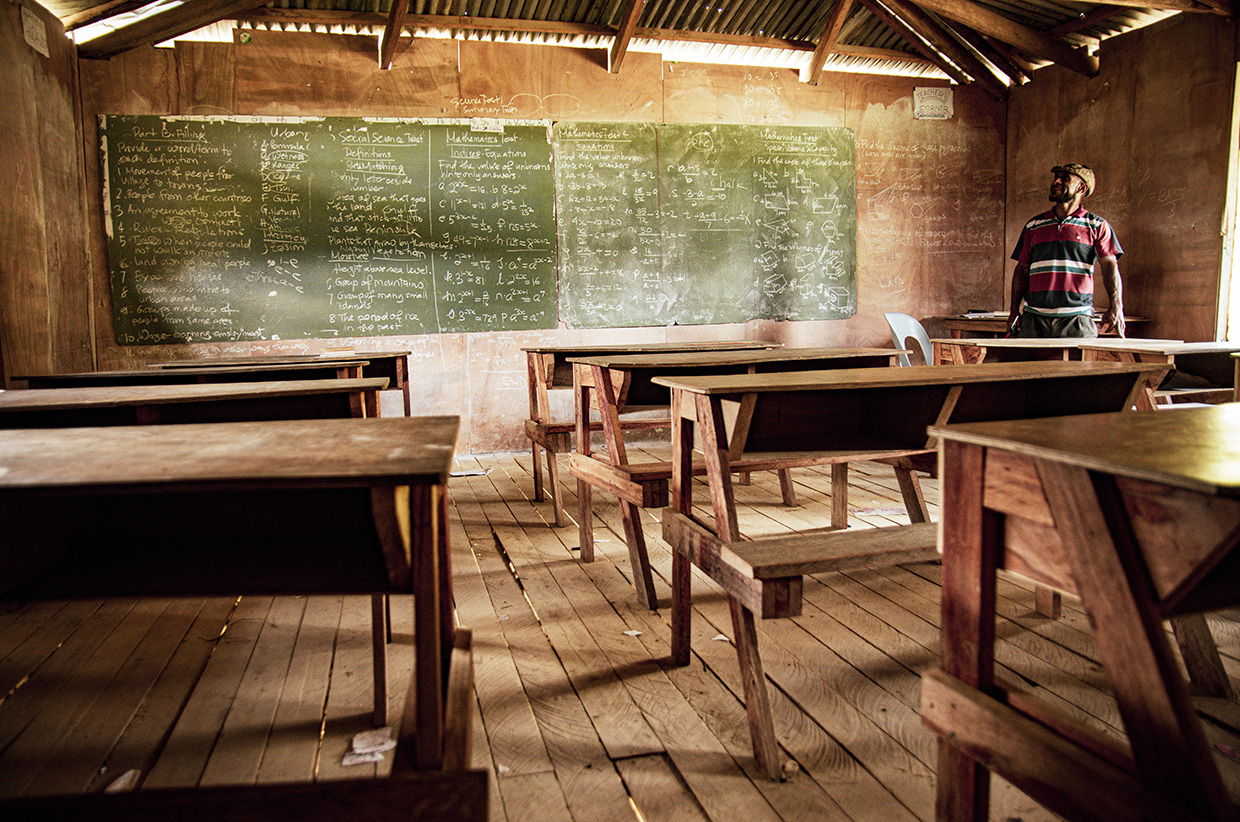
I undertook this journey motivated by a personal exploration quest, only to understand how trivial and selfish such pursuits are without extra depth. But in the end Karolina was right. Hours of knowledge were passed to us from the villagers who call this forest home, just as we helped them to know their worth. Not in terms of playing God or setting ourselves above them, but helping to make them ready for those mining visits and road threats. To raise questions, to ask for more, to lead and take ownership, to plan for their future, to value education, and to make informed choices. It was after our visit that Aedro appointed a representative who registered their village in Kiunga and asked for government help in future development – including establishment of a school. The journey took him a month. In the future, it might take him an hour.
The very existence of many Western Province communities hangs by a thread. The forest is under constant pressure from loggers. Villagers get regular visits from mining companies. In a country where the last say over land claims always belongs to locals, should they give in to the prospects of development or should they protect their world – where peace abounds and food is plenty? Having witnessed Yasep villagers build an airstrip with rudimentary tools, the urge of the locals becomes clearer. Seeing Kevin scrambling in the rain over muddy ridges with an umbrella, I could already see that development cannot be denied. But that umbrella acts as a wider metaphor, because for centuries the forests of the Blucher Range did for its people what an umbrella is meant to do: shield from storms and protect against external interference.
Fast-forward to 2024. A road has been built across the neighbouring Star Mountains, cutting right across one of the last strongholds of undiscovered species on Earth. Yet the villagers of Yasep have also made real progress – half a mile of runway visible on satellite images. One thing helped me come to peace with what is happening. The chief of Yasep asked me a favour during our farewell, handing me a bilum: ‘Go back to your world and let your people know that my people exist. Tell them everyone is welcome here any time.’