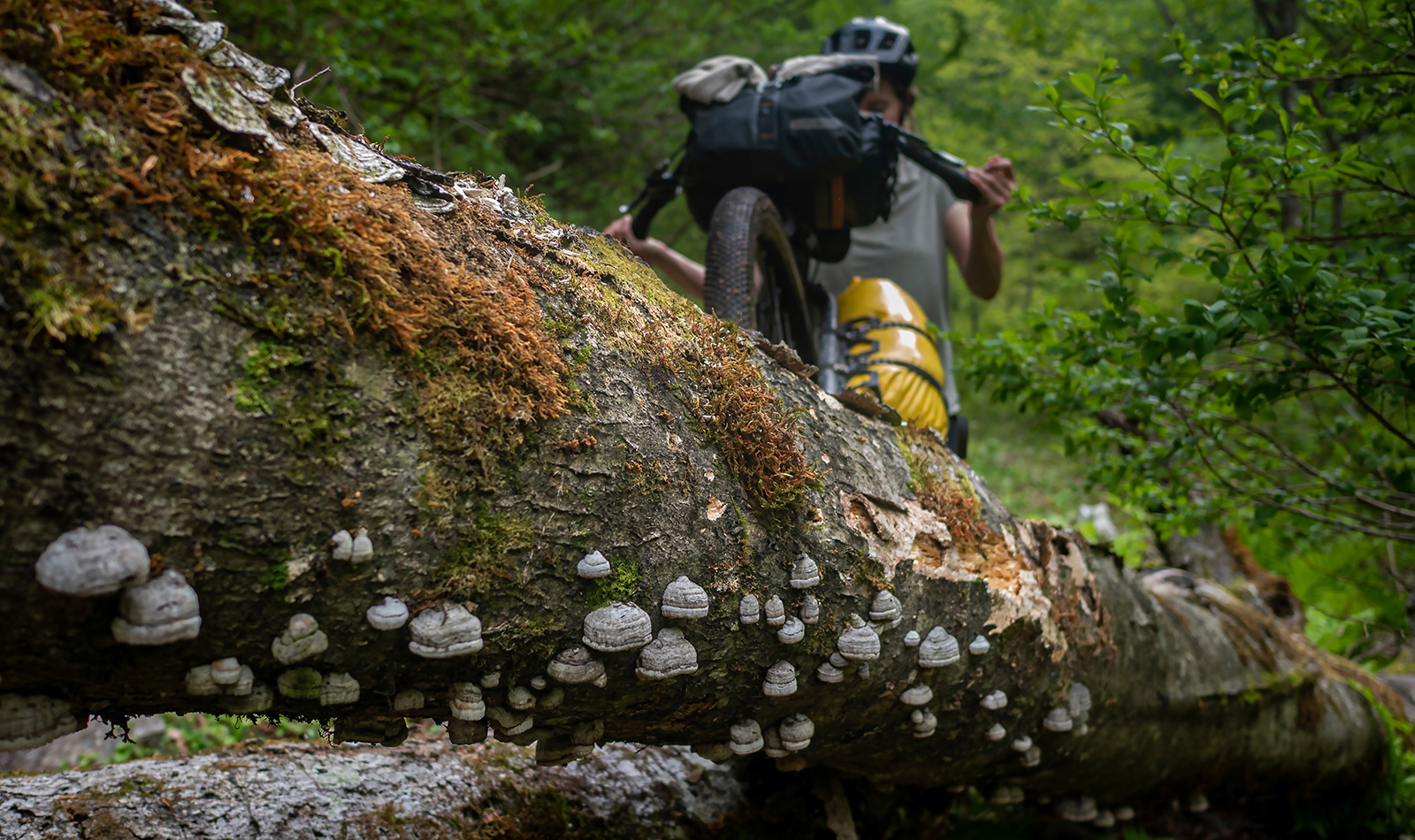
Japan’s Forgotten Roads
Bikepacking along Japan's Rindo: forgotten forest roads
Words & Photography by Hans De Neve
Another blocked road. The gate, bright red and reinforced with pointy black rebars, reminds me of an ancient fortified castle abandoned in the wilderness. Still out of breath from the climb, Silke and I look at each other and smile. Her cheeks are glowing from the effort, and her braid clings to a thin layer of sweat on her neck. As she wipes the sweat from her face, she chuckles, ‘Of course there had to be a gate right on top of the pass!’
林道 Rindo (‘forest road, old mountain pass road’)
We dismount our bicycles and reassess the route. It’s a mere 10km to where we link up to a major road, and all downhill. So we decide to take the gamble – this is not the first closed road we’ve dealt with on the trip. A lower section in the gate is clearly used for pedestrians, probably local workers or hunters. Silke swiftly climbs across, and I lift the bikes over the gate. Then we hop back on our bikes and start the descent.
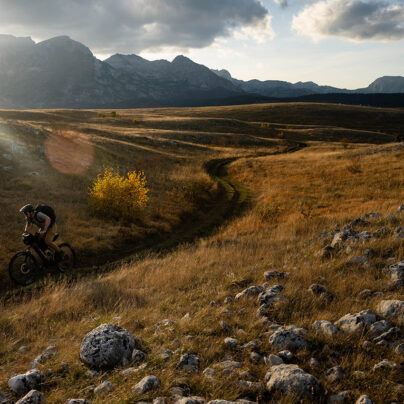
At first the gravel feels smooth, and we make quick progress zigzagging down the mountainside through the dense forest. I stop a couple of times to take pictures of Silke speeding down the curved roads. These pauses are also opportunities to soak in the environment. Take away the grinding and crunching of our tyres and there’s utter silence. But after a while, I start noticing it’s not silent at all; birds are singing their songs, bugs and insects squirming their way through the fallen pine needles on the ground, treetops dancing on the rhythm of the whistling wind.
Then I hear Silke yelling: ‘Hey! Bear!’
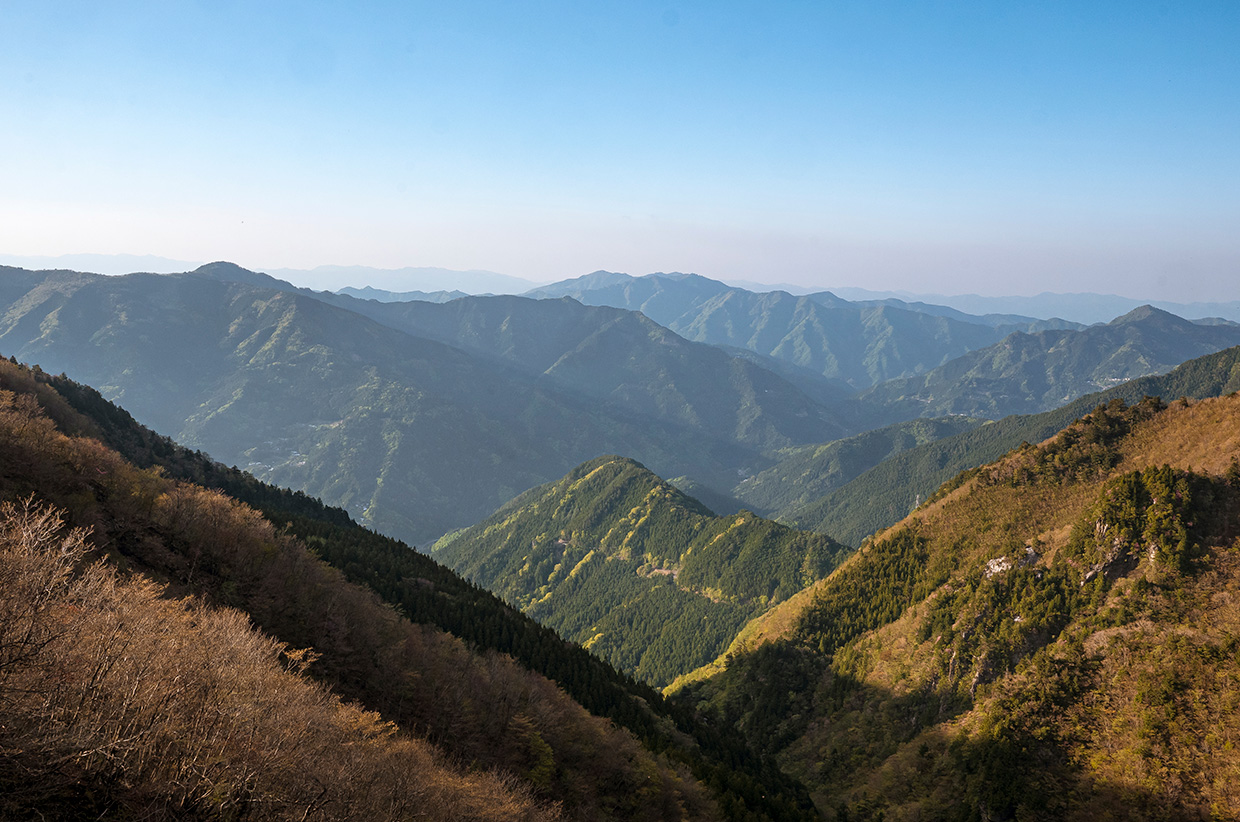

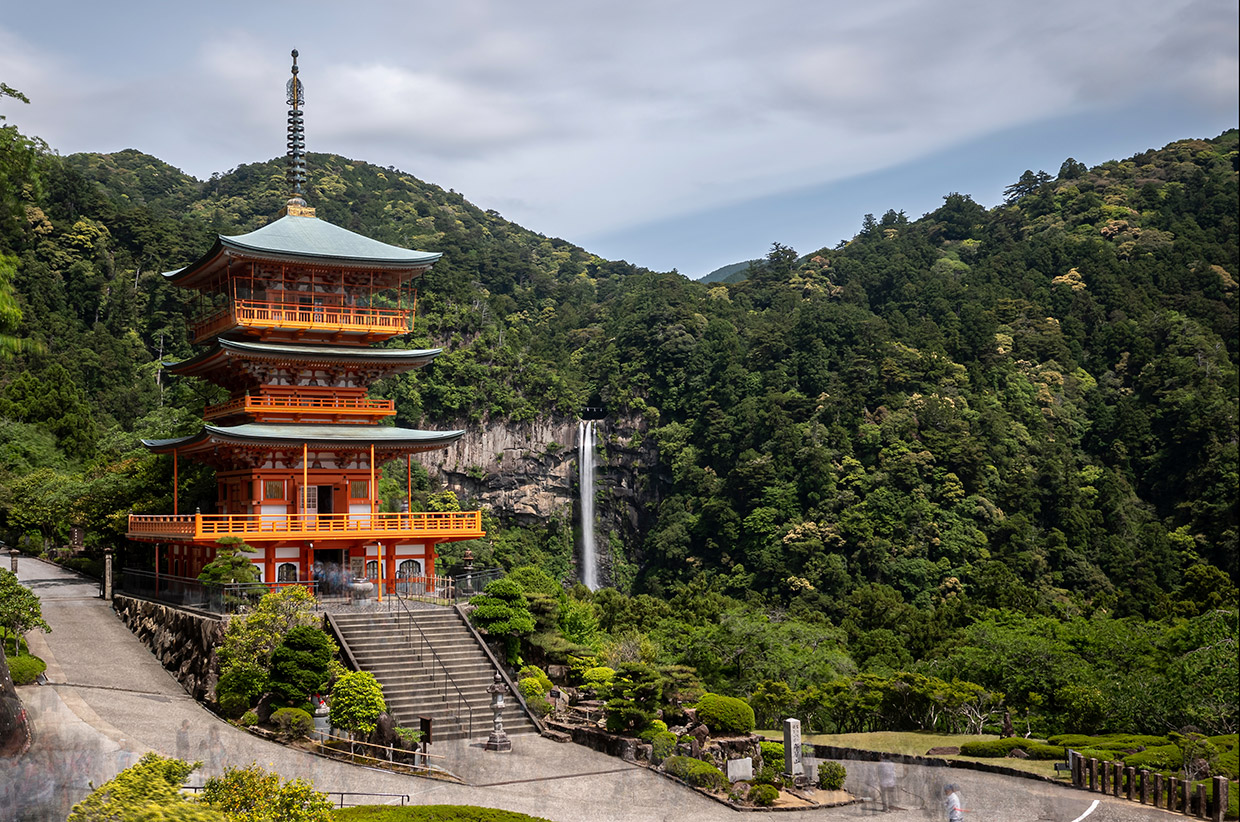
Japan always had an atypical allure for us. As outdoor enthusiasts, we will usually be biking remote landscapes, scaling glaciated peaks, seeking solitude altogether. But this is not something one expects to find in Japan, home to 126 million people and the most populous metropolitan area in the world.
Fresh off a long journey through the Andes, we were ready for a new adventure – one that posed the perfect fusion of exploring challenging trails and connecting with a new culture. The idea of exploring Japan’s lesser-known wild spaces intrigued us; how could such a densely populated country, known for its futuristic megacities and high-speed bullet trains, also boast unspoilt wild places? We envisioned a route connecting the modernity of bustling cities with a very different way of life in the countryside.
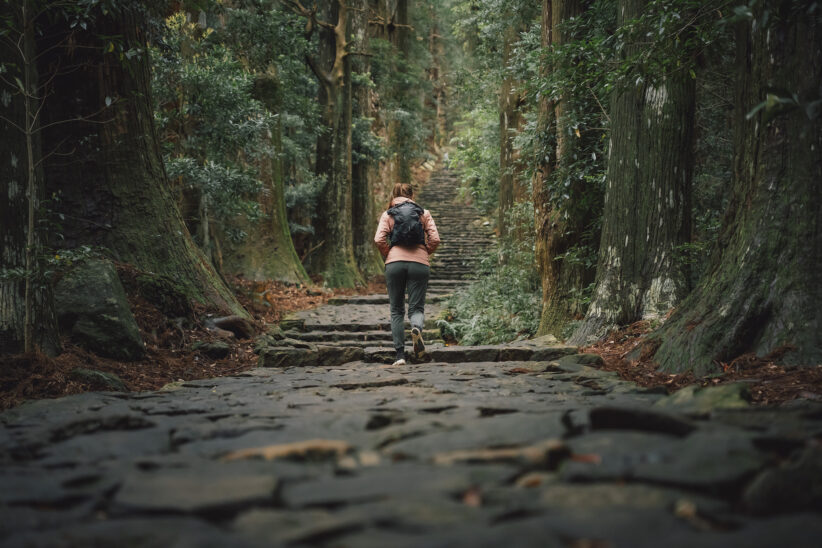
Historically, Japan’s rugged mountainous terrain posed many challenges, making roads difficult to maintain and often isolating villages in the winter. Over the centuries, extensive government initiatives were undertaken to construct new, safer routes through the mountains, involving the construction of major highways and tunnels. When researching and plotting a route across Japan, it didn’t take long for us to stumble on the concept of Rindo roads. These older routes, either closed to vehicular traffic or transformed into forested pathways, gradually faded into obscurity.
The more we read about these car-free roads, surrounded by nature and wildlife, the more excited we got. A bikepacking trip along these weathered routes promised an exhilarating trip through Japan’s heritage.
***
I huddle back in the saddle and quickly navigate the upcoming curve. I see Silke pointing and shouting at something fleeing up the mountainside – a big black spot the size of a small boulder. We know that Japan is home to the Japanese black bear and the Ussuri brown bear, and that they are often spotted on abandoned roads like these. Soon the animal is out of sight.
‘Maybe it’s just a mountain serow,’ I say uncertainly, and Silke looks doubtful, but we convince ourselves to put our minds at rest.
The descent grows steeper, the road narrower. The forest has reclaimed much of the path, but every now and then a clear stretch of road emerges, pulling us deeper into the mountains.

We swiftly navigate a landslide, only needing to carry the bicycles for a short distance before the road reappears on the opposite side. Silke spots a parked car in the distance, covered by blue canvas to safeguard it from the elements. ‘I guess this means the road will be clear of landslides from now on,’ she says. ‘So we should make it to town before dark.’ It’s about 20km away. We’re both longing for some fresh food and a dip in the local hot springs.
Without us really noticing it the gravel road turns into double track, then singletrack.
Intoxicated by the idea that we have already overcome the major obstacles, we push deeper into the forest. The valley walls steepen, the bush grows thick again, and fallen trees block our path. Suddenly, out of nowhere, we come across a second landslide – smaller than the first, but the surrounding terrain is far more imposing. Huge boulders cover our path as the disintegrating valley wall towers vertically above us. Looking far below to the churning river, we see fragments of old tarmac scattered amongst the rocks.
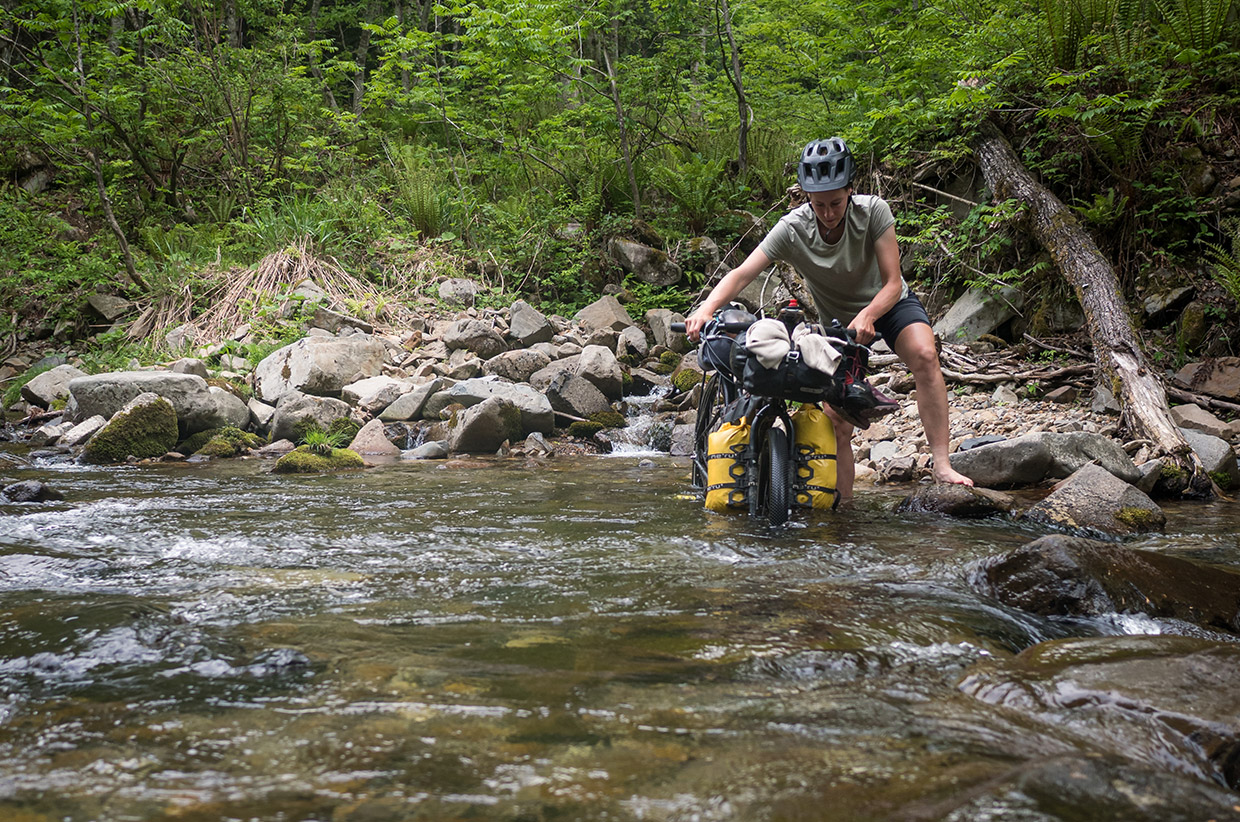
I manage to scramble to a higher vantage point, hands dirty and scratched from clawing at the loose gravel. I scan the area, breathing heavily, trying to find a way forward. There seems to be no way across this shifting sea of smashed rock – but perhaps if we can get down to the river we can rejoin the trail. ‘I can see the road!’ I yell to Silke, metres below. ‘But I think we need to cross the river to get there…’
Silke looks up at me with a familiar expression, eyes filled with uncertainty and doubt. ‘It looks deep…’ she says, but I reply calmly, trying to reassure her. ‘It’s about 20m below us, but I am sure we can make it.’ After many tough moments, we know exactly what we’re capable of together. And as usual we don’t need a discussion to decide to push on. Small gestures, vocal tone, and our general vibe are more than enough to determine whether we should continue. We actually have one simple principle: if one of us expresses true discomfort, we turn back no matter what. We can talk about the situation later, when safe; there’s no point doing that in the moment.
As we manoeuvre our bikes down the steep slope one by one, I silently hope this will be the last challenging section. We were prepared for hard work while exploring Japan’s back roads, but this is undeniably one of the toughest moments.
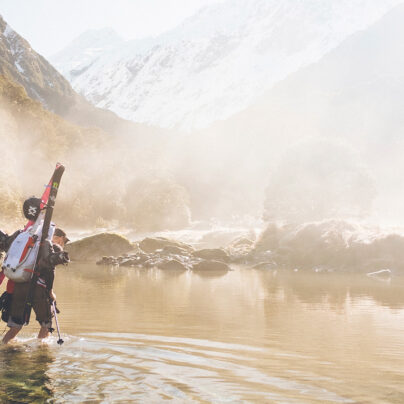
We carefully wade the river’s cold water and follow its bank on the other side for about 100m before crossing again, where I spotted the road earlier. Together we push our bikes up the final slope, thick vegetation scraping and scoring our legs. But there it is: the road!
カムイ ミンタラ Kamui Mintara (‘playground of the gods’)
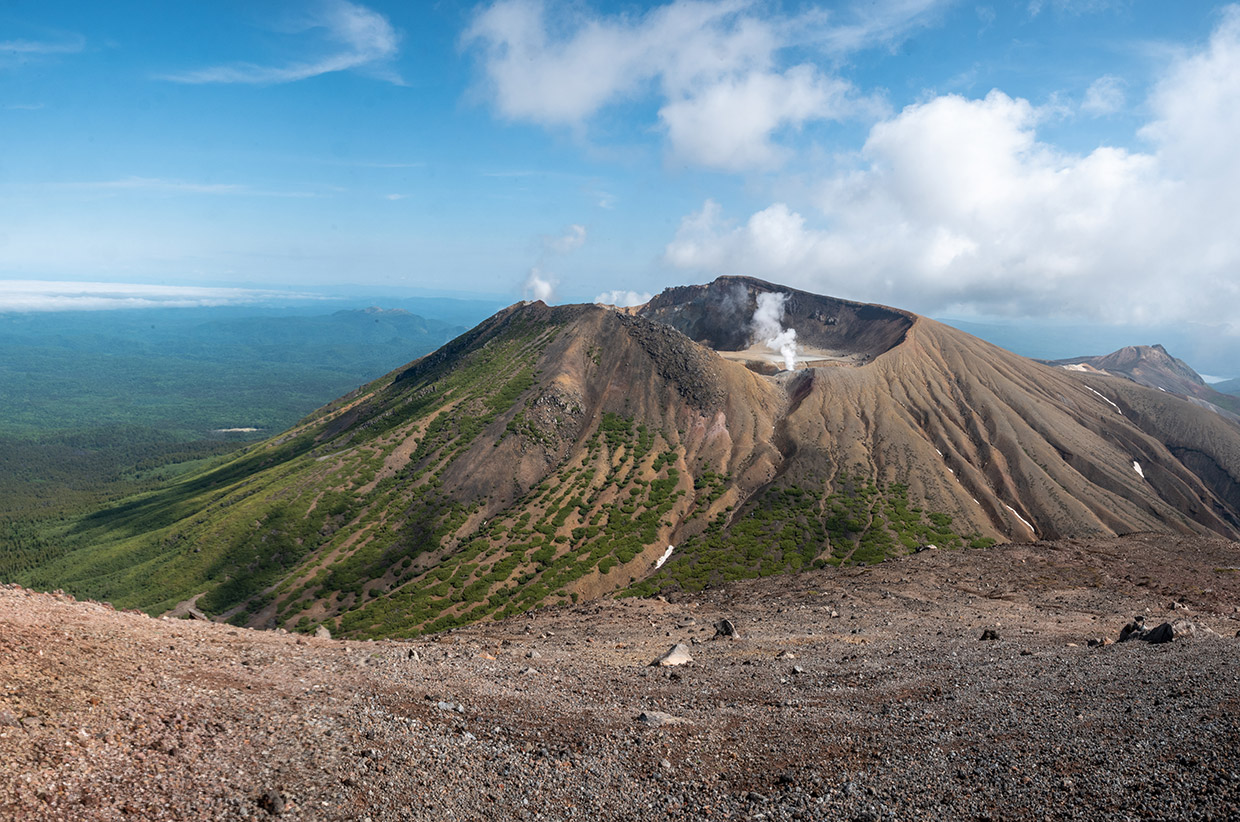
Hokkaido, Japan’s second largest and northernmost island, is home to rugged volcanoes, pristine mountain lakes, and expansive forests. The urban sprawl has had less effect compared to the other islands, and many Japanese travel or relocate there to find solitude. This is also what initially drew us there, but the ice cream is really good too!
Nipesotsu-yama (ニペソツ山, ‘place with many shinanoki trees’) stands as one of the few peaks in Hokkaido surpassing 2,000m, situated in a secluded eastern corridor of the Daisetsuzan massif. The legend goes that Kyūya Fukada, author of the 100 Famous Japanese Mountains, reportedly felt remorse for omitting Nipesotsu-yama. Reading ‘one cannot be considered a true Hokkaido climber until you’ve tackled Nipesotsu’ inspired us even more.
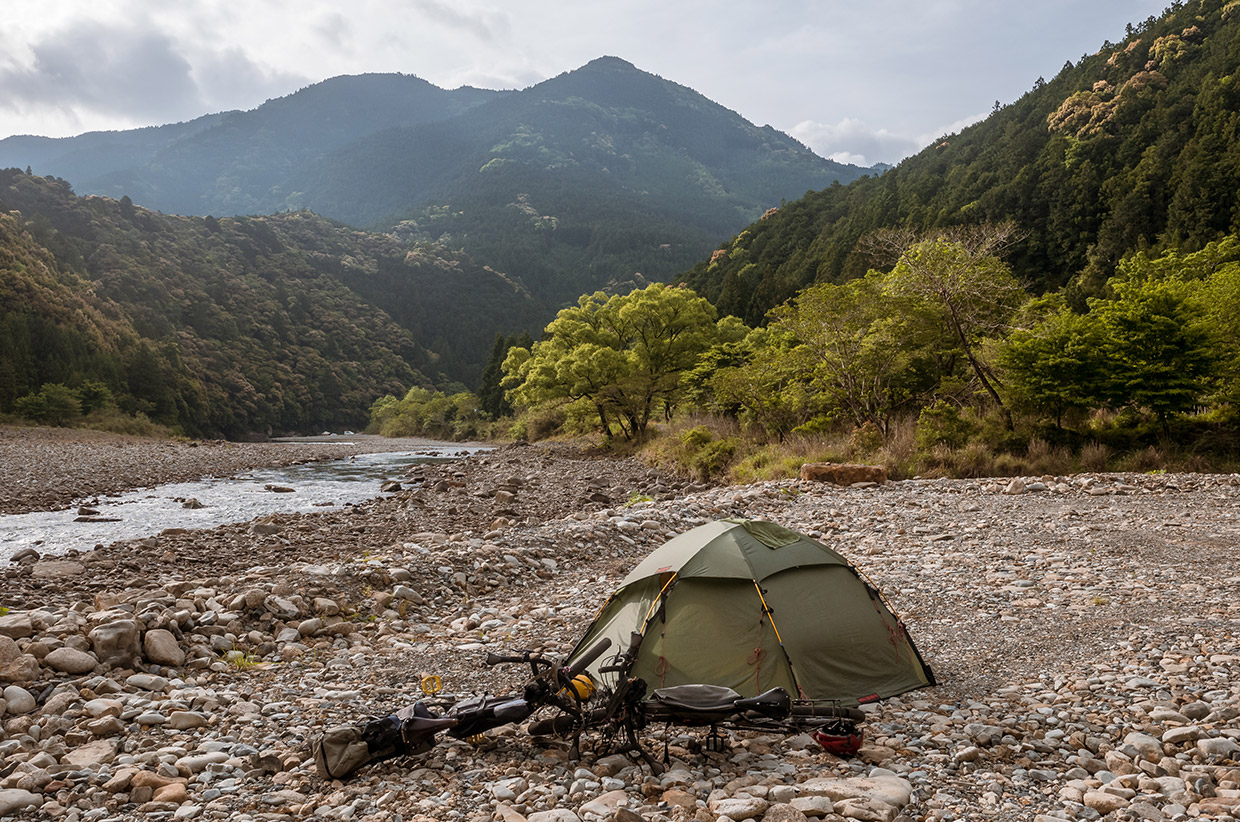
The trailhead is a small clearing in the woods with room for a handful of cars. A ranger had warned us about bear activity in the area, so we anxiously pitch our tent right in the middle, fortifying our campsite with a barrier of fallen branches. ‘At least we’ll hear the bear approaching now…’ we say to each other as we snuggle into our sleeping bags.
***
We wake up to the buzz of the alarm for a second time. ‘One more… one more time…’ Silke mumbles as she turns in her sleeping bag. Despite the early hour, the summer sun is already rising. Its virgin rays pierce the dense forest canopy, casting dancing shadows on our tent’s flysheet. Animals emerge to embrace its light and warmth. The forest stirs to life, and so do we, preparing our bags for the long day ahead. The round trip is approximately 26km with an elevation gain of about 1,800m, and we anticipate it will take us 10 to 12 hours to complete.
For the first few hours we rise steadily through the forest on a clear trail, while shouting the occasional ‘Hey! Bear!’ We spot groups of sika deer elegantly leaping over fallen trees, and a red fox searching for its first meal of the day. Trekking through woodland during the early hours, observing the vibrant life of all its inhabitants, feels like a special privilege.
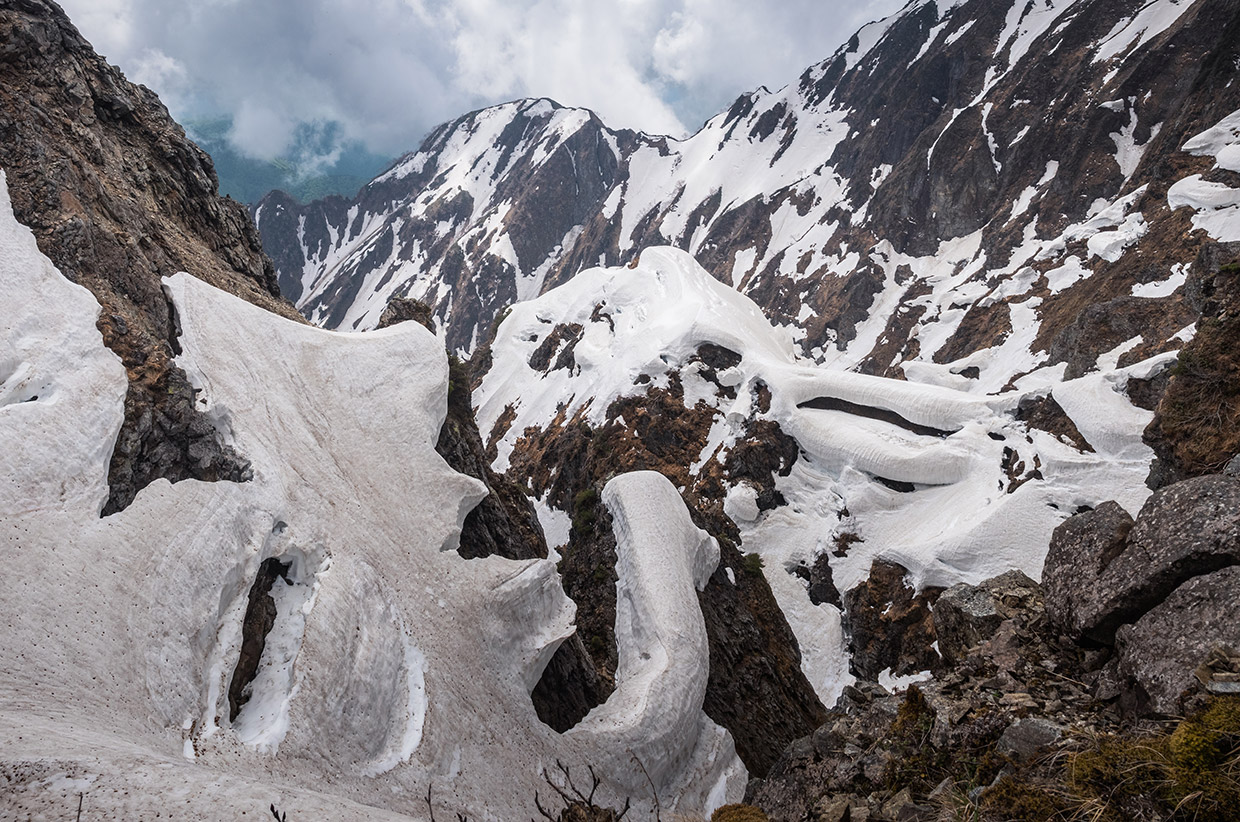
After some time, we emerge onto Shakunage Ridge, where the first glimpse of Nipesotsu-yama unfolds upon us. While its summit remains obscured by clouds, the snow-draped black cliffs tower majestically above the forested valley below. Pressing higher above the treeline, the ridge narrows and the snow patches grow bigger. I’m relieved that we’ve packed microspikes for this section.
Soaring trees give way to short, stubby shrubs nestled among rocky outcrops. It resembles a landscape we’re familiar with in Northern Europe, but it’s not what we had envisioned for Japan. Chipmunk-like creatures leap from boulder to boulder while we traverse the jagged ridgeline. As we reach the summit, clearing clouds finally unveil the vast expanse of the mountains surrounding us. In Hokkaido’s native Ainu language, the Daisetsuzan are commonly known as Kamui Mintara, or ‘the playground of the gods’. It’s easy to comprehend why, as the snow-capped peaks emerging from the sea of forest below make us feel humble and insignificant.
‘Climb Mt. Fuji, and you’ll speak of the height of mountains.
Climb Daisetsuzan, and you’ll speak of the vastness of mountains.’
—Keigetsu Omachi, 1921
温泉 Onsen (‘hot spring’)
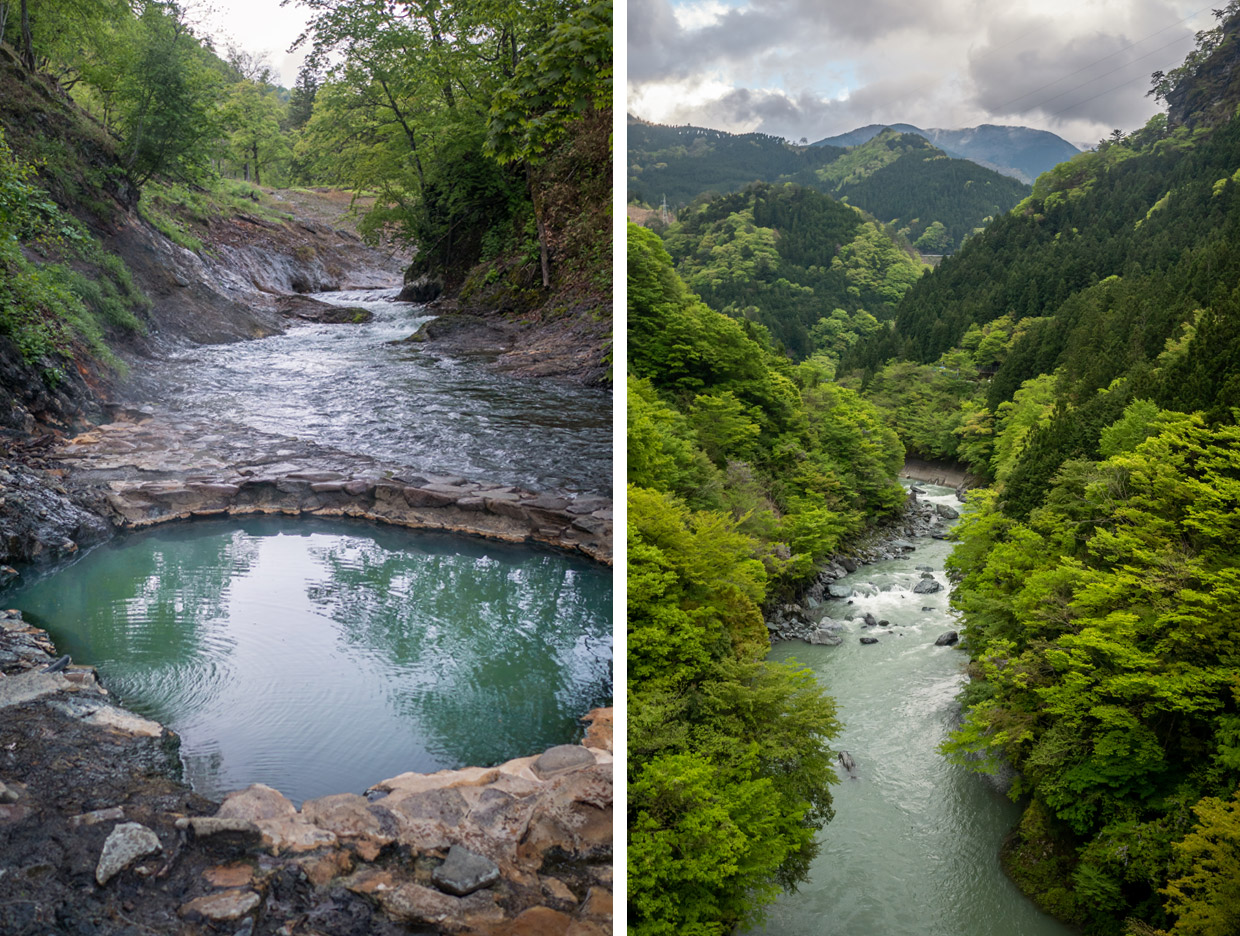
After days in the mountains, we yearn for rest and relaxation. Horoka Onsen, deep in the forest, feels like the perfect pinnacle to our trip. The weathered building and its serene surroundings mirror the ancient Rindo and forgotten trails we have been exploring; places where time stands still, offering a sublime and simple beauty for those willing to put in the effort.
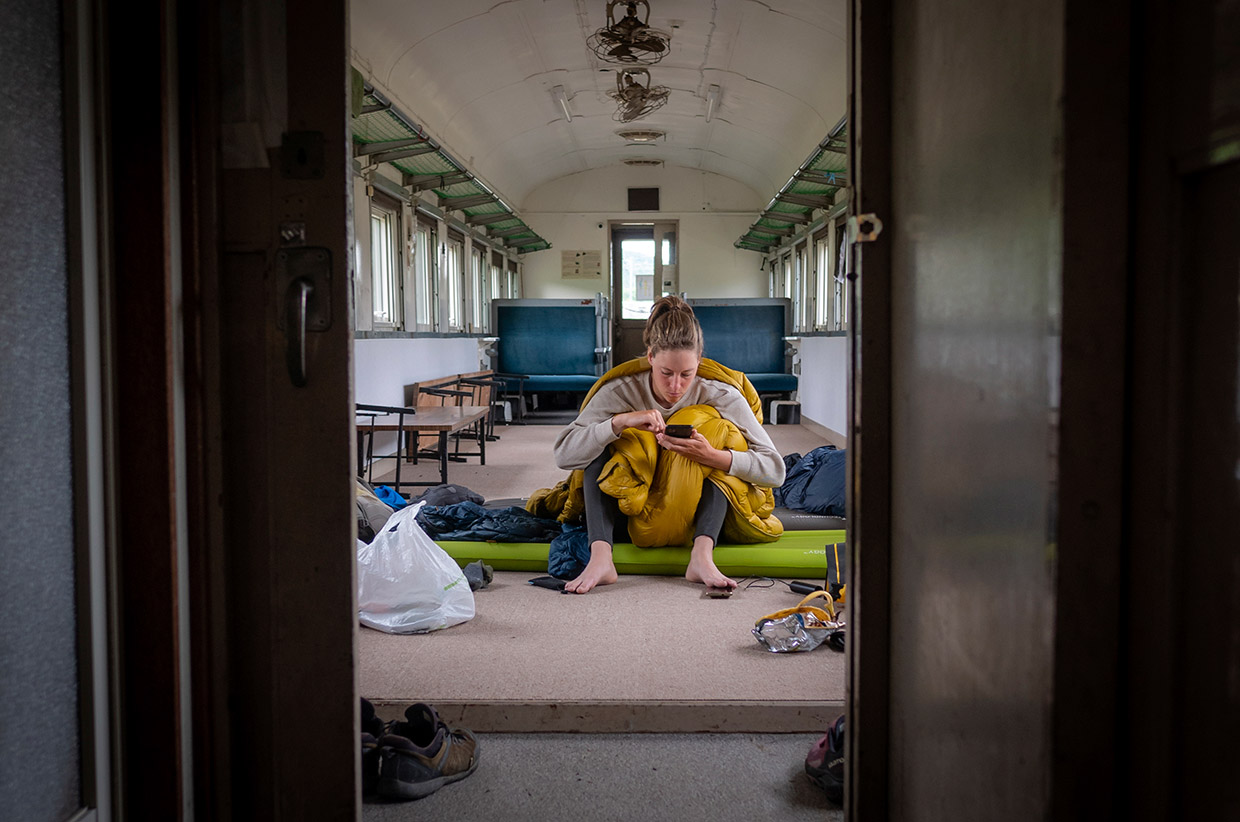
After shedding wet jackets and muddy shoes, we enter to a warm welcome from the young Japanese couple managing the hot spring inn. Our limited Japanese makes communication challenging, but we’ve learnt over the years that connecting with people transcends language barriers. The ground floor opens up as an extensive tatami room (named for the woven mats covering the floor) with shoji walls dissecting the dark wooden sideboards. Despite unmistakable signs that time has taken its toll, we experience a sense of comfort and genuine hospitality.
The man gestures us to follow him upstairs, guiding us to our room. Like a traditional ryokan, the space lacks any furniture or beds – only a small table adorns the centre. Without Wi-Fi, television, or phone signal, the room offers its visitors a retreat from modern distractions to engage in relaxation, conversation, and drinking tea. After enjoying some tea ourselves and devouring the remainder of our snacks, we are excited to check out the baths.
The facilities are rather simple – no pre-bath showers, just a couple of metals buckets next to the warm water inlets. The worn concrete floor and aged wooded walls emphasise the passage of time. Mineral-rich waters work their magic, soothing our aching muscles and washing away the fatigue of the day. At first, the water is uncomfortable, causing a slight burning sensation on the various wounds and cuts on our legs. However, it doesn’t take long before we succumb to its soothing and relaxing warmth. ‘This is exactly what we needed,’ we whisper to each other as we submerge our bodies even deeper.
A young man approaches and asks whether we mind him joining us. We nod and smile: ‘Of course, no problem.’ The man speaks good English, and we start talking. He reveals that he is a pilot from Tokyo, enjoying a weekend off. When we inquire about what brought him here and why he travelled so far, it’s clear that his visit holds a deeper significance beyond just bathing.‘The connection with nature,’ he explains, gesturing to the serene surroundings, ‘but also the traditional atmosphere and the quality of the mineral water. Onsens in Tokyo are lifeless concrete buildings, where the water lacks true natural mineral content.’ It becomes clear that despite our different backgrounds, we are drawn to the same fundamental need: the desire to find peace in a world that can offer little of it.
***
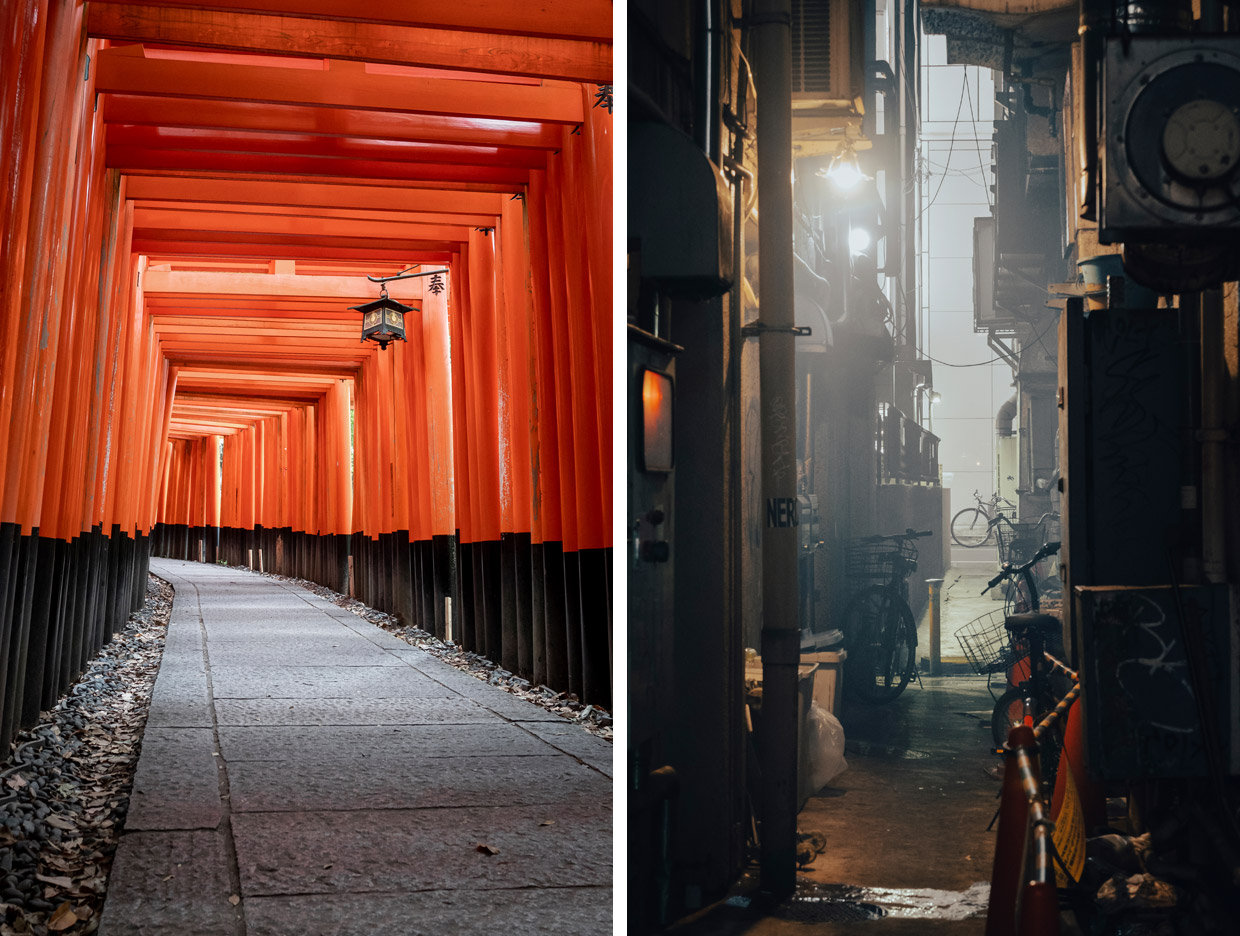
Our journey through Japan was one of many contrasts: modernity against tradition, chaos versus order, the city opposed to the wild. Yet, in these contrasts, we found a harmony that resonated with us. The roads we travelled, the mountains we climbed, and the people we met all wove together into a tapestry of experiences that will stay with us long after we’ve returned home.
First published in Sidetracked Volume 31
Words and photography by Hans De Neve // @deneve.hans