
Wild Encounters
Kayaking the Inside Passage
Words & Photography by Oli Broadhead
Nudged awake in the dark tent: ‘Bear,’ Dad whispers. A bear encounter was bound to happen sooner or later. This is sooner.
We both listen, breath held, hearts thumping, buzzing with adrenaline. There’s an angry snort. A rumbling grunt. I can hear it breathing by the tent now. There’s something about the breathing that sounds… big. Enormous. A big bear, and, by the sounds of it, not a happy one.
While the bear decides what to do with this unwelcome obstruction, we have a moment to think about how badly things could go in the next few minutes. I manage to extract one arm from my sleeping bag, fumbling for my bear spray in the dark. I flick the safety off. Remember, you don’t need to outrun the bear, you just have to outrun the person next to you, I think, wondering how fast I can wiggle away in my sleeping bag. But the bear has got bored – it gives a final grunt, then shuffles off into the night. We pull wide-eyed, open-mouthed, that-was-nuts expressions at each other in the dark.
We’d only set off three days ago. At first light, we pack the kayaks and heave them down the shingle, then cook porridge by the water’s edge so we can head off in a hurry if the bear comes back for breakfast. Ahead of us lie four months of kayaking. Sitting on the windswept shingle beach, backed by spruce trees, hemmed in by snow-capped mountains, I consider the gravity of this journey. The vast channel in front of us is Icy Strait, the northernmost link on the Inside Passage: around 1,000 miles of islands and inlets that shelter Canada’s west coast and Southeast Alaska from the brunt of the Pacific’s swell. This shelter means you can launch a kayak in almost any weather, although depending on the sea conditions you might not get very far.
A pair of bald eagles chirrup happily on their nest at the back of the beach whilst we slurp down the rest of our porridge. The water is calm, but odd currents and small whirlpools ruffle the surface. When we launch it is into blazing sunshine. Heat shimmers on the water and we’re both turning red. But I barely notice. Paddling beneath wind-whistling peaks, cruising over giant anemones and trailed by snorting sea lions, it’s utterly surreal.


This trip was a long time coming. Dad, an extremely fit sea kayaker, came up with the idea to mark his retirement. I, a reasonably fit sea kayaker, agreed. Then Covid arrived, putting the trip on hold for two years. In the third year, Dad dislocated his shoulder when a rogue wave slammed him into a rock gully whilst paddling near home in Cornwall. Then I managed to dislocate my shoulder falling off a climb. The trip was off for another year. A friend joked that the universe was obviously trying to tell us something, and that if we did finally go and a bear ate us, we’d only have ourselves to blame.
Once our shoulders were sorted, Dad got back to training. Meanwhile I moved to rural India for my partner’s PhD fieldwork, lost whatever muscles I had left, and did no training at all. And now, inevitably, I’m paying the price. Every paddle stroke is an effort, an hour is endless, and four months… well, best not to think about that.
***
A fortnight later, the weather is back at it. It’s not yet dawn, the wind is lashing our poorly repaired tent, and our kit spans the spectrum of damp to soaked. It’s not fun to put on our wet gear in the dark. After some trial and error, I manage to cook porridge with wet wood. Whitecaps are streaking offshore. We launch anyway. Breaking waves pile up as we round the first corner, and we fight them for a bit. ‘Is this stupid?’ Dad yells, and I shout back, ‘This is stupid!’ We retreat to our last camp, unpack, and go back to sleep.
The morning is cold, cold, cold. I layer on all my headgear: beanie, windproof hood, peak cap. A hat trick. The sea is calm finally, but the rain is constant. We paddle under overhanging cliffs with salmon fry huddled in its shadows and sunstars in the cracks. But the wind builds against us and I can’t force my throbbing back to keep pace any longer. ‘I’m done with this shit, I’m getting out of here!’ I yell. Dad, slowing, calls to me: ‘I’ll paddle ahead and look for a better landing. I can’t get out there…’ But I ignore him and head for the rocky shore.


I’m being irresponsible and I know it. Dad stacked it over a tree root a week back, and his already bad knee barely bends any more. Waves and wet rocks will be a serious struggle for him, but I’m infuriated at how easy Dad is finding the paddling – or how much I’m struggling with it, I can’t tell. Both, maybe. And this is some sort of stupid getting-my-own back, because I’ll be able to get out over the rocks and Dad will need my help.
He’s caught up. ‘You’re being bloody childish!’ he shouts, and he’s got a point. I’ve noticed that being out here with Dad is making me act immaturely. I snap and swear more easily. Because it doesn’t really matter how experienced I am – Dad is still Dad, and somewhere in my head that means he’s responsible and I’m irresponsible.
I calm down, and, together, we manage to lug the kit and kayaks over seaweed and shale to a dubious camp on a small saltmarsh. It rains hard through dinner, but food improves the mood. I lie awake in my sleeping bag and decide to do better.
***
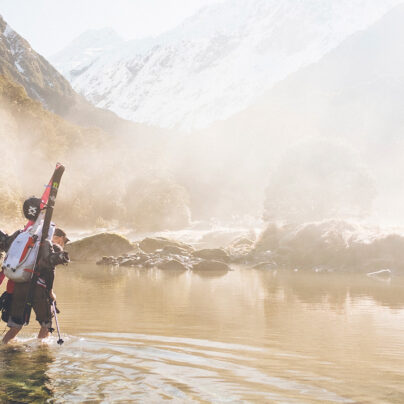
Another night, another bear sniffing at the tent. Right behind our heads this time. We sit up slowly – very slowly – in our sleeping bags, and the bear shuffles off. Today we’re hoping to cross Dry Strait, a wide sandflat deposited by the Stikine River. Yesterday’s attempt failed when strong winds slowed us to a standstill, and we even tried hauling the kayaks for a while, wading along in the shallows with the boats on towlines and neat bear prints in the mud beside us. It was fun, but it didn’t get us far, so we jumped back in the boats and got blown back out into the strait.
Today we’re up before dawn to avoid the wind. It’s dead calm and we make good progress for a bit, then get stuck on a series of shallow sandbars and have to sit around watching the tide rise. Silty water, like milky coffee, reflects the clouds. Weird currents form as the sandflats flood, so we hug the shore as we edge forward. The wind is back with whitecaps, and my upper back feels like someone’s jabbing splinters into it, but there are icebergs on the horizon. We’re nearing the entrance to LeConte Bay, home of a tidewater glacier – a glacier that calves into the sea. Soon we’re among the bergs, some as big as houses.
I’ve never kayaked with icebergs, but I know one thing: don’t get close, because they can flip at any time. Knowing this, I immediately paddle up to the first big berg we meet. The surface pops and crackles in the sunlight and the recesses glow luminous blue. The incoming tide surges around and under the iceberg, forming a choppy eddy that whips me under an overhang and out the other side.


After I’m out, Dad has a go, then I have another go… and then the iceberg collapses. Completely, suddenly, solidly. I turn to Dad. ‘That was… close,’ I say, but we’re both grinning. Lesson learnt. It turns out, as we paddle past more icebergs, that they collapse pretty often.
There’s an eerie, echoing call in the night. My half-asleep brain hears ‘Nooo, ruuun, nooo!’ I wake up with a jolt, and eventually decide it must have been a weird seal howl – no doubt the foundation for a terrifying local myth. Morning brings midges, and big blue bergs drifting offshore, and I notice that the icebergs on the beach have shifted during the night. We launch and paddle up the bay towards the glacier. On the first corner, a pair of bald eagles, haloed with midges and beaks bloody, are ripping into a dead seal pup.
***
Two months have passed slowly, but they have passed. We’re edging close to the Canadian border, approximately our halfway point, but the remotest and roughest stretches of water are behind us. Today is a dull day, hugging grey cliffs under a grey sky. But at midday, the water begins to bubble. Vast shoals of herring are swirling close to the rock walls, showing silver through murky water. Then, far off, a whale blows. I see the black fins first. ‘Orcas!’ I shout to Dad.
The pod is distant, but headed our way, following the same cliffs. ‘What do you reckon – raft up?’ I ask, heart thumping although my words sound calm. Dad nods. We back up to the cliffs and raft up, grabbing each other’s boats to make a stable structure, nerves breaking through as a running commentary on the orcas: ‘There’s four there, four at the front, they’ve got a calf – did you see it breach? They’re going to pass, they haven’t seen us, or maybe they have, maybe they don’t care.’ A pause. ‘There’s another lot coming, maybe 10? That’s a bull, bloody hell, did you see the size of that fin? He’s a big one. Wait, there’s two – two bulls.’ Another pause. We can hear them breathing now, and making occasional rasping noises that echo across the water.
By now they’re circling in the mid-channel. ‘I reckon they know we’re here,’ I say, then we both go silent, waiting. Two split off and head, slowly, straight at us. ‘Shit. They’ve noticed.’ I’m still feeling reasonably calm. The pair slide under the surface, then break it in a surge – they’ve accelerated, hard, charging us, and I’m not feeling calm now.
They dive. There’s a long pause. Then a big blow, right behind us, a jolt of thrill and fear, and they dive again, under the kayaks, almost bumping us. I feel a desperate urge to lift up off my seat as they pass under. I can feel my hands shaking and I don’t trust myself to talk any more in case my voice breaks. The whole group is heading our way now.


Then they’re everywhere. Behind us, under us. Snorts and splashes. Bloody hell they’re close. I look down to my left and there’s an orca staring back. Another passes the length of my kayak, fins almost scraping the side. It’s impossible to keep track of them all, and I’m pretty sure that’s deliberate. Eventually, one by one, they get bored of us, a pair of bobbing bath toys, and move off.
I turn to Dad with a mad grin, but I’m so shaken up that I can barely keep my voice steady. ‘What do you reckon, highlight of the trip?’ Dad’s grinning too, but his voice is as shaky as mine. ‘If the trip ended today, I’d be happy with it. It can’t get better.’
We camp at a small rocky beach with a tricky landing, but Dad’s leg is miles better, and he manages to wobble over stacked boulders whilst I unpack both kayaks. Hauling kit after a full day’s paddle, I feel fit for the first time in a long while. Everything still aches, but it aches less. The full four months finally feels achievable. As I unload the final haul, a lone humpback cruises past.
We pitch the tent on lumpy boulders, but find a wide, flat stone for a dinner table. Another day done. Another bowl of pasta to slurp while we sit and talk over the best moments so far: bears, icebergs, and orcas. The best but, strangely, also the most dangerous. ‘Two months left,’ I say. ‘Not long enough,’ Dad replies, and I nod in agreement. And I mean it.
First published in Sidetracked Volume 30
Words and photography by Oli Broadhead // @oli_broadhead